If you are not familiar with Eisenstein Integers, please start here. The details of today's blog are based on an English translation of Heinrich Dorrie's 100 Great Problems of Elementary Mathematics.
Lemma: There is no Eisenstein integer whose norm is 2.
(1) The norm of a G-number aJ + bO is a2 + b2 - ab.
(2) We note first that both abs(a) and abs(b) need to be greater than 1.
Case I: 0,0 --> 02 + o2 - (0)(0) = 0
Case II: 1,0 --> 12 + o2 - (1)(0) = 1
Case III: 0,1 --> 02 + 12 - (0)(1) = 1
(3) There is no solution where the min(a,b) ≥ 2.
(a) In all cases, a2 + b2 - ab ≥ min(a,b)2
Case I: a=b: a2 + b2 - ab = a2 + a2 - a2 = a2
Case II: b greater than a: this implies that b2 is greater than ab and therefore: a2 + (b2 - ab) is at least equal or greater than a2
Case III: The same argument applies only swap a for b.
(b) So, in this case, if min(a,b) ≥ 2 → Norm ≥ 4.
(4) But there is also no solution for max(a,b) ≥ 2.
Assume b greater than a: this implies that 2b + 1 is greater than a which implies that 2b + 1 - a is greater than 0. Adding the equation to both sides, this gives us that a2 + (b+1)2 - a(b+1) is greater than a2 + b2 - ab.
So all we need to do is to show that the equation doesn't hold for b=2, a=0 and b=2,a=1. We know that any other value of b will be greater than our result here and a must be less than 2.
Case I: b=2,a=0 (0)2 + (2)2 - (0)(2) = 4.
Case II: b=2,a=1 (1)2 + (2)2 - (1)(2) = 3.
QED
Lemma: If J - O divides αβγ where αβγ ≠ 0, then we have reached a position of infinite descent.
(1) Let us suppose that J-O divides α. [We can apply the same argument where it divides β or γ since we are assuming a form where α3 + β3 + γ3 = 0]
(2) We can assume that J-O does not divide β nor γ since all three are relatively prime to each other.
(3) For purposes of clarity, let's let ζ = J - O.
(4) So, α3 ≡ 0 (mod ζ3). [J-O divides ζ implies (J-O)3 divides ζ3; Start here if you unfamiliar with the '≡' symbol.]
(5) We also know that β3 + γ3 ≡ 0 (mod ζ3) [See Definition 1, here if this point is not clear]
(6) Since J-O doesn't divide β3 or γ3, we can conclude that:
β3 ≡ e (mod 9), γ3 ≡ f (mod 9) where e=±1 and f= ±1. [See Lemma 8, here for proof]
(7) Now since ζ3 divides 9 (see Corollary 9.1 here), we also have:
β3 ≡ e (mod ζ3), γ3 ≡ f (mod ζ3) [From step #6 above]
(8) Now e + f ≡ 0 (mod ζ3). [From Step #5 above since f + e ≡ β3 + γ3 ≡ -α3 ≡ 0 (mod ζ3)]
(9) So, f = -e . [From step #8 above and step #6]
(10) But then e + f = 0 and e + f ≡ 0 (mod 9); and therefore β3 + γ3 ≡ 0 (mod 9). [Since from step #6, e + f ≡ β3 + γ3 (mod 9)
(11) Which gives us that α ≡ 0 (mod 9) [since -α = β3 + γ3] and since 9 = ζ4:
α3 ≡ 0 (mod ζ4). [See here for proof of 9 = (J-O)4]
(12) And since J-O divides α, we know that:
α ≡ 0 (mod ζ2).
(13) Let us now define 3 values: η, μ, χ where:
η = βJ + γO
μ = βO + γJ
χ = β + γ
(14) Now, it follows that: β3 + γ3 = ημχ since:
(a) (βJ + γO)(βO + γJ)(β + γ) =
(β2OJ + βγJ2 + βγO2 + γ2OJ)(β + γ) = [β2 + γ2 + βγ(-O) + βγ(-J)](β + γ) =
(β2 + γ2 - βγ)(β + γ)
(b) (β2 + γ2 - βγ)(β + γ) =
β3 + β2γ + βγ2 + γ3 - β2γ - βγ2 = β3 + γ3
(15) Now, it also follows that each value η, μ, χ is divisible by J-O since:
(a) (J-O)3 divides ημχ. [Since J-O divides α and α3 = ημχ]
(b) J - O divides μ - η since μ - η = ( βO + γJ) - (βJ + γO)=(J-O)(γ - β)
(c) Also note that μ + η = βO + γJ + βJ + γO = β + γ = χ
(d) From (a), we know that J-O divides μ, η, or χ. [See Euclid's Generalized Lemma for details since J-O is a prime.]
(e) This is enough to show that J-O divides all three since:
Case I: J-O divides μ
(i) Step 15b gives us that J - O divides μ - η
(ii) Since J-O divides μ, it must also divide η.
(iii) Then J-O divides χ, since χ = μ + η from step #c above.
Case II: J-O divides η,
(i) Step 15b gives us that J - O divides μ - η
(ii) Since J-O divides η, it must also divide μ.
(iii) Then J-O divides χ, since χ = μ + η from step #c above.
Case III: J-O divides χ
(i) Then J-O divides μ + η since χ = μ + η from step #c above.
(ii) But J-O divides μ - η from step 15b above.
(iii) This means that J-O divides both 2μ = (μ + η) + (μ - η) and 2η = (μ + η) - (μ - η).
(iv) Now, J-O is prime (see Lemma 5, here), we can apply Euclid's Lemma for Gaussian Integers (see Corollary 3.3, here) to establish that for each J-O divides 2 or J-O divides both μ and η.
(v) J-O does not divide 2.
In order for J-O to divide 2, then N(J-O) must divide N(2) [This is the same as the argument for norms for Gaussian Integers, see Corollary 7.1, here ]. N(J-O) = 3 [See Lemma 5, here] and N(2) = a2 + b2 - ab = 22 + 0 - 0 = 4 [See Lemma 3, here] And clearly, 3 does not divide 4.
(16) So, there exists: μ', η', χ' such that:
μ = μ'(J-O)
η = η'(J-O)
χ = χ'(J-O)
(17) And we can further show that μ', η', χ' are all coprime since:
(a) If any two have a common divisor, then μ', η' would have a common divisor.
Case I: μ', χ' have common divisor δ: μ' = μ''δ, χ' = χ''δ. (η')(J-O) + (μ')(J-O) =(χ')(J-O) so η' + μ' = χ' so that η' = χ' - μ' = δ(χ'' - μ'').
Case II: η', χ' have common divisor. You can apply the same argument as above.
(b) Assume η', μ' have a common divisor δ which is not a unit.
(c) Then δ divides β - γ since:
μ' - η' = (β - γ) [From 13b above]
(d) And δ divides β + γ since:
μ + η = β + γ [From 13c above and the fact that δ divides μ + η]
(e) So, δ divides both 2β and 2γ since:
2β = (β + γ) + (β - γ)
2γ = (β + γ) - (β - γ)
(f) Now, since β, γ are relatively prime and 2 is an Eisenstein prime (see below), we can conclude that δ = 2.
We know that any number that is only divisible by itself and 1 is a prime. We also know that if a number is divisible by another number, then its norm is likewise divisible by the norm of the other number.
The norm(2) = 2J+2O = 22 + 22 - (2)(2) = 4.
4 is divisible by 1,2,4. So, to prove that 2 is a prime, we only need to prove that there is no Eisenstein integer whose norm is 2.
We already proved this in the lemma above.
(g) But the we have a contradiction since η is not divisible by 2. Here is the details:
Since δ = 2, both β + γ and β - γ are divisible by 2.
This means that there are four possible states where λ, θ are half the value - a unit.:
Case I: β has a form 2λ + unit, γ has a form 2θ + unit.
Case II: β has a form 2λ + unit, γ has a form 2θ - unit.
Case III: β has a form 2λ - unit, γ has a form 2θ + unit.
Case IV: β has a form 2λ - unit, γ has a form 2θ - unit.
Let's look at η = βJ + γO. So:
CaseI: μ = (2λ + unit)J + (2θ + unit)O = 2λJ + (unit)*J + 2θO + (unit)*O = 2(λJ + θO) + unit.
Case II: gets us: 2λJ + unitJ + 2θO = unitO = 2(λJ + θO) + unit(J-O)
Case III: gets us: 2λJ - unitJ + 2θO = unitO = 2(λJ + θO) - unit(J-O).
Case IV. gets us: 2(λJ + θO) - unit.
(h) So we reject our assumption (b).
(18) Since J-O divides α, we know that there exists a value ω such that:
α = (J-O)*ω
Which also gives us that:
(α)3 = (J-O)3(ω)3 = -ημχ
And dividing both sides by (J-O)3 gives us:
(ω)3 = -η'μ'χ'
(19) Since η', μ', and χ' are coprime, we can know that they are equal to a cube multiplied to a unit. [See here for the proof on this.]
So we could suppose that there exist: ι, ν, ξ which are Eisenstein Integers and ο, ρ, τ which will represent units. With this, we can assume:
μ' = ο * ι3
η' = ρ * ν3
-χ' = τ * ξ3
(20) Putting it all together, gives:
ω3 = ορτ*ι3ν3ξ3 where ορτ = a unit.
(21) Since μ' + η' = χ', we also have:
ο * ι3 + ρ * ν3 + τ * ξ3 = 0.
(22) Since μ', η', and χ' are coprime so: ι, ν, ξ must be coprime.
(23) Now, we also know that there exists κ such that:
ω = κ * ινξ.
So that κ3 = ορτ = a G-unit. Since J-O is not a unit, we know it doesn't divide κ and we have κ ≡ E (mod 9) which means that ορτ ≡ E (mod 9).
So that ορτ = E and E2 = 1.
(24) Since we know that from step (10) that α ≡ 0 (mod ζ2), we know that:
ω ≡ 0 (mod J-O).
So we know that J-O divides ι, ν, or ξ. Let us suppose that it divides ι so that we have:
ι ≡ 0 (mod J-O)
ν not ≡ 0 (mod J-O)
ξ not ≡ 0 (mod J-O)
So that we have:
ν3 ≡ e (mod 9) where e2 = 1
ξ3 ≡ f (mod 9) where f2 = 1.
And then since ρ * ν3 + τ * ξ3 ≡ 0 (mod [J-O]3), and since (J-O)3 equals 9, we know that:
ρ *ν3 + τ * ξ3 ≡ 0 (mod 9) and applying above, we he have: e*ρ + f*τ ≡ 0 (mod 9) and since e*ρ + f*τ is less than 9, we know that e*ρ + f*τ = 0.
If we set F = -e/f then we have:
τ = Fρ
Combining this with E = ορτ, we get:
E = ορ2F.
And we know that F2 = (-e/f)2 = e2/f2 = 1.
Multiplying Fρ2 to both sides of ο * ι3 + ρ * ν3 + τ * ξ3 = 0, we get:
E* ι3 + Fρ3* ν3 + (F2)τ3 * ξ3 = E* ι3 + Fρ3* ν3 +τ3 * ξ3 = 0
(25) Now, if we set α' = Fρν, β' = τξ, γ' = Eι, then we get:
α'3 + β'3 + γ3 = (F2)Fρ3* ν3 + τ3 * ξ3 + (E2)Eι3.
(26) But, we know that α'*β'*γ' is divisible fewer times by J-O than α*β*γ is since:
α3 = (J-O)3(μ'η'χ') and
μ'η'χ' = ε(α'3*β'3*γ'3) where ε is a unit.
(27) We can then apply the same reasoning to these values which prove infinite descent.
QED
Friday, August 19, 2005


Friday, July 29, 2005
Proof for n=3: Eisenstein Integers: Step One
If you are not familiar with Eisenstein Integers, please start here. The details of today's blog are based on an English translation of Heinrich Dorrie's 100 Great Problems of Elementary Mathematics.
Lemma: α3 + β3 + γ3 = 0 → that J-O divides one and only one of α, β, or γ.
(1) Assume that J-O doesn't divide any of them.
(2) We know that there exists e,f,g such that:
α3 ≡ e (mod 9)
β3 ≡ f (mod 9)
γ3 ≡ g (mod 9)
(3) e2 = f2 = g2 = 1. [See here for proof]
(4) But then e + f + g is not ≡ 0 (mod 9) since: [See here for a review of modular arithmetic]
Case I: 1,1,1 : e + f + g ≡ 3 (mod 9)
Case II: -1,1,1 : e + f + g ≡ 1 (mod 9)
Case III: -1,-1,1 : e + f + g ≡ -1 (mod 9)
Case IV: -1,-1,-1 : e + f + g ≡ -3 (mod 9)
(5) And yet this contradicts α3 + β3 + γ3 ≡ 0 (mod 9).
(6) So we reject our assumption at step 1.
QED
Corrolary: Only 1 of the three values is divisible by J - O
(1) We know this since α, β, γ are relatively prime to each other.
Lemma: α3 + β3 + γ3 = 0 → that J-O divides one and only one of α, β, or γ.
(1) Assume that J-O doesn't divide any of them.
(2) We know that there exists e,f,g such that:
α3 ≡ e (mod 9)
β3 ≡ f (mod 9)
γ3 ≡ g (mod 9)
(3) e2 = f2 = g2 = 1. [See here for proof]
(4) But then e + f + g is not ≡ 0 (mod 9) since: [See here for a review of modular arithmetic]
Case I: 1,1,1 : e + f + g ≡ 3 (mod 9)
Case II: -1,1,1 : e + f + g ≡ 1 (mod 9)
Case III: -1,-1,1 : e + f + g ≡ -1 (mod 9)
Case IV: -1,-1,-1 : e + f + g ≡ -3 (mod 9)
(5) And yet this contradicts α3 + β3 + γ3 ≡ 0 (mod 9).
(6) So we reject our assumption at step 1.
QED
Corrolary: Only 1 of the three values is divisible by J - O
(1) We know this since α, β, γ are relatively prime to each other.
Thursday, July 21, 2005
Proof for n=3: Using Eisenstein Integers
If you are not familiar with Eisenstein Integers, please start here. The details of today's blog are based on an English translation of Heinrich Dorrie's 100 Great Problems of Elementary Mathematics.
For those who would like to see this proof done in terms of rational integers only, check out this previous blog.
As in previous blogs, I will use Greek letters to represent quadratic integers and Latin letters to represent rational integers.
Theorem: The equation α3 + β3 = γ3 does not have any integer solutions where
α, β, γ, are Eisenstein integers and α * β * γ ≠ 0.
(1) Since Eisenstein Integers are Euclidean (proof), we know that they are characterized by a Division Algorithm (proof), Bezout's Identity (proof), and Unique Factorization (proof).
(2) We can assume that α, β and γ are coprime. [See here for proof]
(3) If we set ζ = -γ, then we have:
α3 + β3 + ζ3 = 0.
(4) Let:
J = (1 + i√3)/2
O = (1 - i√3)/2
(5) Then, J - O is an Eisenstein prime number (proof ) which divides α*β*ζ [See here for proof.]
(6) But if α * β * γ ≠ 0, then we have an infinite descent. [See here for proof.]
QED
For those who would like to see this proof done in terms of rational integers only, check out this previous blog.
As in previous blogs, I will use Greek letters to represent quadratic integers and Latin letters to represent rational integers.
Theorem: The equation α3 + β3 = γ3 does not have any integer solutions where
α, β, γ, are Eisenstein integers and α * β * γ ≠ 0.
(1) Since Eisenstein Integers are Euclidean (proof), we know that they are characterized by a Division Algorithm (proof), Bezout's Identity (proof), and Unique Factorization (proof).
(2) We can assume that α, β and γ are coprime. [See here for proof]
(3) If we set ζ = -γ, then we have:
α3 + β3 + ζ3 = 0.
(4) Let:
J = (1 + i√3)/2
O = (1 - i√3)/2
(5) Then, J - O is an Eisenstein prime number (proof ) which divides α*β*ζ [See here for proof.]
(6) But if α * β * γ ≠ 0, then we have an infinite descent. [See here for proof.]
QED
Tuesday, July 19, 2005
Eisenstein Integers
Eistenstein integers are quadratic integers of the form Z[(-1 + √-3)/2]. They are named in honor of Ferdinand Eisenstein. For those, who need a review of quadratic integers, start here.
In today's blog, I will go over some basic properties of Eisenstein Integers. Later on, I will show how they can be used to prove that Fermat's Last Theorem has no solutions for n=3.
The details of today's blog are based on an English translation of Heinrich Dorrie's 100 Great Problems of Elementary Mathematics.
For purposes of the proof, Dorrie proposed the idea of G-numbers. There are numbers that are based on two values: J,O where
J = (1 + i√3)/2
O = (1 - i√3)/2.
NOTE: In case this is not clear to anyone, i√3 = √-3.
Lemma 1: Every integer g is also a G-number.
g = gJ + gO = (g + gi√3)/2 + (g - gi√3)/2 = 2g/2 = g.
QED
Lemma 2: The following properties are true:
(a) J + O = 1
From the previous lemma.
(b) JO = 1
JO = (1 - [(-1)(3)])/4 = 4/4=1
(c) J2 + O = 0
J2 = (1 + i√3)2/4 = (1 + 2i√3 + (-1)(3)) /4 = (-2 + 2i√3)/4 =
(-1 + i√3) /2
(d) O2 + J = 0
O2 = (1 - i√3)2/4 = (1 - 2i√3 + (-1)(3))/4 = (-2 - 2i√3)/4 =
(-1 - i√3) /2
(e) J3 = -1
J2 = -O [From (c)]
So, J3 = -JO = -1 [From (b)]
(f) O3 = -1
O2 = -J [From (d)]
So, O3 = -OJ = -1 [From (b)]
QED
Lemma 3: The norm of a G-number aJ + bO is a2 + b2 - ab
(1) aJ + bO = (a + ai√3)/2 + (b - bi√3)/2 = (a + b)/2 + [(a - b)i√3]/2
(2) Norm(aJ + bO) = [(a + b)/2 + [(a - b)i√3]/2][(a + b)/2 - [(a - b)i√3]/2] =
(a + b)2/4 - (a - b)2(-1)(3)/4 =
[a2 + 2ab + b2]/4 - (-3)[a2 - 2ab + b2]/4 =
(a2 + 3a2 + b2 + 3b2 + 2ab - 6ab)/4
= a2 + b2 - ab.
QED
Corollary 3.1: The norm is always greater or equal to 0.
In other words, we can prove that a2 + b2 ≥ ab.
Case I: a=b
a2 + b2 = 2a2 which is ≥ ab = a2.
Case II: a is greater than b
In this case: a2 is greater than ab.
Case III: a is less than b
Same argument using b instead of a
QED
Lemma 4: The following numbers are units: J,-J, O, -O, 1,-1
(a) The norm of each of these values is 1. [See here for the explanation of why the norm of a unit is one]
J = 1(J) + 0(O) = 1 + 0 + 0 = 1
-J = (-1)J + 0(O) = 1 + 0 + 0 = 1
O = 0J + 1(O) = 0 + 1 + 0 = 1
-O = 0J + (-1)O = 0 + 1 + 0 = 1
1 = (1)J + (1)O = 1 + 1 - 1 = 1
-1 = (-1)J + (-1)O = 1 + 1 -1 = 1
(b) There are no other units
Norm(Z[(-1 + i√3)/2]) =[(a + bi√3)/2][(a - bi√3)/2] = (a2 - b2(-3) )/4= ±1
This means that: (since the norm in this case must be positive)
a2 + 3b2 = 4.
We know that absolute(b) has to be less than 2. Otherwise, 3b2 is greater than 4.
This means that we only need to consider b=-1,0,1.
If b = 0, a = ±2.
If b = 1 or b = -1 a = ±1
So, the only units are:
a=2,b=0: (2+0i√3)/2 = 1
a=-2,b=0 (-2+0i√3)/2=-1
a=1,b=1 (1 + i√3)/2 = J
a=-1,b=1 (-1 + i√3)/2 = -O
a=1, b=-1 (1 - i√3)/2 = O
a=-1, b=-1 (-1 - i√3)/2 = -J
QED
Lemma 5: J-O is a prime.
(1) Norm(J-O) = (1)2 + (-1)2 - (1)(-1) = 3.
(2) Only primes have norms that are rational integer primes. [The argument is the same as the one for Gaussian Integers, see here]
QED
Lemma 6: If aJ+bO is divisible by J-O, then a + b is divisible by 3.
(1) Since aJ + bO is divisible by J-O, there exists a value mJ + nO such that:
aJ + bO = (mJ + nO)(J - O) = mJ2 - mJO + nJO - nO2
(2) From the properties of G-Numbers (see above), we know that:
J2 = -O
O2 = -J
OJ = 1
-m = -mJ -mO
n = nJ + nO
(3) Applying these properties to (1), gives us:
aJ + bO = m(-O) -mJ - mO +nJ + nO -n(-J) = (2n-m)J + (n - 2m)O
(4) So that:
a = 2n-m
b = n-2m
(5) a + b = 2n -m + n - 2m = 3(n - m)
QED
Lemma 7: If 3 divides a + b, then J - O divides aJ + bO.
(1) So there exists g such that a + b = 3g
(2) We also support that there exists m,n such that n - m = g and 2n -m = a.
(3) This gives us that b = 3g -a = 3n - 3m - 2n + m = n - 2m.
(4) aJ + bO = (2n - m)J + (n - 2m)O
(5) Applying the reverse logic from above, we get:
(2n - m)J + (n - 2m)O = m(-O) -mJ - mO +nJ + nO -n(-J) =
=mJ2 - mJO + nJO - nO2 = (mJ + nO)(J - O)
QED
Lemma 8: If J - O doesn't divide aJ + bO, then (aJ + bO)3 ≡ ±1 (mod 9)
(1) Since J - O doesn't divide aJ + bO, we know that 3 doesn't divide a + b since:
(a) Assume that J-O doesn't divide aJ + bO
(b) Assume that 3 divides a + b
(c) Then by the Lemma above J-O divides aJ + bO
(d) But this is not true by the assumption in (a) so we have a contradiction and we reject the assumption in (b) and conclude that 3 doesn't divide a+b.
(2) This means that we have the following possible cases:
(a) a = 3g, b = 3k ±1
(b) a = 3g ±1, b = 3k
(c) a = 3g ±1, b = 3k ±1
(3) Let λ = gJ + kO. Then in each of the three cases we have:
(a) (3g)J + (3k ±1)O = 3λ ±O
(b) (3g ±1)J + (3k)O = 3λ ±J
(c) (3g ±1)J + (3k ±1)O = 3λ ±1
(4) We can rewrite this as 3λ + ε where ε = ±O, ±J, or ±1.
(5) We can cube this result to get:
(3λ + ε)3 = (9λ2 + 6λε + ε2)(3λ + ε) =
=27λ3 + 18λ2ε + 3λε2 + 9λ2ε + 6λε2 + ε3 =
= 9 (3λ3 + 3λ2ε + λε2) + ε3
(6) Additionally, we note that ε3 = ±1 since:
(a) O3 = -1
(b) (-O)3 = 1
(c) J3 = -1
(d) (-J)3 = 1
(e) 13 = 1
(f) (-1)3 = -1
(7) Hence, we have shown that:
(aJ + bO)3 ≡ ±1 (mod 9).
QED
Lemma 9: J - O divides 3.
(1) 3 = 3J + 3O
(2) Since 3 + 3 is divisible by 3, then 3J + 3O is also divisible by J - O. [See above]
QED
Corollary 9.1: (J-O)3 divides 9.
(1) (J - O)3 = (J2 - 2JO + O2)(J - O) =
J3 - 2J2O + JO2 - J2O +2JO2 - O3 =
-1 -3J2O + 3JO2 + 1 =
3(JO2 - J2O)
(2) Since O2 = -J and J2 = -O, we get:
3(O2 - J2) = 3(O - J)(O + J) = 3(-1)(1)(J - O)
QED
Lemma 10: (J - O)2 = -3
(1) (J - O)2 = J2 - 2JO + O2
(2) Since OJ = 1, -2JO = -2.
(3) Since O2 = -J and J2 = -O, we get J2 + O2 = -O + -J = -1(O + J) = -1.
QED
In today's blog, I will go over some basic properties of Eisenstein Integers. Later on, I will show how they can be used to prove that Fermat's Last Theorem has no solutions for n=3.
The details of today's blog are based on an English translation of Heinrich Dorrie's 100 Great Problems of Elementary Mathematics.
For purposes of the proof, Dorrie proposed the idea of G-numbers. There are numbers that are based on two values: J,O where
J = (1 + i√3)/2
O = (1 - i√3)/2.
NOTE: In case this is not clear to anyone, i√3 = √-3.
Lemma 1: Every integer g is also a G-number.
g = gJ + gO = (g + gi√3)/2 + (g - gi√3)/2 = 2g/2 = g.
QED
Lemma 2: The following properties are true:
(a) J + O = 1
From the previous lemma.
(b) JO = 1
JO = (1 - [(-1)(3)])/4 = 4/4=1
(c) J2 + O = 0
J2 = (1 + i√3)2/4 = (1 + 2i√3 + (-1)(3)) /4 = (-2 + 2i√3)/4 =
(-1 + i√3) /2
(d) O2 + J = 0
O2 = (1 - i√3)2/4 = (1 - 2i√3 + (-1)(3))/4 = (-2 - 2i√3)/4 =
(-1 - i√3) /2
(e) J3 = -1
J2 = -O [From (c)]
So, J3 = -JO = -1 [From (b)]
(f) O3 = -1
O2 = -J [From (d)]
So, O3 = -OJ = -1 [From (b)]
QED
Lemma 3: The norm of a G-number aJ + bO is a2 + b2 - ab
(1) aJ + bO = (a + ai√3)/2 + (b - bi√3)/2 = (a + b)/2 + [(a - b)i√3]/2
(2) Norm(aJ + bO) = [(a + b)/2 + [(a - b)i√3]/2][(a + b)/2 - [(a - b)i√3]/2] =
(a + b)2/4 - (a - b)2(-1)(3)/4 =
[a2 + 2ab + b2]/4 - (-3)[a2 - 2ab + b2]/4 =
(a2 + 3a2 + b2 + 3b2 + 2ab - 6ab)/4
= a2 + b2 - ab.
QED
Corollary 3.1: The norm is always greater or equal to 0.
In other words, we can prove that a2 + b2 ≥ ab.
Case I: a=b
a2 + b2 = 2a2 which is ≥ ab = a2.
Case II: a is greater than b
In this case: a2 is greater than ab.
Case III: a is less than b
Same argument using b instead of a
QED
Lemma 4: The following numbers are units: J,-J, O, -O, 1,-1
(a) The norm of each of these values is 1. [See here for the explanation of why the norm of a unit is one]
J = 1(J) + 0(O) = 1 + 0 + 0 = 1
-J = (-1)J + 0(O) = 1 + 0 + 0 = 1
O = 0J + 1(O) = 0 + 1 + 0 = 1
-O = 0J + (-1)O = 0 + 1 + 0 = 1
1 = (1)J + (1)O = 1 + 1 - 1 = 1
-1 = (-1)J + (-1)O = 1 + 1 -1 = 1
(b) There are no other units
Norm(Z[(-1 + i√3)/2]) =[(a + bi√3)/2][(a - bi√3)/2] = (a2 - b2(-3) )/4= ±1
This means that: (since the norm in this case must be positive)
a2 + 3b2 = 4.
We know that absolute(b) has to be less than 2. Otherwise, 3b2 is greater than 4.
This means that we only need to consider b=-1,0,1.
If b = 0, a = ±2.
If b = 1 or b = -1 a = ±1
So, the only units are:
a=2,b=0: (2+0i√3)/2 = 1
a=-2,b=0 (-2+0i√3)/2=-1
a=1,b=1 (1 + i√3)/2 = J
a=-1,b=1 (-1 + i√3)/2 = -O
a=1, b=-1 (1 - i√3)/2 = O
a=-1, b=-1 (-1 - i√3)/2 = -J
QED
Lemma 5: J-O is a prime.
(1) Norm(J-O) = (1)2 + (-1)2 - (1)(-1) = 3.
(2) Only primes have norms that are rational integer primes. [The argument is the same as the one for Gaussian Integers, see here]
QED
Lemma 6: If aJ+bO is divisible by J-O, then a + b is divisible by 3.
(1) Since aJ + bO is divisible by J-O, there exists a value mJ + nO such that:
aJ + bO = (mJ + nO)(J - O) = mJ2 - mJO + nJO - nO2
(2) From the properties of G-Numbers (see above), we know that:
J2 = -O
O2 = -J
OJ = 1
-m = -mJ -mO
n = nJ + nO
(3) Applying these properties to (1), gives us:
aJ + bO = m(-O) -mJ - mO +nJ + nO -n(-J) = (2n-m)J + (n - 2m)O
(4) So that:
a = 2n-m
b = n-2m
(5) a + b = 2n -m + n - 2m = 3(n - m)
QED
Lemma 7: If 3 divides a + b, then J - O divides aJ + bO.
(1) So there exists g such that a + b = 3g
(2) We also support that there exists m,n such that n - m = g and 2n -m = a.
(3) This gives us that b = 3g -a = 3n - 3m - 2n + m = n - 2m.
(4) aJ + bO = (2n - m)J + (n - 2m)O
(5) Applying the reverse logic from above, we get:
(2n - m)J + (n - 2m)O = m(-O) -mJ - mO +nJ + nO -n(-J) =
=mJ2 - mJO + nJO - nO2 = (mJ + nO)(J - O)
QED
Lemma 8: If J - O doesn't divide aJ + bO, then (aJ + bO)3 ≡ ±1 (mod 9)
(1) Since J - O doesn't divide aJ + bO, we know that 3 doesn't divide a + b since:
(a) Assume that J-O doesn't divide aJ + bO
(b) Assume that 3 divides a + b
(c) Then by the Lemma above J-O divides aJ + bO
(d) But this is not true by the assumption in (a) so we have a contradiction and we reject the assumption in (b) and conclude that 3 doesn't divide a+b.
(2) This means that we have the following possible cases:
(a) a = 3g, b = 3k ±1
(b) a = 3g ±1, b = 3k
(c) a = 3g ±1, b = 3k ±1
(3) Let λ = gJ + kO. Then in each of the three cases we have:
(a) (3g)J + (3k ±1)O = 3λ ±O
(b) (3g ±1)J + (3k)O = 3λ ±J
(c) (3g ±1)J + (3k ±1)O = 3λ ±1
(4) We can rewrite this as 3λ + ε where ε = ±O, ±J, or ±1.
(5) We can cube this result to get:
(3λ + ε)3 = (9λ2 + 6λε + ε2)(3λ + ε) =
=27λ3 + 18λ2ε + 3λε2 + 9λ2ε + 6λε2 + ε3 =
= 9 (3λ3 + 3λ2ε + λε2) + ε3
(6) Additionally, we note that ε3 = ±1 since:
(a) O3 = -1
(b) (-O)3 = 1
(c) J3 = -1
(d) (-J)3 = 1
(e) 13 = 1
(f) (-1)3 = -1
(7) Hence, we have shown that:
(aJ + bO)3 ≡ ±1 (mod 9).
QED
Lemma 9: J - O divides 3.
(1) 3 = 3J + 3O
(2) Since 3 + 3 is divisible by 3, then 3J + 3O is also divisible by J - O. [See above]
QED
Corollary 9.1: (J-O)3 divides 9.
(1) (J - O)3 = (J2 - 2JO + O2)(J - O) =
J3 - 2J2O + JO2 - J2O +2JO2 - O3 =
-1 -3J2O + 3JO2 + 1 =
3(JO2 - J2O)
(2) Since O2 = -J and J2 = -O, we get:
3(O2 - J2) = 3(O - J)(O + J) = 3(-1)(1)(J - O)
QED
Lemma 10: (J - O)2 = -3
(1) (J - O)2 = J2 - 2JO + O2
(2) Since OJ = 1, -2JO = -2.
(3) Since O2 = -J and J2 = -O, we get J2 + O2 = -O + -J = -1(O + J) = -1.
QED
Wednesday, July 13, 2005
Ferdinand Gotthold Max Eisenstein
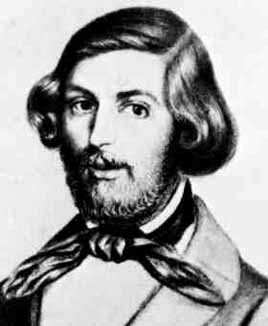 Ferdinand Gotthold Max Eisenstein was born in Berlin on April 16, 1823. His family was not well off. His father had served in the Prussian army for 8 years and when he returned to civilian life, he moved from the job to job throughout Ferdinand's youth.
From the earliest age, he suffered from bad health as did all his brothers and sisters. He was the only one of the six children to survive past childhood. All of his brothers and sisters died at an early age of meningitis. Eisenstein also suffered through meningitis but was somehow able to survive.
From an early age, he showed a great talent for music. He was able to play the piano and composed songs throughout his short life. When he was 11 years old, his parents sent him to a military academy near Berlin. He hated the discipline and routines and yet it was here that he developed his love for mathematics. One of his teachers taught mathematics by presenting theorems and then asking each student to work alone on the proof. Once a student proved the theorem, the teacher presented the next theorem and asked the student to likewise prove this one. Eisenstein found this approach very enjoyable and had proved 100 elementary theorems in the time that students were expected to solve 11 or 12.
In 1837, at the age of 14, he entered Gymnasium in Berlin where his mathematical talents were recognized by his teachers. By the age of 15, he was going beyond the mathematical curriculum and started studying mathematical books on his own.
In 1842, he purchased a copy of Gauss's Disquisitiones arithmeticae and became fascinated with number theory. When his father moved to England, he was able to meet with Hamilton and in this way was introduced to the ideas of Abel another very famous mathematician who died young.
In 1843, he enrolled at the University of Berlin. During his first year, he was releasing new math articles almost weekly. In 1844, Crelle's Journal published 27 articles, 16 of which were from Eisenstein. In March 1844, Eisenstein met von Humboldt who would become a big sponsor of his. Eisenstein hated to receive grants that were given grudgingly. Through out Eisenstein's life, von Humboldt worked hard to help him get position and funds.
In June 1844, Eisenstein went on a trip to meet Gauss. Gauss had a reputation for being very hard to impress. Eisenstein had sent Gauss some of his papers and Gauss was very impressed. Eisenstein had generalized many of Gauss's results.
In February 1845, Eisenstein received an honorary doctorate thanks to the help of Kummer and Jacobi. He would later be involved with a priority dispute with Jacobi.
In 1847, Eisenstein began to lecture at the University of Berlin. Reimann attended one of these lectures and there is speculation that Eisenstein was very influential on Reimann's famous paper on the Zeta function.
In 1848, there was political unrest in Germany and shots were fired on German soldiers from a house while Eisenstein was there. Eisenstein was arrested. He was later released but his arrest made it more difficult for him to get funds.
Despite these setbacks, Eisenstein continued to publish. In 1851, he was elected to the Gottingen Academy and in 1852, he was elected to the Berlin Academy.
Eisenstein died on October 11, 1852 of pulmonary turbucolosis at the age of 29.
Eisenstein made significant contributions in quadratic forms, generalizing the results of Gauss, higher reciprocity laws that generalized Gauss's quadratic reciprocity result.
Gauss would say that the three most brilliant mathematicians of all time were Archimedes, Newton, and Eisenstein.
The details for this blog were taken from the following sources:
Sunday, July 10, 2005
Euclidean Integers
A quadratic integer is considered Euclidean if it can be characterized by a division algorithm. This is the algorithm which states that division of any integer by an nonzero integer results in two unique values: a quotient and a remainder and the norm of the remainder is always less than the norm of the divisor.
In a previous blog, I gave the proof for this with regard to Gaussian Integers and with regard to rational integers. So, using these proofs, I have shown that both Gaussian Integers and rational integers are Euclidean.
Since the greatest common divisors algorithm from Euclid derives from the division algorithm, we can also conclude that all Euclidean integers have a greatest common denominator that is a linear combination of two other integers. It is also straight forward to show that all Euclidean integers are characterized by unique factorization.
This means that one sure path to establishing unique factorization is to show that a quadratic integer is Euclidean. Interestingly, it turns out that there are quadratic integers which are not Euclidan which still possess unique factorization.
Definition of Euclidean Integer: A quadratic integer a + b√d is Euclidean if for all integers α, β where β is nonzero, there exists a unique value δ such that δ = α - η*β and absolute(Norm(δ)) is less than absolute(Norm(β)).
Lemma: Z[√2], Z[√-2], Z[√3] are Euclidean
(1) For purposes of this proof, assume that √d = √2, √-2, or √3.
(2) There exists a,b,e,f such that [from the definition quadratic integers]
α = a + b√d
β = e + f√d
(3) α/β = (a + b√d)/(e + f√d) = (a + b√d)(e - f√d) /(e2 - f2d)=
(ae - af√d + be√d - bdf)/(e2 - f2d) =
(ae - bdf)/(e2 - f2d) + √d(be - af)/(e2 - f2d)
(4) Let r = (ae - bdf)/(e2 - f2d), s = (be - af)/(e2 - f2d) where r,s are rational but not necessarily integer. [For a review of rational numbers and their properties, see here]
(5) So α/β = r + s√d.
(6) We know that there exists m,n which are rational integers such that:
absolute(r - m) ≤ (1/2) and absolute(s - n) ≤ (1/2). [See here for proof]
(7) Let η = m + n√d, let δ = α - β * η where η, δ are quadratic integers of type Z[√d]. [For a review of quadratic integers, see here.]
NOTE: The keypoint point is to prove that absolute(Norm(δ)) is less than absolute(Norm(β)).
(8) Norm(δ) = Norm(α - β * η) = Norm(β[(α / β) - η) =
Norm(β) * Norm([α/β] - η)
(9) This means that the key point is to prove that absolute(Norm([α/β] - η)) is less than 1.
(10) We know that:
Norm([α/β] - η) = Norm([r + s√d] - [m + n√d]) = Norm([r - m] + [s - n]√d) =
([r - m] + [s - n]√d)([r - m] - [s - n]√d) = (r - m)2 - d(s - n)2
(11) Applying step(6),
gives us for d=2:
absolute((r - m)2 - d(s - n)2) ≤ absolute((1/2)2 - 2(1/2)2) =
absolute((1/4) - 2(1/4)) = absolute(-1/4) = 1/4 which is less than 1.
gives us for d=-2:
absolute((r - m)2 - d(s - n)2) ≤ absolute((1/2)2 + 2(1/2)2) =
absolute((1/4) + 2(1/4)) = absolute(3/4) = 3/4 which is less than 1.
gives us for d=3:
absolute((r - m)2 - d(s - n)2) ≤ absolute((1/2)2 - 3(1/2)2) =
absolute((1/4) - 3(1/4)) = absolute(-2/4) = 1/2 which is less than 1.
QED
Lemma: Z[(1+√-3)/2], Z[(1+√-7)/2], Z[(1+√-11)/2], Z[(1+√5)/2] are Euclidean
(1) For purposes of this proof, assume that √d = √-3, √-7 ,√-11 , or √5.
(2) There exists a,b,e,f such that
α = a + b√d
β = e + f√d
(3) α/β = (a + b√d)/(e + f√d) = (a + b√d)(e - f√d) /(e2 - f2d)=
(ae - af√d + be√d - bdf)/(e2 - f2d) =
(ae - bdf)/(e2 - f2d) + √d(be - af)/(e2 - f2d)
(4) Let r = (ae - bdf)/(e2 - f2d), s = (be - af)/(e2 - f2d) where r,s are rational but not necessarily integer. [For a review of rational numbers and their properties, see here]
(5) So α/β = r + s√d.
(6) We also know that there exists p which is a rational integer such that:
absolute(s - p/2) ≤ 1/4. [See here for proof]
(7) We also know that there exists o which is a rational integer such that:
absolute(r - p/2 - o) ≤ 1/2. [See here for proof]
(8) let η = r + s[(1 + √d)/2] which is an integer as explained in a previous blog since in all above cases d ≡ 1 (mod 4).
(9) Let δ = β*([r - p/2 - o] + [s - p/2]√d)
(10) Norm(δ) = Norm(β) * Norm([r - p/2 - o] + [s - p/2]√d)
(11) Once again, to finish this proof, we need only to show that abs(Norm([r - p/2 - o] + [s - p/2]√d)) is less than 1.
(12) Norm([r - p/2 - o] + [s - p/2]√d) = ([r - p/2 - o] + [s - p/2]√d)([r - p/2 - o] -[s - p/2]√d)
= [r - p/2 - o]2 - d[s - p/2]2 ≤ (1/2)2 - d(1/4)2 = (1/4) - d/16.
QED
In addition, here are more interesting facts:
In a previous blog, I gave the proof for this with regard to Gaussian Integers and with regard to rational integers. So, using these proofs, I have shown that both Gaussian Integers and rational integers are Euclidean.
Since the greatest common divisors algorithm from Euclid derives from the division algorithm, we can also conclude that all Euclidean integers have a greatest common denominator that is a linear combination of two other integers. It is also straight forward to show that all Euclidean integers are characterized by unique factorization.
This means that one sure path to establishing unique factorization is to show that a quadratic integer is Euclidean. Interestingly, it turns out that there are quadratic integers which are not Euclidan which still possess unique factorization.
Definition of Euclidean Integer: A quadratic integer a + b√d is Euclidean if for all integers α, β where β is nonzero, there exists a unique value δ such that δ = α - η*β and absolute(Norm(δ)) is less than absolute(Norm(β)).
Lemma: Z[√2], Z[√-2], Z[√3] are Euclidean
(1) For purposes of this proof, assume that √d = √2, √-2, or √3.
(2) There exists a,b,e,f such that [from the definition quadratic integers]
α = a + b√d
β = e + f√d
(3) α/β = (a + b√d)/(e + f√d) = (a + b√d)(e - f√d) /(e2 - f2d)=
(ae - af√d + be√d - bdf)/(e2 - f2d) =
(ae - bdf)/(e2 - f2d) + √d(be - af)/(e2 - f2d)
(4) Let r = (ae - bdf)/(e2 - f2d), s = (be - af)/(e2 - f2d) where r,s are rational but not necessarily integer. [For a review of rational numbers and their properties, see here]
(5) So α/β = r + s√d.
(6) We know that there exists m,n which are rational integers such that:
absolute(r - m) ≤ (1/2) and absolute(s - n) ≤ (1/2). [See here for proof]
(7) Let η = m + n√d, let δ = α - β * η where η, δ are quadratic integers of type Z[√d]. [For a review of quadratic integers, see here.]
NOTE: The keypoint point is to prove that absolute(Norm(δ)) is less than absolute(Norm(β)).
(8) Norm(δ) = Norm(α - β * η) = Norm(β[(α / β) - η) =
Norm(β) * Norm([α/β] - η)
(9) This means that the key point is to prove that absolute(Norm([α/β] - η)) is less than 1.
(10) We know that:
Norm([α/β] - η) = Norm([r + s√d] - [m + n√d]) = Norm([r - m] + [s - n]√d) =
([r - m] + [s - n]√d)([r - m] - [s - n]√d) = (r - m)2 - d(s - n)2
(11) Applying step(6),
gives us for d=2:
absolute((r - m)2 - d(s - n)2) ≤ absolute((1/2)2 - 2(1/2)2) =
absolute((1/4) - 2(1/4)) = absolute(-1/4) = 1/4 which is less than 1.
gives us for d=-2:
absolute((r - m)2 - d(s - n)2) ≤ absolute((1/2)2 + 2(1/2)2) =
absolute((1/4) + 2(1/4)) = absolute(3/4) = 3/4 which is less than 1.
gives us for d=3:
absolute((r - m)2 - d(s - n)2) ≤ absolute((1/2)2 - 3(1/2)2) =
absolute((1/4) - 3(1/4)) = absolute(-2/4) = 1/2 which is less than 1.
QED
Lemma: Z[(1+√-3)/2], Z[(1+√-7)/2], Z[(1+√-11)/2], Z[(1+√5)/2] are Euclidean
(1) For purposes of this proof, assume that √d = √-3, √-7 ,√-11 , or √5.
(2) There exists a,b,e,f such that
α = a + b√d
β = e + f√d
(3) α/β = (a + b√d)/(e + f√d) = (a + b√d)(e - f√d) /(e2 - f2d)=
(ae - af√d + be√d - bdf)/(e2 - f2d) =
(ae - bdf)/(e2 - f2d) + √d(be - af)/(e2 - f2d)
(4) Let r = (ae - bdf)/(e2 - f2d), s = (be - af)/(e2 - f2d) where r,s are rational but not necessarily integer. [For a review of rational numbers and their properties, see here]
(5) So α/β = r + s√d.
(6) We also know that there exists p which is a rational integer such that:
absolute(s - p/2) ≤ 1/4. [See here for proof]
(7) We also know that there exists o which is a rational integer such that:
absolute(r - p/2 - o) ≤ 1/2. [See here for proof]
(8) let η = r + s[(1 + √d)/2] which is an integer as explained in a previous blog since in all above cases d ≡ 1 (mod 4).
(9) Let δ = β*([r - p/2 - o] + [s - p/2]√d)
(10) Norm(δ) = Norm(β) * Norm([r - p/2 - o] + [s - p/2]√d)
(11) Once again, to finish this proof, we need only to show that abs(Norm([r - p/2 - o] + [s - p/2]√d)) is less than 1.
(12) Norm([r - p/2 - o] + [s - p/2]√d) = ([r - p/2 - o] + [s - p/2]√d)([r - p/2 - o] -[s - p/2]√d)
= [r - p/2 - o]2 - d[s - p/2]2 ≤ (1/2)2 - d(1/4)2 = (1/4) - d/16.
QED
In addition, here are more interesting facts:
- There are exactly 21 types of quadratic integers that are Euclidean: a quadratic integer is Euclidean if d = -11, -7, -3, -2, -1, 2, 3, 5, 6, 7, 11, 13, 17, 19, 21, 29, 33, 37,41, 57, and 73.
- Z[(-1 + √-19)/2] is not Euclidean but still has unique factorization
- Z[√-5] does not have unique factorization.
Tuesday, July 05, 2005
Quadratic Integers: Generalizing Gaussian Integers
Leonhard Euler proposed a proof for Fermat's Last Theorem: n = 3, using integers based on a+b√-3. Carl Friedrich Gauss showed the need for a proof for uniqueness of factorization for a + b√-1. Both of these integer extensions are examples of what we call today quadratic integers.
Quadratic integers are integers that are extended in the form of a + bα where α is an irrational value that is a solution to a quadratic equation. A quadratic equation is any equation that can be represented in the form x2 + bx + c = 0 where b,c are rational integers. The important point is that the coefficient for x2 needs to be 1 and the other coefficients need to be rational integers.
Applying basic algebra, we know that quadratic equations have the following solution:
Theorem: ax2 + bx + c = 0 → x = (-b ± √b2 - 4ac)/2a.
(1) Subtracting c from both sides gives us:
ax2 + bx = -c
(2) Multiplying both sides by 4a gives us:
4a2x2 + 4abx = -4ac.
(3) Adding b2 to both sides, gives us:
4a2x2 + 4abx + b2 = b2 - 4ac.
(4) Now, since (2ax + b)*(2ax + b) = 4a2x2 + 4abx + b2, we get:
(2ax + b)2 = b2 - 4ac.
(5) Taking the square root of both sides, gives us:
2ax + b = ± √b2 - 4ac
(6) Finally, subtracting b and then dividing both sides by 2a gives us our proof.
QED
From this formula, we see that Euler's integer is a solution to:
x2 + 3 = 0.
and Gaussian Integers are a solution to:
x2 + 1 = 0.
For purposes of notation, a set of quadratic integers is identified using a Z-notation. Z by itself represents the set of standard integers. Z[i] represents the set of Gaussian Integers. Z[√-3] represents the set of Euler's integers.
Now, when it comes to integers of the form Z[√d] where d ≡ 1 (mod 4), it turns out that an integer is of the form: (a + b√d)/2 where a,b are both odd or both even.
To understand the mathematics behind this result, let's start out with a very simple lemma:
Lemma: a2 ≡ 1 or 0 (mod 4).
(1) We know that a ≡ 0, 1, 2, or 3 (mod 4).
(2) Now here's what we get for each of these values in the case of a2
(a) 02 ≡ 0 * 0 ≡ 0 (mod 4).
(b) 12 ≡ 1 * 1 ≡ 1 (mod 4).
(c) 22 ≡ 2 * 2 ≡ 0 (mod 4).
(d) 32 ≡ 3 * 3 ≡ 1 (mod 4).
QED
Here is the lemma that establishes this:
Lemma: for a set of quadratic integers Z[√d] , if d ≡ 1 (mod 4), then the form of this quadratic integer is (a + b√d)/2 where both a,b are even or both a,b are odd, otherwise, it is a + b√d
(1) The goal here is to prove that (a + b√d)/2 is an integer, that is, it satisfies an equation of the form x2 + bx + c = 0.
(2) Now let's assume that we have a value α which is equal to (e + f√d)/2 where e,f are rational integers and d ≡ 1 (mod 4).
(3) Let x = (e + f√d)/2
(4) Then,
2x - e = f√d
(5) And squaring each side gives us:
4x2 - 4ex + e2 = f2d
(6) Which amounts to:
4x2 - 4ex + e2 - f2d = 0
(7) Now if we divide both sides by 4, we get:
x2 - ex + (1/4)[e2 - f2d] = 0
(8) Now, if both e,f are odd, then: [from the lemma above]
e2 - f2d ≡ 1 - 1*1 ≡ 0 (mod 4).
(9) Now, if both e,f are even, then: [from the lemma above]
e2 - f2d ≡ 0 - 0 * 1 ≡ 0 (mod 4).
(10) This value then meets our definition of quadratic integer.
QED
Corollary: if d ≡ 1 (mod 4), a number is an integer if it can be written as a + b[(1 + √d)/2], where a,b are rational integers.
(1) a + b(1 + √d)/2 = [(2a + b) + b√d]/2
If b is odd, then (2a + b) is odd. If b is even, then (2a + b) is even. In both cases (2a + b),b are both even or both odd.
(2) If a,b are both even or both odd.
(a + b√d)/2 = (a - b)/2 + b(1 + √d)/2
QED
The result of this is that in the case of d=-3, the set of integers is Z[(-1+√-3)/2] because we are dealing with integers of the form (a + b√-3)/2. I will go into more detail on this when I revisit a proof for n=3 based on Eisenstein integers.
The other interesting point about quadratic integers is that it turns out that not all of them are characterized by unique factorization and most of them are not characterized by a division algorithm.
I will go into more detail about this in my next blog.
The content of this blog is based in a large part on Harold M. Stark's An Introduction to Number Theory.
Quadratic integers are integers that are extended in the form of a + bα where α is an irrational value that is a solution to a quadratic equation. A quadratic equation is any equation that can be represented in the form x2 + bx + c = 0 where b,c are rational integers. The important point is that the coefficient for x2 needs to be 1 and the other coefficients need to be rational integers.
Applying basic algebra, we know that quadratic equations have the following solution:
Theorem: ax2 + bx + c = 0 → x = (-b ± √b2 - 4ac)/2a.
(1) Subtracting c from both sides gives us:
ax2 + bx = -c
(2) Multiplying both sides by 4a gives us:
4a2x2 + 4abx = -4ac.
(3) Adding b2 to both sides, gives us:
4a2x2 + 4abx + b2 = b2 - 4ac.
(4) Now, since (2ax + b)*(2ax + b) = 4a2x2 + 4abx + b2, we get:
(2ax + b)2 = b2 - 4ac.
(5) Taking the square root of both sides, gives us:
2ax + b = ± √b2 - 4ac
(6) Finally, subtracting b and then dividing both sides by 2a gives us our proof.
QED
From this formula, we see that Euler's integer is a solution to:
x2 + 3 = 0.
and Gaussian Integers are a solution to:
x2 + 1 = 0.
For purposes of notation, a set of quadratic integers is identified using a Z-notation. Z by itself represents the set of standard integers. Z[i] represents the set of Gaussian Integers. Z[√-3] represents the set of Euler's integers.
Now, when it comes to integers of the form Z[√d] where d ≡ 1 (mod 4), it turns out that an integer is of the form: (a + b√d)/2 where a,b are both odd or both even.
To understand the mathematics behind this result, let's start out with a very simple lemma:
Lemma: a2 ≡ 1 or 0 (mod 4).
(1) We know that a ≡ 0, 1, 2, or 3 (mod 4).
(2) Now here's what we get for each of these values in the case of a2
(a) 02 ≡ 0 * 0 ≡ 0 (mod 4).
(b) 12 ≡ 1 * 1 ≡ 1 (mod 4).
(c) 22 ≡ 2 * 2 ≡ 0 (mod 4).
(d) 32 ≡ 3 * 3 ≡ 1 (mod 4).
QED
Here is the lemma that establishes this:
Lemma: for a set of quadratic integers Z[√d] , if d ≡ 1 (mod 4), then the form of this quadratic integer is (a + b√d)/2 where both a,b are even or both a,b are odd, otherwise, it is a + b√d
(1) The goal here is to prove that (a + b√d)/2 is an integer, that is, it satisfies an equation of the form x2 + bx + c = 0.
(2) Now let's assume that we have a value α which is equal to (e + f√d)/2 where e,f are rational integers and d ≡ 1 (mod 4).
(3) Let x = (e + f√d)/2
(4) Then,
2x - e = f√d
(5) And squaring each side gives us:
4x2 - 4ex + e2 = f2d
(6) Which amounts to:
4x2 - 4ex + e2 - f2d = 0
(7) Now if we divide both sides by 4, we get:
x2 - ex + (1/4)[e2 - f2d] = 0
(8) Now, if both e,f are odd, then: [from the lemma above]
e2 - f2d ≡ 1 - 1*1 ≡ 0 (mod 4).
(9) Now, if both e,f are even, then: [from the lemma above]
e2 - f2d ≡ 0 - 0 * 1 ≡ 0 (mod 4).
(10) This value then meets our definition of quadratic integer.
QED
Corollary: if d ≡ 1 (mod 4), a number is an integer if it can be written as a + b[(1 + √d)/2], where a,b are rational integers.
(1) a + b(1 + √d)/2 = [(2a + b) + b√d]/2
If b is odd, then (2a + b) is odd. If b is even, then (2a + b) is even. In both cases (2a + b),b are both even or both odd.
(2) If a,b are both even or both odd.
(a + b√d)/2 = (a - b)/2 + b(1 + √d)/2
QED
The result of this is that in the case of d=-3, the set of integers is Z[(-1+√-3)/2] because we are dealing with integers of the form (a + b√-3)/2. I will go into more detail on this when I revisit a proof for n=3 based on Eisenstein integers.
The other interesting point about quadratic integers is that it turns out that not all of them are characterized by unique factorization and most of them are not characterized by a division algorithm.
I will go into more detail about this in my next blog.
The content of this blog is based in a large part on Harold M. Stark's An Introduction to Number Theory.
Sunday, June 26, 2005
Proof for n=4 using Gaussian Integers: Step 2
Today's blog continues a proof that was first presented in a previous blog. If you are new to unique factorization, start here. If you are new to Gaussian Integers, start here. To begin this proof, start here.
Today's result is based on work presented by Paulo Ribenboim's Fermat's Last Theorem for Amateurs.
Today's blog shows the details to Step 2 in Fermat's Last Theorem n = 4. As before, I use Greek letters to refer to Gaussian Integers and Latin letters to refer to rational integers. I introduced the Gaussian Prime λ in a previous blog.
Lemma: if Fermat's Last Theorem is true for n = 4, then there exist Gaussian integers: μ1, μ2, β, ε, λ such that:
ε * λ4(r-1) * μ24 + μ14 = β2.
(1) From the previous lemma, we know that:
ε * λ4r*α4 = γ2 - β4 = (γ - β2)(γ + β2)
(2) We know that λ2 divides both (γ - β2) and (γ + β2) since:
(a) Assume λ2 does not divide γ - β2
(b) Then, it must divide γ + β2 [From Euclid's Generalized Lemma for Gaussian Integers and (step #1 above)]
(c) But then it necessarily divides γ - β2 since
(γ + β2) + (γ - β2) = 2*γ = (λ2)(i * γ) [Since 2= i*λ2]
(d) Having found a contradiction we reject our assumption in step #2a above. We can make the same exact argument if we assume that λ2 does not divide γ + β2
(e) So, we are left concluding that λ2 necessarily divides both γ - β2 and γ + β2.
(3) We can also conclude that gcd(γ - β2, γ + β2) cannot be greater than 2.
(a) Assume that gcd(γ - β2, γ + β2) is greater than 2. Then gcd = λ3 or there exists a prime μ that is greater than 2. [Since we know that λ divides 2, see Lemma 2, here and further, we know that there is no other prime less than 2; see Lemma 4, here]
(b) First, let's assume that there exists a prime μ that is greater than 2.
(c)Then there exists values δ1, δ2 such that:
γ - β2 = μ * δ1 and γ + β2 = μ * δ2.
(d) And this means that: μ divides γ since:
2 * γ = (γ - β2) + (γ + β2) = μ(δ1 + δ2).
(e) And this also means that μ divides β2 since:
2 * β2 = (γ + β2) - (γ - β2) = μ(δ2 - δ1).
(f) But this is a contradiction since from the lemma cited in step #1 above (see step #4, here), we know that gcd(β2,γ) = 1.
(g) So we reject our assumption in step #3b above and assume that gcd = λ3.
(h) But, then λ3 divides 2 * γ = (γ - β2) + (γ + β2) and λ3 divides 2 * β2.
(i) Since λ2 is an associate of 2 (see Lemma 2, here), this gives us that λ divides both γ and β2.
(j) But this is impossible since we know that β and γ are relatively prime from the lemma cited in step #1 above (see step #4, here)
(k) So we can also reject the assumption in step #3g above and for that matter, the assumption in step #3a above.
(l) So, we can conclude that gcd(γ - β2, γ + β2) cannot be greater than 2.
(4) So, we can conclude that λ4r-2 divides either γ + β2 or γ - β2 since:
(a) From step #1 above, we know that: λr divides (γ - β2)(γ + β2).
(b) From step #2 above, we know that λ2 divides both (γ - β2) and (γ + β2).
(c) But, from step #3 above, we know that (λ4r/λ2 = λ4r-2) can only divide (γ + β2) or (γ - β2) but not both.
(5) So, there exist two values: let's call them η1 and η2 such that:
γ ± β2 = λ2 * η1
γ ± β2 = λ4r-2 * η2
NOTE: Please read ± as + or -. So that one of these values is γ + β2 and another of these values is γ - β2.
(6) We also can conclude that gcd(η1,η2) = 1.
(a) Assume that gcd(η1,η2) = δ which is not a unit.
(b) So that δ ≥ λ [Since there is no other prime less than λ, see Lemma 4, here]
(c) But then δ*λ2 would be greater than 2 which contradicts Step (3) above.
(7) Thus, ε*λ4rα4 = λ4rη1η2 since:
ε*λ4rα4 =(γ - β2)(γ + β2) [From step #1 above]
λ4rη1η2 =(γ - β2)(γ + β2) [From step #5 above]
(8) By the lemma of relatively prime divisors of n-powers, we can conclude that there exists μ1 and μ2 such that:
η1 = ε1 * μ14
η2 = ε2 * μ24
NOTE: ε1 and ε2 are units.
(9) Now, we know that:
2*β2 = γ + β2 - (γ - β2)
(10) From step(5) above and step(8) above, let's assume that:
γ - β2 = ε1 * λ2 * μ14
γ + β2 = ε2 * λ4r-2 * μ24
NOTE: We can make a similiar argument if the other case is true.
(11) Then,
2 * β2 = ε2 * λ4r-2 * μ24 - ε1 * λ2 * μ14
(12) Which dividing both sides by i*λ2 gives us:
β2 = -i*ε2*λ4r-4*μ24 + i*ε1*μ14
[Note: since 2=i*λ2, see Lemma 2, here and since 1/i=-i since -i*i=-(-1)=1]
(13) Now, we can assume that i*ε1 = 1 since:
(a) r ≥ 2, so we know that λ4 divides β2 - i*ε1*μ14.
(b) But, λ does not divide β
[if it did, from step #2 above, this would mean λ also divides γ, but this is impossible since they are relatively prime from the lemma cited in step #1 above (see step #4, here)]
(c) So, λ cannot divide μ1
[if λ divided μ1, then it would also divide η1 from step #8 above and this is impossible since gcd(η1,λ)=1 from step #5 above.]
(d) So μ1 ≡ 1 (mod λ6) [See Lemma 5, here]
(e) So that, λ4 divides β2 - i*ε1.
(f) But, λ6 divides β4 - 1 = (β2 - 1)(β2 + 1)
(g) So, β2 ≡ 1 or -1 (mod λ4)
(h) This shows that i*ε1 = ± 1.
(i) If μ1 = -1, by multiplication with -1, we obtain the relation:
-i*ε1λ4(r-1)μ24 + μ14 = (iβ)2.
(14) Combining Step (12) and Step(13) and setting ε = -i*ε1 gives us:
β2 = ε*λ4(r-1)*μ24 + μ14
QED
Today's result is based on work presented by Paulo Ribenboim's Fermat's Last Theorem for Amateurs.
Today's blog shows the details to Step 2 in Fermat's Last Theorem n = 4. As before, I use Greek letters to refer to Gaussian Integers and Latin letters to refer to rational integers. I introduced the Gaussian Prime λ in a previous blog.
Lemma: if Fermat's Last Theorem is true for n = 4, then there exist Gaussian integers: μ1, μ2, β, ε, λ such that:
ε * λ4(r-1) * μ24 + μ14 = β2.
(1) From the previous lemma, we know that:
ε * λ4r*α4 = γ2 - β4 = (γ - β2)(γ + β2)
(2) We know that λ2 divides both (γ - β2) and (γ + β2) since:
(a) Assume λ2 does not divide γ - β2
(b) Then, it must divide γ + β2 [From Euclid's Generalized Lemma for Gaussian Integers and (step #1 above)]
(c) But then it necessarily divides γ - β2 since
(γ + β2) + (γ - β2) = 2*γ = (λ2)(i * γ) [Since 2= i*λ2]
(d) Having found a contradiction we reject our assumption in step #2a above. We can make the same exact argument if we assume that λ2 does not divide γ + β2
(e) So, we are left concluding that λ2 necessarily divides both γ - β2 and γ + β2.
(3) We can also conclude that gcd(γ - β2, γ + β2) cannot be greater than 2.
(a) Assume that gcd(γ - β2, γ + β2) is greater than 2. Then gcd = λ3 or there exists a prime μ that is greater than 2. [Since we know that λ divides 2, see Lemma 2, here and further, we know that there is no other prime less than 2; see Lemma 4, here]
(b) First, let's assume that there exists a prime μ that is greater than 2.
(c)Then there exists values δ1, δ2 such that:
γ - β2 = μ * δ1 and γ + β2 = μ * δ2.
(d) And this means that: μ divides γ since:
2 * γ = (γ - β2) + (γ + β2) = μ(δ1 + δ2).
(e) And this also means that μ divides β2 since:
2 * β2 = (γ + β2) - (γ - β2) = μ(δ2 - δ1).
(f) But this is a contradiction since from the lemma cited in step #1 above (see step #4, here), we know that gcd(β2,γ) = 1.
(g) So we reject our assumption in step #3b above and assume that gcd = λ3.
(h) But, then λ3 divides 2 * γ = (γ - β2) + (γ + β2) and λ3 divides 2 * β2.
(i) Since λ2 is an associate of 2 (see Lemma 2, here), this gives us that λ divides both γ and β2.
(j) But this is impossible since we know that β and γ are relatively prime from the lemma cited in step #1 above (see step #4, here)
(k) So we can also reject the assumption in step #3g above and for that matter, the assumption in step #3a above.
(l) So, we can conclude that gcd(γ - β2, γ + β2) cannot be greater than 2.
(4) So, we can conclude that λ4r-2 divides either γ + β2 or γ - β2 since:
(a) From step #1 above, we know that: λr divides (γ - β2)(γ + β2).
(b) From step #2 above, we know that λ2 divides both (γ - β2) and (γ + β2).
(c) But, from step #3 above, we know that (λ4r/λ2 = λ4r-2) can only divide (γ + β2) or (γ - β2) but not both.
(5) So, there exist two values: let's call them η1 and η2 such that:
γ ± β2 = λ2 * η1
γ ± β2 = λ4r-2 * η2
NOTE: Please read ± as + or -. So that one of these values is γ + β2 and another of these values is γ - β2.
(6) We also can conclude that gcd(η1,η2) = 1.
(a) Assume that gcd(η1,η2) = δ which is not a unit.
(b) So that δ ≥ λ [Since there is no other prime less than λ, see Lemma 4, here]
(c) But then δ*λ2 would be greater than 2 which contradicts Step (3) above.
(7) Thus, ε*λ4rα4 = λ4rη1η2 since:
ε*λ4rα4 =(γ - β2)(γ + β2) [From step #1 above]
λ4rη1η2 =(γ - β2)(γ + β2) [From step #5 above]
(8) By the lemma of relatively prime divisors of n-powers, we can conclude that there exists μ1 and μ2 such that:
η1 = ε1 * μ14
η2 = ε2 * μ24
NOTE: ε1 and ε2 are units.
(9) Now, we know that:
2*β2 = γ + β2 - (γ - β2)
(10) From step(5) above and step(8) above, let's assume that:
γ - β2 = ε1 * λ2 * μ14
γ + β2 = ε2 * λ4r-2 * μ24
NOTE: We can make a similiar argument if the other case is true.
(11) Then,
2 * β2 = ε2 * λ4r-2 * μ24 - ε1 * λ2 * μ14
(12) Which dividing both sides by i*λ2 gives us:
β2 = -i*ε2*λ4r-4*μ24 + i*ε1*μ14
[Note: since 2=i*λ2, see Lemma 2, here and since 1/i=-i since -i*i=-(-1)=1]
(13) Now, we can assume that i*ε1 = 1 since:
(a) r ≥ 2, so we know that λ4 divides β2 - i*ε1*μ14.
(b) But, λ does not divide β
[if it did, from step #2 above, this would mean λ also divides γ, but this is impossible since they are relatively prime from the lemma cited in step #1 above (see step #4, here)]
(c) So, λ cannot divide μ1
[if λ divided μ1, then it would also divide η1 from step #8 above and this is impossible since gcd(η1,λ)=1 from step #5 above.]
(d) So μ1 ≡ 1 (mod λ6) [See Lemma 5, here]
(e) So that, λ4 divides β2 - i*ε1.
(f) But, λ6 divides β4 - 1 = (β2 - 1)(β2 + 1)
(g) So, β2 ≡ 1 or -1 (mod λ4)
(h) This shows that i*ε1 = ± 1.
(i) If μ1 = -1, by multiplication with -1, we obtain the relation:
-i*ε1λ4(r-1)μ24 + μ14 = (iβ)2.
(14) Combining Step (12) and Step(13) and setting ε = -i*ε1 gives us:
β2 = ε*λ4(r-1)*μ24 + μ14
QED
Subscribe to:
Posts (Atom)


