In addition to this blog, I have started a series of "softer" mathematical essays on hubpages.com.
You can see my first posting in the series here. It is on Abel's proof.
Friday, July 18, 2008


Monday, June 02, 2008
Paolo Ruffini
 Paolo Ruffini was born on September 22, 1765 in what is today Italy. In 1783, he entered the University of Modena where he studied geometry, calculus and medicine. In 1787, he was asked to teach the course on calculus even though he was still a student. Later, in 1788, he became a professor at the university.
Even as he taught mathematics, he continued to study medicine and in 1791, he received his license to practice medicine.
1796 was the time of Napoleon Bonaparte who took over Modena. Napoleon set up what became the Cisalpine Republic that included Modena. All faculty of the university were required to swear an oath of allegiance to the new republic.
Ruffini refused to swear this oath and so lost his job and was no longer allowed to teach. This change enabled him to focus on medicine and to actively study his own projects in mathematics.
One of his math projects was an effort to solve the quintic equation in terms of radicals. The quadratic equation was long known to be solvable. The cubic equation had been solved by Giralomo Cardano and the quartic equation had been solved by Lodovico Ferrari. No one had yet solved the quintic.
It was at this point, that Paolo Ruffini approached the problem differently than others had before him. He was the first person to propose that the problem was not solvable in terms of radicals. In 1799, Ruffini published his math treatise which he titled: General theory of equations in which it is shown that the algebraic solution of the general equation of degree greater than four is impossible.
In the introduction, he writes:
In writing this work, he made arguments in terms of group theory. Since group theory had not yet been invented, Ruffini had to invent concepts which made his argument even hard to follow. In this work, we find such concepts as order, cycles, and the notion of primitive elements. Joseph-Louis Lagrange had previously written about permutations but Ruffini applied these points to his argument in ways that Lagrange had not. In this work, he successfully proved some very important theorems of group theory.The algebraic solution of general equations of degree greater than four is always impossible. Behold a very important theorem which I believe I am able to assert (if I do not err): to present the proof of it is the main reason for publishing this volume. The immortal Lagrange, with his sublime reflections, has provided the basis of my proof.
Unfortunately, he did not succeed in proving his claim about the quintic equation. He came very close. So close, in fact, that it was later accepted by Augustin Louis Cauchy as valid. In retrospect, it is clear that his argument had a significant gap which would later be resolved by Niels Abel. Ruffini assumed but failed to demonstrate that:
"...if an expression by radicals is a root of the general equation of some degree, then every function of it is composed is a rational expression of the roots." (Jean-Pierre Tignol, p211).In fairness to Ruffini, he received no response from the mathematical community on this point. He sent a copy to Lagrange in 1801. He got no response. He sent out a second copy of his book with the following message:
Because of the uncertainty that you may have received my book, I send you another copy. If I have erred in any proof, or if I have said something which I believed new, and which is in reality not new, finally if I have written a useless book, I pray you point it out to me sincerely.He still got no response. In 1802, he wrote a follow up letter. Again, no response.
A mathematician named Gian Malfatti did respond with objections that today are viewed as a misunderstanding of Ruffini's ideas. Ruffini responded with additional proofs that are today accepted as answering Malfatti's objections.
Why didn't anyone respond? The answer seems to be that Ruffini was tackling a question in a way that no one wanted to be right. The mathematical community was not yet ready to concede that quintic equations were not solvable by radicals. In addition, Ruffini's proof was over 516 pages and the mathematical argument was difficult to follow.
In 1810, Ruffini asked the Institute of Science in Paris to make a formal statement on the validity of his proof. After over a year, Adrien-Marie Legendre, Lagrange, and Sylvestre Francois de Lacroix concluded that there was nothing of importance here and that it was not "worthy of attention."
Ruffini made the same request of the Royal Society. The response was polite but again reflected disinterest in the topic area.
In 1814, after the fall of Napoleon, Ruffini was reinstated back at the University of Modena. All this time, Ruffini had a reputation for honesty and integrity. As a doctor, he treated patients from the richest to the poorest backgrounds. In 1817, there was a typhus epidemic. Ruffini proceeded to continue to treat patients and caught the disease himself. Although, he made a recovery, he never regained his health and had to resign from his university position in 1819.
The year before his death, he received the following correspondence from Cauchy which would represent the only recognition he received while he was alive from a major mathematician:
... your memoir on the general resolution of equations is a work which has always seemed to me worthy of the attention of mathematicians and which, in my judgement, proves completely the impossibility of solving algebraically equations of higher than the fourth degree.Even so, Ruffini does not get credit for proof that the quintic equation is not solvable by radicals. That honor goes to Niels Abel. On this point, R. G. Ayoub writes:
... the mathematical community was not ready to accept so revolutionary an idea: that a polynomial could not be solved in radicals. Then, too, the method of permutations was too exotic and, it must be conceeded, Ruffini's early account is not easy to follow. ... between 1800 and 1820 say, the mood of the mathematical community ... changed from one attempting to solve the quintic to one proving its impossibility...Paolo Ruffini died on May 10, 1822 in Modena.
References
- "Paolo Ruffini: Biography", MacTutor
- Jean-Pierre Tignol, Galois' Theory of Algebraic Equations
, World Scientific, 2001
Sunday, April 06, 2008
Gauss: Construction of regular polygons
It was not enough for Carl Friedrich Gauss to prove the constructibility a heptadecagon (a seventeen sided polygon). He generalized the idea to come up with the theorem that I will present today.
The content in today's blog is taken from Jean-Pierre Tignol's Galois' Theory of Algebraic Equations.
Lemma 1: The periods of two terms are (2 cos 2kπ/p) for k = 1 ... (p-1)/2
Proof:
(1) ηj = ζj + ζ[j + (p-1)/2] [See Definition 3, here where e = (p-1)/2 and f = 2]
(2) ζ[j + (p-1)/2] = (ζj)g(p-1)/2 [See Definition 1, here]
(3) g(p-1)/2 ≡ -1 (mod p) since:
(a) (g(p-1)/2)2 ≡ gp-1 (mod p)
(b) gp-1 ≡ 1 (mod p) [By Fermat's Little Theorem, see here]
(c) Thus, g(p-1)/2 ≡ ± 1 (mod p)
(d) But since g is a primitive root modulo p (see Definition 2 and Definition 4, here) and since (p-1)/2 is less than p-1, it follows that g(p-1)/2 ≠ 1.
(e) Thus, we have that g(p-1)/2 ≡ -1 (mod p).
(4) So, we have ηj = ζj + ζj-1 [See Lemma 1, here]
(5) We can express the p-th roots of unity as solutions to Φp(x) such that they are the solution to:
xp-1 + xp-2 + ... + 1 = 0 [See Lemma 1, here]
(6) The trigonometric solution for the equation above are (see Corollary 1.1, here):
cos 2kπ/p + isin 2kπ/p where 1 ≤ k ≤ p-1.
(7) For ζj, there exists an integer m such that:
ζj = cos 2mπ/p + i sin 2mπ/p
(8) Using Lemma 4, here, where u= 2mπ/p, we have:
ζj + ζj-1 = cos 2mπ/p + i sin 2mπ/p + cos 2mπ/p - isin 2mπ/p = 2 cos 2m π/p.
QED
Theorem 2: If p is a prime number of the form p = 2m+1 (with m ∈ N) then the regular polygon with p sides can be constructed with ruler and compass.
Proof:
(1) Since p=2m + 1, p-1 is a power of 2.
(2) We can thus view p-1 as a chain of multiplications such as:
1 → 2 → ... → 2m-2 → 2m-1 → 2m
(3) Using a previous result (see Lemma 5, here), we can see that the chain of multiplication in step #2 shows that the periods of two terms can be determined by solving a sequence of quadratic equations.
(4) The periods of two terms are the values 2 cos 2kπ/p for k = 1 ... (p-1)/2 [See Lemma 1 above]
(5) Since the solution of a quadratic equation only requires rational operations and extraction of square roots (see Theorem, here), it follows that cos 2π/p can be obtained from 0 and 1 by rational operations and extractions of roots.
(6) So, using Wantzel's Constructibility Criterion (see Theorem 5, here), it follows that (cos 2π/p, 0) is constructible.
(7) Let A be a point at (0,a) and O at (0,0) such that we take OA as one unit of measurement and circle OA is a unit circle (see here for details if needed on unit circles)
(8) Point P0 = (cos 2π/p, sin 2π/p) is obtained in the following way:
(a) Let Q be the point at (cos 2π/p, 0) that we showed was constructible in step #6 above.
(b) Let QP0 be a line that is perpendicular to OQ and where P0 intersects with the unit circle OA. [See here for Euclid, Book I, Proposition 11 which shows this construction]
(c) Now, we can see that P0 is at (cos 2π/p, sin 2π/p) since:
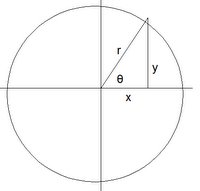

By the diagram above:
x = cos 2π/p
r = 1
Since cos θ = (cos 2π/p)/1 = cos 2π/p, we have θ = 2π/p.
Also, we have: sin θ = sin 2π/p = y/1 = y
(9) The point P0 is a vertex of the regular polygon with p sides. The line AP0 forms one side of the polygon, so we can label point A as P1.
(10) We can find the other p-1 sides in the following way. Let P0P1 be a circle at point P1 with radius equal to P0P1 (see Postulate 2, here). Call P2 the point where circle P0P1 intersects with unit circle OA (and is not point P0). We can repeat for circle P2P1 (finding point P3), circle P3P2 (find point P4), etc. until we have constructed our regular p-sided figure.
QED
Corollary 2.1: A regular polygon with n sides can be constructed with a ruler and compass if n is a product of distinct Fermat primes and a power of 2.
Proof:
(1) A regular polygon with n sides is constructible when n is a Fermat prime. [By Theorem 2 above]
(2) Since we can always do a repeated bisection of angles (see here for Euclid's Elements, Book I, Prop 9), a regular polygon with n sides is also constructible when n is a power of 2.
(3) So, to complete this proof, we only need to show that if n1 and n2 are relatively prime and a polygon with n1 sides is constructible and a polygon with n2 sides is constructible, then it follows that a polygon with n1n2 sides is constructible.
(4) Since n1, n2 are relatively prime, there exists integers m1, m2 such that (see Lemma 1, here):
m1n1 + m2n2 = 1.
(5) Multiplying both sides by 2π/(n1n2) gets us:
m1(2π/n2) + m2(2π/n1) = 2π/(n1n2)
(6) Therefore using Wantzel's Criterion (see Theorem 5, here), it follows that 2π/(n1n2) can be constructed by repeating a certain number of times 2π/n1 and 2π/n2.
(7) It therefore follows that the regular polygon with n1n2 sides can be constructed from regular n1 polygon and a regular n2 polygon.
QED
References
The content in today's blog is taken from Jean-Pierre Tignol's Galois' Theory of Algebraic Equations.
Lemma 1: The periods of two terms are (2 cos 2kπ/p) for k = 1 ... (p-1)/2
Proof:
(1) ηj = ζj + ζ[j + (p-1)/2] [See Definition 3, here where e = (p-1)/2 and f = 2]
(2) ζ[j + (p-1)/2] = (ζj)g(p-1)/2 [See Definition 1, here]
(3) g(p-1)/2 ≡ -1 (mod p) since:
(a) (g(p-1)/2)2 ≡ gp-1 (mod p)
(b) gp-1 ≡ 1 (mod p) [By Fermat's Little Theorem, see here]
(c) Thus, g(p-1)/2 ≡ ± 1 (mod p)
(d) But since g is a primitive root modulo p (see Definition 2 and Definition 4, here) and since (p-1)/2 is less than p-1, it follows that g(p-1)/2 ≠ 1.
(e) Thus, we have that g(p-1)/2 ≡ -1 (mod p).
(4) So, we have ηj = ζj + ζj-1 [See Lemma 1, here]
(5) We can express the p-th roots of unity as solutions to Φp(x) such that they are the solution to:
xp-1 + xp-2 + ... + 1 = 0 [See Lemma 1, here]
(6) The trigonometric solution for the equation above are (see Corollary 1.1, here):
cos 2kπ/p + isin 2kπ/p where 1 ≤ k ≤ p-1.
(7) For ζj, there exists an integer m such that:
ζj = cos 2mπ/p + i sin 2mπ/p
(8) Using Lemma 4, here, where u= 2mπ/p, we have:
ζj + ζj-1 = cos 2mπ/p + i sin 2mπ/p + cos 2mπ/p - isin 2mπ/p = 2 cos 2m π/p.
QED
Theorem 2: If p is a prime number of the form p = 2m+1 (with m ∈ N) then the regular polygon with p sides can be constructed with ruler and compass.
Proof:
(1) Since p=2m + 1, p-1 is a power of 2.
(2) We can thus view p-1 as a chain of multiplications such as:
1 → 2 → ... → 2m-2 → 2m-1 → 2m
(3) Using a previous result (see Lemma 5, here), we can see that the chain of multiplication in step #2 shows that the periods of two terms can be determined by solving a sequence of quadratic equations.
(4) The periods of two terms are the values 2 cos 2kπ/p for k = 1 ... (p-1)/2 [See Lemma 1 above]
(5) Since the solution of a quadratic equation only requires rational operations and extraction of square roots (see Theorem, here), it follows that cos 2π/p can be obtained from 0 and 1 by rational operations and extractions of roots.
(6) So, using Wantzel's Constructibility Criterion (see Theorem 5, here), it follows that (cos 2π/p, 0) is constructible.
(7) Let A be a point at (0,a) and O at (0,0) such that we take OA as one unit of measurement and circle OA is a unit circle (see here for details if needed on unit circles)
(8) Point P0 = (cos 2π/p, sin 2π/p) is obtained in the following way:
(a) Let Q be the point at (cos 2π/p, 0) that we showed was constructible in step #6 above.
(b) Let QP0 be a line that is perpendicular to OQ and where P0 intersects with the unit circle OA. [See here for Euclid, Book I, Proposition 11 which shows this construction]
(c) Now, we can see that P0 is at (cos 2π/p, sin 2π/p) since:
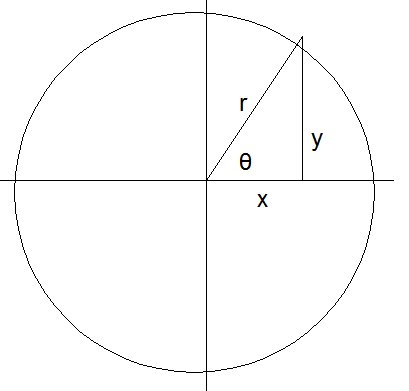
By the diagram above:
x = cos 2π/p
r = 1
Since cos θ = (cos 2π/p)/1 = cos 2π/p, we have θ = 2π/p.
Also, we have: sin θ = sin 2π/p = y/1 = y
(9) The point P0 is a vertex of the regular polygon with p sides. The line AP0 forms one side of the polygon, so we can label point A as P1.
(10) We can find the other p-1 sides in the following way. Let P0P1 be a circle at point P1 with radius equal to P0P1 (see Postulate 2, here). Call P2 the point where circle P0P1 intersects with unit circle OA (and is not point P0). We can repeat for circle P2P1 (finding point P3), circle P3P2 (find point P4), etc. until we have constructed our regular p-sided figure.
QED
Corollary 2.1: A regular polygon with n sides can be constructed with a ruler and compass if n is a product of distinct Fermat primes and a power of 2.
Proof:
(1) A regular polygon with n sides is constructible when n is a Fermat prime. [By Theorem 2 above]
(2) Since we can always do a repeated bisection of angles (see here for Euclid's Elements, Book I, Prop 9), a regular polygon with n sides is also constructible when n is a power of 2.
(3) So, to complete this proof, we only need to show that if n1 and n2 are relatively prime and a polygon with n1 sides is constructible and a polygon with n2 sides is constructible, then it follows that a polygon with n1n2 sides is constructible.
(4) Since n1, n2 are relatively prime, there exists integers m1, m2 such that (see Lemma 1, here):
m1n1 + m2n2 = 1.
(5) Multiplying both sides by 2π/(n1n2) gets us:
m1(2π/n2) + m2(2π/n1) = 2π/(n1n2)
(6) Therefore using Wantzel's Criterion (see Theorem 5, here), it follows that 2π/(n1n2) can be constructed by repeating a certain number of times 2π/n1 and 2π/n2.
(7) It therefore follows that the regular polygon with n1n2 sides can be constructed from regular n1 polygon and a regular n2 polygon.
QED
References
- Jean-Pierre Tignol, Galois' Theory of Algebraic Equations
Friday, April 04, 2008
Fermat Numbers
While of all Pierre de Fermat's proposed theorems really turned out to be theorems, not all of his conjectures turned out to be true.
In all fairness to Fermat, these theorems and conjectures were published after his death and were based on the notes he kept.
Pierre de Fermat conjectured that the Fn = 22n + 1 is prime for every integer n. These values Fn are today called Fermat Numbers.
The content in today's blog is taken from Jean-Pierre Tignol's Galois' Theory of Algebraic Equations.
Now, for n=0, 1, 2, 3, 4 the results are F0=3, F1=5, F2=17, F3=257, and F4=65537 which are all prime.
In 1732, Leonhard Euler showed that F5 = 641*6,700,417.
Since then, it has been shown that for 5 ≤ n ≤ 16, Fn is not prime.
Despite all these efforts, no other Fermat number has been found to be prime and no proof has been offered that would resolve this issue.
I will end today's blog with the following proof:
Lemma 1: If a prime number p has the form 2m + 1, then m is a power of 2.
Proof:
(1) Assume that m is not a power of 2.
(2) Then it is divisible by some odd integer k.
(3) Now, we know that:
xk + 1 = (x + 1)(xk-1 - xk-2 + ... - x + 1) [See Lemma 4, here where a=x, b=1]
(4) Let x= 2m/k
(5) This then gives us:
(2m/k)k + 1= (2m/k + 1)([2m/k]k-1 - [2m/k]k-2 + ... - [2m/k] + 1)
(6) Since (2m/k)k + 1 = 2m + 1, it follows that 2m + 1 cannot be a prime since it is divisible by (2m/k + 1).
(7) Therefore, we have a contradiction and we reject our assumption in step #1.
QED
References
In all fairness to Fermat, these theorems and conjectures were published after his death and were based on the notes he kept.
Pierre de Fermat conjectured that the Fn = 22n + 1 is prime for every integer n. These values Fn are today called Fermat Numbers.
The content in today's blog is taken from Jean-Pierre Tignol's Galois' Theory of Algebraic Equations.
Now, for n=0, 1, 2, 3, 4 the results are F0=3, F1=5, F2=17, F3=257, and F4=65537 which are all prime.
In 1732, Leonhard Euler showed that F5 = 641*6,700,417.
Since then, it has been shown that for 5 ≤ n ≤ 16, Fn is not prime.
Despite all these efforts, no other Fermat number has been found to be prime and no proof has been offered that would resolve this issue.
I will end today's blog with the following proof:
Lemma 1: If a prime number p has the form 2m + 1, then m is a power of 2.
Proof:
(1) Assume that m is not a power of 2.
(2) Then it is divisible by some odd integer k.
(3) Now, we know that:
xk + 1 = (x + 1)(xk-1 - xk-2 + ... - x + 1) [See Lemma 4, here where a=x, b=1]
(4) Let x= 2m/k
(5) This then gives us:
(2m/k)k + 1= (2m/k + 1)([2m/k]k-1 - [2m/k]k-2 + ... - [2m/k] + 1)
(6) Since (2m/k)k + 1 = 2m + 1, it follows that 2m + 1 cannot be a prime since it is divisible by (2m/k + 1).
(7) Therefore, we have a contradiction and we reject our assumption in step #1.
QED
References
- Jean-Pierre Tignol, Galois' Theory of Algebraic Equations
Thursday, March 13, 2008
Wantzel: Constructibility Criterion
The criterion presented in today's blog was known to Carl Friedrich Gauss in 1796 when he presented his criterion for the constructibility of regular polygons. Even so, the proof of the criteroin was first presented in 1837 by Pierre Laurent Wantzel.
The content in today's blog is taken from Jean-Pierre Tignol's Galois' Theory of Algebraic Equations.
To simplify the proof, I offer the following postulates.
Postulate 1:
It is possible to draw a line between any two points that are already determined.
Posulate 2:
It is possible to draw a circle with a center at a point already determined and with the radius equal to the distance between any two points already determined.
Postulate 3:
If two lines are not parallel and not colinear, then they intersect at exactly one point.
Postulate 4:
If a circle's center is at a point on a line then the circle intersects the extended line at two points.
I will now use these postulates to present some lemmas:
Lemma 1: (0,v) is constructible if and only if (v,0) is constructible
Proof:
This follows from Postulate 2 above setting center A at (0,0) and radius = v. If C at (v,0) is constructible, then we can obtain B at (0,v). If B at (0,v) is constructible, then we can obtain C at (v,0).
QED
Lemma 2: (u,0) is constructible and (0,v) is constructible if and only if (u,v) is constructible
Proof:
(1) Assume that B at (u,0) and D at (0,v) are constructible.
(2) If B at (u,0) is constructible and D at (0,v) is constructible, then F at (u,v) is constructible since:
(a) Let BG be a line that intersects B at (u,0) and is parallel to the y-axis. [Euclid: Book I, Prop 12, see here]
(b) Let DE be a line that insersects D at (0,v) and is parallel to the x-axis. [Euclid: Book I, Prop 12, see here]
(c) Then F at (u,v) is constructible since it is the point where BG,DE intersect [See Postulate 3 above]
(4) Assume that F at (u,v) is constructible.
(5) Since F at (u,v) is constructible, we know that B at (u,0) is constructible and D at (0,v) is constructible since:
(a) Let FG be a line parallel to the y-axis that passes through F at (u,v) [Euclid: Book I, Prop 12, see here]
(b) Then B at (u,0) is the point where FG and the x-axis intersect. [See Postulate 3 above]
(c) Let EF be a line parallel to the x-axis that passes through F at (u,v) [Euclid: Book I, Prop 12, see here]
(d) Then D at (0,v) is the point where EF and the y-axis intersect. [See Postulate 3 above]
QED
Lemma 3:
If a line passes through two points (a1,b1) and (a2,b2), then it has the equation of form:
αX + βY = γ
where
α = b2 - b1
β = a1 - a2
γ = a1b2 - b1a2
Proof:
(1) This lemma is proved if it can be shown that both points satisfy the equation given.
That is, both equations, lead to γ = a1b2 - b1a2
(2) Case I: (a1,b1)
α(a1) + β(b1) = (b2 - b1)(a1) + (a1 - a2)(b1) = a1b2 - b1a2
(3) Case II: (a2,b2)
α(a2) + β(b2) = (b2 - b1)(a2) + (a1 - a2)(b2) = a1b2 - b1a2
QED
Lemma 4:
If we construct a circle with center (a1,b1) and radius equal to the distance between (a2,b2) and (a3,b3), then it's equation has the form:
X2 + Y2 = αX + βY + γ
where:
α, β, γ are rational expressions of a1, a2, a3, b1, b2, b3
Proof:
(1) The equation for this circle is (see Theorem 1, here):
(X - a1)2 + (Y - b1)2 = (a2 - a3)2 + (b2 - b3)2
(2) Multiplying out the squares involving X,Y gives us:
X2 - 2a1X + a12 + Y2 - 2b1Y - b12
(3) Moving everything but X2,Y2 to the other side gives us:
X2 + Y2 = 2a1X + 2b1Y + [-a12 -b12 + (a2 - a3)2 + (b2 - b3)2]
QED
Theorem 5: Criterion of Constructibility
Let O be a circle that with center at (0,0) and radius = 1 unit.
The point (u,v) is constructible from O if and only if (u,v) can be obtained from (1,0) by a sequence of operations of the following types:
(i) rational operations
(ii) extraction of square roots
Proof:
(1) I will prove the first part of the theorem using induction.
(2) For the base case, we assume that u=a or 0 and v=a or 0.
(3) To prove the base case, we have four cases to prove:
(a) (a,0),(0,0) [Constructible from the given]
(b) (0,a) [Constructible from (a,0) and Proposition 2 above if we set center at (0,0) and radius=a].
(c) (a,a) [Constructible from (a,0) and Lemma 1 above]
(4) So we assume that all points (u',v') are constructible.
(5) To complete the first half of the proof, we need to show that if (u',v') is constructible and (u,v) is obtained in a single operation from (u',v'), then (u,v) is constructible.
(6) Using Lemma 2 above, step #5 is achieved if we show that the following points are constructible:
(u'+v',0)
(u' -v',0)
(u'v',0)
(u'v'-1,0) [assuming v ≠ 0 ]
(√u',0) [assuming u ≥ 0]
(7) (u'+v',0) and (u' -v',0) are constructible [From Postulate 2 above where the center is (u',0) and the radius=v and Postulate 4 above where (u'-v',0) and (u'+v',0) are the intersection of the circle and the x-axis.]
(8) (u'v',0) is constructible since:
(a) We are given that F at (0,v') is constructible.
(b) We are given that C at (u',0) is constructible.
(c) Let E at (0,b) be a point where b is less than v' and b is greater than 0 such that we consider b our unit of measure (i.e. b is length = 1 unit)
(d) Draw a line EC connecting E at (0,b) and C at (u',0) [See Posulate 1 above]
(e) Draw a line called FB parallel to EC and passing through F at (0,v') [Euclid: Book I, Prop 12, see here]
(f) Let B at (z,0) be the point where FB intersects with the x-axis. [See Postulate 3 above]
(g) Triangles EAC and FAB are similar since:
∠ EAC and ∠ FAB are the same.
∠ AEC is congruent to ∠ AFB and ∠ ACE is congruent to ∠ ABF since FB and EC are parallel [Euclid: Book I, Prop 29]
(h) So, we know that:
AC/AE = AB/AF [see Lemma 3, here]
(i) Since in step #8c above we assumed that AE = 1 unit, we have:
AC = AB/AF
or equivalently:
AB = AF*AC
(j) Since the length of AB is z [since A is at (0,0) and B is at (z,0)], the length of AF is v' [since A is at (0,0) and F is at (0,v')] and the length of AC is u' [since A is at (0,0) and C is at (u',0)], it follows that:
z = u'*v'
(9) (u'v'-1,0) is constructible since:
(a) Using the same diagram as step #8 above, we are given that F at (0,v') is constructible.
(b) Let us assume that we are given B at (u',0) is constructible.
(c) Let E at (0,b) be a point where b is less than v' and b is greater than 0 such that we consider b our unit of measure (i.e. b is length = 1 unit)
(d) Draw a line EC connecting E at (0,b) with a point C at (c,0) on the x-axis. [Euclid: Book I, Prop 12, see here]
(e) We can use the same arguments as #8g above to establish that Triangles EAC and FAB are similar
(f) Using the same argument as #8i, we have:
AC = AB/AF
(g) Since the length of AB is u' [since A is at (0,0) and B is at (u',0)], the length of AF is v' [since A is at (0,0) and F is at (0,v')] and the length of AC is c [since A is at (0,0) and C is at (c,0)], it follows that:
c = u'/v' = u'*v'-1
(10) Assuming u ≥ 0, then ( √u , 0) is constructible since:
(a) Assume that point B is at (0,0)
(b) Let D be a point on the x-axis at (d,0) such that BD = 1 unit.
(c) Let C be a point on the x-axis at (1+u',0) where 1 = BD. [See step #7 above]
(d) Let us a draw a circle O whose center is at the midpoint M of BC and whose radius is MC. [See Postulate 2 above]
(e) Let A at (1,a) be the intersection of O and a line drawn from D that is perpendicular to BC. [Euclid: Book I, Prop 11, see here]
(f) We can see that triangle BDA and triangle ADC are similar since:
Both ∠ BDA and ∠ ADC are right angles
And, ∠ BAC is a right angle [see Euclid: Book III, Prop 31]
So, ∠ BAD + ∠ DAC = 90 °
Since triangle ADC is a right triangle, we also have ∠ DAC + ∠ DCA = 90 ° [See Lemma 4, here]
So, we have shown that ∠ BAD ≅ ∠ DCA.
(g) Since the two triangles are equiangular, we have [see Lemma 3, here]:
DA/BD = DC/DA
(h) Since the length of DA is c [since A is at (1,c) and D is at (1,0)], the length of BD is 1 [since B is at (0,0) and D is at (1,0)] and the length of DC is u' [since D is at (1,0) and C is at (1+u,0)], it follows that:
c/1 = u'/c
Further, this gives us that:
c2 = u'
which means that:
c = √u'
(11) To complete the second half of the proof, I will show that if a point (u,v) can be constructed from (1,0) then it can be obtained from (1,0) through a finite sequence of operations.
(12) To accomplish, I need to show that the following imply points obtained from (1,0):
(a) two lines intersecting
(b) two circles intersecting
(c) line intersecting with a circle
(13) A point at two lines intersecting implies that this new point is obtained from the previous points since:
(a) By Lemma 3 above, the two lines can be represented by:
α1X + β1Y = γ1
α2X + β2Y = γ2
(b) Assuming that α1 ≠ 0, we multiply the top equation by (-α2/α1) and add the two equations together to get:
(-α2/α1)β1Y + β2Y = γ1 + γ2
which gives us that:
Y[(-α2/α1)β1 + β2] = γ1 + γ2
which shows that Y can be obtained from the given points.
Y = [γ1 + γ2 ]/[(-α2/α1)β1 + β2]
(c) Now, all we need to do is show that X can be obtained from the given points which can be shown using the first equation:
α1X + β1Y = γ1
which then shows:
X = (γ1 - β1Y)/(α1)
(14) A point at two circles intersecting implies that this new point is obtained from the previous points since:
(a) By Lemma 4 above, the two circles can be represented by:
X2 + Y2 = α1X + β1Y + γ1
X2 + Y2 = α2X + β2Y + γ2
which gives us:
α1X + β1Y + γ1 = α2X + β2Y + γ2
and moving X to one side and Y to the other gives us:
α1X - α2X = β2Y - β1Y + γ2 - γ1
(b) Now, assuming that (α1 - α2) ≠ 0, we can state X in terms of Y
X = [(β2 - β1)Y + γ2 - γ1]/(α1 - α2)
(c) Now, we can state Y as a quadratic equation since:
Using:
X2 + Y2 = α1X + β1Y + γ1
We get:
{[(β2 - β1)Y + γ2 - γ1]/(α1 - α2)}2 + Y2 = α1{[(β2 - β1)Y + γ2 - γ1]/(α1 - α2)} + β1Y + γ1
(d) Since a quadratic equation is solvable in terms of the coefficients (see Theorem, here if needed), we have shown that in this case, the points are obtained from the previous points.
(15) A point at a circle intersecting with a line is obtained from the previous points since:
(a) By Lemma 3 above, the line can be represented by:
α1X + β1Y = γ1
(b) By Lemma 4 above, the circle can be represented by:
X2 + Y2 = α2X + β2Y + γ2
(c) Assuming α1 ≠ 0, we can restate X in terms of Y using step #15a since:
X = (γ1 - β1Y)/α1
(d) Substituting into the equation in #15b gives us the following quadratic equation:
([γ1 - β1Y]/α1)2 + Y2 = α2([γ1 - β1Y]/α1) + β2Y + γ2
(e) Since a quadratic equation is solvable in terms of the coefficients (see Theorem, here if needed), we have shown that in this case, the points are obtained from the previous points.
QED
References
The content in today's blog is taken from Jean-Pierre Tignol's Galois' Theory of Algebraic Equations.
To simplify the proof, I offer the following postulates.
Postulate 1:
It is possible to draw a line between any two points that are already determined.
Posulate 2:
It is possible to draw a circle with a center at a point already determined and with the radius equal to the distance between any two points already determined.
Postulate 3:
If two lines are not parallel and not colinear, then they intersect at exactly one point.
Postulate 4:
If a circle's center is at a point on a line then the circle intersects the extended line at two points.
I will now use these postulates to present some lemmas:
Lemma 1: (0,v) is constructible if and only if (v,0) is constructible
Proof:
This follows from Postulate 2 above setting center A at (0,0) and radius = v. If C at (v,0) is constructible, then we can obtain B at (0,v). If B at (0,v) is constructible, then we can obtain C at (v,0).
QED
Lemma 2: (u,0) is constructible and (0,v) is constructible if and only if (u,v) is constructible
Proof:
(1) Assume that B at (u,0) and D at (0,v) are constructible.
(2) If B at (u,0) is constructible and D at (0,v) is constructible, then F at (u,v) is constructible since:
(a) Let BG be a line that intersects B at (u,0) and is parallel to the y-axis. [Euclid: Book I, Prop 12, see here]
(b) Let DE be a line that insersects D at (0,v) and is parallel to the x-axis. [Euclid: Book I, Prop 12, see here]
(c) Then F at (u,v) is constructible since it is the point where BG,DE intersect [See Postulate 3 above]
(4) Assume that F at (u,v) is constructible.
(5) Since F at (u,v) is constructible, we know that B at (u,0) is constructible and D at (0,v) is constructible since:
(a) Let FG be a line parallel to the y-axis that passes through F at (u,v) [Euclid: Book I, Prop 12, see here]
(b) Then B at (u,0) is the point where FG and the x-axis intersect. [See Postulate 3 above]
(c) Let EF be a line parallel to the x-axis that passes through F at (u,v) [Euclid: Book I, Prop 12, see here]
(d) Then D at (0,v) is the point where EF and the y-axis intersect. [See Postulate 3 above]
QED
Lemma 3:
If a line passes through two points (a1,b1) and (a2,b2), then it has the equation of form:
αX + βY = γ
where
α = b2 - b1
β = a1 - a2
γ = a1b2 - b1a2
Proof:
(1) This lemma is proved if it can be shown that both points satisfy the equation given.
That is, both equations, lead to γ = a1b2 - b1a2
(2) Case I: (a1,b1)
α(a1) + β(b1) = (b2 - b1)(a1) + (a1 - a2)(b1) = a1b2 - b1a2
(3) Case II: (a2,b2)
α(a2) + β(b2) = (b2 - b1)(a2) + (a1 - a2)(b2) = a1b2 - b1a2
QED
Lemma 4:
If we construct a circle with center (a1,b1) and radius equal to the distance between (a2,b2) and (a3,b3), then it's equation has the form:
X2 + Y2 = αX + βY + γ
where:
α, β, γ are rational expressions of a1, a2, a3, b1, b2, b3
Proof:
(1) The equation for this circle is (see Theorem 1, here):
(X - a1)2 + (Y - b1)2 = (a2 - a3)2 + (b2 - b3)2
(2) Multiplying out the squares involving X,Y gives us:
X2 - 2a1X + a12 + Y2 - 2b1Y - b12
(3) Moving everything but X2,Y2 to the other side gives us:
X2 + Y2 = 2a1X + 2b1Y + [-a12 -b12 + (a2 - a3)2 + (b2 - b3)2]
QED
Theorem 5: Criterion of Constructibility
Let O be a circle that with center at (0,0) and radius = 1 unit.
The point (u,v) is constructible from O if and only if (u,v) can be obtained from (1,0) by a sequence of operations of the following types:
(i) rational operations
(ii) extraction of square roots
Proof:
(1) I will prove the first part of the theorem using induction.
(2) For the base case, we assume that u=a or 0 and v=a or 0.
(3) To prove the base case, we have four cases to prove:
(a) (a,0),(0,0) [Constructible from the given]
(b) (0,a) [Constructible from (a,0) and Proposition 2 above if we set center at (0,0) and radius=a].
(c) (a,a) [Constructible from (a,0) and Lemma 1 above]
(4) So we assume that all points (u',v') are constructible.
(5) To complete the first half of the proof, we need to show that if (u',v') is constructible and (u,v) is obtained in a single operation from (u',v'), then (u,v) is constructible.
(6) Using Lemma 2 above, step #5 is achieved if we show that the following points are constructible:
(u'+v',0)
(u' -v',0)
(u'v',0)
(u'v'-1,0) [assuming v ≠ 0 ]
(√u',0) [assuming u ≥ 0]
(7) (u'+v',0) and (u' -v',0) are constructible [From Postulate 2 above where the center is (u',0) and the radius=v and Postulate 4 above where (u'-v',0) and (u'+v',0) are the intersection of the circle and the x-axis.]
(8) (u'v',0) is constructible since:
(a) We are given that F at (0,v') is constructible.
(b) We are given that C at (u',0) is constructible.
(c) Let E at (0,b) be a point where b is less than v' and b is greater than 0 such that we consider b our unit of measure (i.e. b is length = 1 unit)
(d) Draw a line EC connecting E at (0,b) and C at (u',0) [See Posulate 1 above]
(e) Draw a line called FB parallel to EC and passing through F at (0,v') [Euclid: Book I, Prop 12, see here]
(f) Let B at (z,0) be the point where FB intersects with the x-axis. [See Postulate 3 above]
(g) Triangles EAC and FAB are similar since:
∠ EAC and ∠ FAB are the same.
∠ AEC is congruent to ∠ AFB and ∠ ACE is congruent to ∠ ABF since FB and EC are parallel [Euclid: Book I, Prop 29]
(h) So, we know that:
AC/AE = AB/AF [see Lemma 3, here]
(i) Since in step #8c above we assumed that AE = 1 unit, we have:
AC = AB/AF
or equivalently:
AB = AF*AC
(j) Since the length of AB is z [since A is at (0,0) and B is at (z,0)], the length of AF is v' [since A is at (0,0) and F is at (0,v')] and the length of AC is u' [since A is at (0,0) and C is at (u',0)], it follows that:
z = u'*v'
(9) (u'v'-1,0) is constructible since:
(a) Using the same diagram as step #8 above, we are given that F at (0,v') is constructible.
(b) Let us assume that we are given B at (u',0) is constructible.
(c) Let E at (0,b) be a point where b is less than v' and b is greater than 0 such that we consider b our unit of measure (i.e. b is length = 1 unit)
(d) Draw a line EC connecting E at (0,b) with a point C at (c,0) on the x-axis. [Euclid: Book I, Prop 12, see here]
(e) We can use the same arguments as #8g above to establish that Triangles EAC and FAB are similar
(f) Using the same argument as #8i, we have:
AC = AB/AF
(g) Since the length of AB is u' [since A is at (0,0) and B is at (u',0)], the length of AF is v' [since A is at (0,0) and F is at (0,v')] and the length of AC is c [since A is at (0,0) and C is at (c,0)], it follows that:
c = u'/v' = u'*v'-1
(10) Assuming u ≥ 0, then ( √u , 0) is constructible since:
(a) Assume that point B is at (0,0)
(b) Let D be a point on the x-axis at (d,0) such that BD = 1 unit.
(c) Let C be a point on the x-axis at (1+u',0) where 1 = BD. [See step #7 above]
(d) Let us a draw a circle O whose center is at the midpoint M of BC and whose radius is MC. [See Postulate 2 above]
(e) Let A at (1,a) be the intersection of O and a line drawn from D that is perpendicular to BC. [Euclid: Book I, Prop 11, see here]
(f) We can see that triangle BDA and triangle ADC are similar since:
Both ∠ BDA and ∠ ADC are right angles
And, ∠ BAC is a right angle [see Euclid: Book III, Prop 31]
So, ∠ BAD + ∠ DAC = 90 °
Since triangle ADC is a right triangle, we also have ∠ DAC + ∠ DCA = 90 ° [See Lemma 4, here]
So, we have shown that ∠ BAD ≅ ∠ DCA.
(g) Since the two triangles are equiangular, we have [see Lemma 3, here]:
DA/BD = DC/DA
(h) Since the length of DA is c [since A is at (1,c) and D is at (1,0)], the length of BD is 1 [since B is at (0,0) and D is at (1,0)] and the length of DC is u' [since D is at (1,0) and C is at (1+u,0)], it follows that:
c/1 = u'/c
Further, this gives us that:
c2 = u'
which means that:
c = √u'
(11) To complete the second half of the proof, I will show that if a point (u,v) can be constructed from (1,0) then it can be obtained from (1,0) through a finite sequence of operations.
(12) To accomplish, I need to show that the following imply points obtained from (1,0):
(a) two lines intersecting
(b) two circles intersecting
(c) line intersecting with a circle
(13) A point at two lines intersecting implies that this new point is obtained from the previous points since:
(a) By Lemma 3 above, the two lines can be represented by:
α1X + β1Y = γ1
α2X + β2Y = γ2
(b) Assuming that α1 ≠ 0, we multiply the top equation by (-α2/α1) and add the two equations together to get:
(-α2/α1)β1Y + β2Y = γ1 + γ2
which gives us that:
Y[(-α2/α1)β1 + β2] = γ1 + γ2
which shows that Y can be obtained from the given points.
Y = [γ1 + γ2 ]/[(-α2/α1)β1 + β2]
(c) Now, all we need to do is show that X can be obtained from the given points which can be shown using the first equation:
α1X + β1Y = γ1
which then shows:
X = (γ1 - β1Y)/(α1)
(14) A point at two circles intersecting implies that this new point is obtained from the previous points since:
(a) By Lemma 4 above, the two circles can be represented by:
X2 + Y2 = α1X + β1Y + γ1
X2 + Y2 = α2X + β2Y + γ2
which gives us:
α1X + β1Y + γ1 = α2X + β2Y + γ2
and moving X to one side and Y to the other gives us:
α1X - α2X = β2Y - β1Y + γ2 - γ1
(b) Now, assuming that (α1 - α2) ≠ 0, we can state X in terms of Y
X = [(β2 - β1)Y + γ2 - γ1]/(α1 - α2)
(c) Now, we can state Y as a quadratic equation since:
Using:
X2 + Y2 = α1X + β1Y + γ1
We get:
{[(β2 - β1)Y + γ2 - γ1]/(α1 - α2)}2 + Y2 = α1{[(β2 - β1)Y + γ2 - γ1]/(α1 - α2)} + β1Y + γ1
(d) Since a quadratic equation is solvable in terms of the coefficients (see Theorem, here if needed), we have shown that in this case, the points are obtained from the previous points.
(15) A point at a circle intersecting with a line is obtained from the previous points since:
(a) By Lemma 3 above, the line can be represented by:
α1X + β1Y = γ1
(b) By Lemma 4 above, the circle can be represented by:
X2 + Y2 = α2X + β2Y + γ2
(c) Assuming α1 ≠ 0, we can restate X in terms of Y using step #15a since:
X = (γ1 - β1Y)/α1
(d) Substituting into the equation in #15b gives us the following quadratic equation:
([γ1 - β1Y]/α1)2 + Y2 = α2([γ1 - β1Y]/α1) + β2Y + γ2
(e) Since a quadratic equation is solvable in terms of the coefficients (see Theorem, here if needed), we have shown that in this case, the points are obtained from the previous points.
QED
References
- Jean-Pierre Tignol, Galois' Theory of Algebraic Equations
Sunday, March 02, 2008
Gauss: Proof that all roots of unity are solvable by radicals
After Carl Friedrich Gauss had solved the seventeenth root of unity, he proceed to generalize this result to show that all roots of unity are solvable by radicals. In today's blog, I will give Gauss's proof which was first presented as part of Gauss's classic work Disquisitiones Arithmeticae when Gauss was 21.
Today's content is taken straight from Jean-Pierre Tignol's Galois' Theory of Algebraic Equations.
In the proofs below, I use σ(f) where f ∈ Q(μk)(μp) which is defined in Definition 6, here. For definition of Kf, see Definition 5, here.
Lemma 1:
Let ζ be a p-th period of unity.
Let ef=p-1
Let ηi = ζi + ζe+i + ζ2e+i + ... + ζe(f-1)+i
Then:
σe(ηi) = ηi
Proof:
σe(ηi) = σe(ζi + ζe+i + ζ2e+i + ... + ζe(f-1)+i) =
=ζe+i + ζ2e+i + ζ3e+i + ... + ζef+i =
= ζe+i + ζ2e+i + ... + ζp-1+i =
= ζe+i + ζ2e+i + ... + ζe(f-1)+i + ζ0+i = ηi
QED
Corollary 1.1:
Let ζ be a p-th period of unity.
Let ef=p-1
Let ηi = ζi + ζe+i + ζ2e+i + ... + ζe(f-1)+i
Let a ∈ Q
Then:
σe(aηi) = aηi
Proof:
σe(aηi) = σe(a[ζi + ζe+i + ζ2e+i + ... + ζe(f-1)+i ]) =
= σe(aζi + aζe+i + aζ2e+i + ... + aζe(f-1)+i ) =
= aζe+i + aζ2e+i + aζ3e+i + ... + aζef+i =
= aζe+i + aζ2e+i + aζ3e+i + ... + aζp-1+i =
= aζe+i + aζ2e+i + ... + aζe(f-1)+i + aζ0+i = aηi
QED
Lemma 2:
Let ζ be a p-th period of unity.
Let ef=p-1
Let ηi = ζi + ζe+i + ζ2e+i + ... + ζe(f-1)+i
Then if ai ∈ Q:
σe(a0η0 + a1η1 + a2η2 + ... + ae-1ηe-1) = a0η0 + a1η1 + a2η2 + ... + ae-1ηe-1
Proof:
(1) σe(a0η0 + a1η1 + a2η2 + ... + ae-1ηe-1) = σe(a0η0) + σe(a1η1) + σe(a2η2) + ... + σe(ae-1ηe-1) [From Definition 5, here]
(2) From Corollary 1.1 above, we have:
σe(a0η0) + σe(a1η1) + σe(a2η2) + ... + σe(ae-1ηe-1) = a0η0 + a1η1 + a2η2 + ... + ae-1ηe-1
QED
Corollary 2.1:
if f(ζ), g(ζ) ∈ Kf, then: f(ζ)*g(ζ) ∈ Kf
Proof:
(1) Using Theorem 2, here, there exists a0, ..., ae-1 and b0, ..., be-1 such that:
f(ζ) = a0η0 + a1η1 + a2η2 + ... + ae-1ηe-1
g(ζ) = b0η0 + b1η1 + b2η2 + ... + be-1ηe-1
(2) σe(f(ζ)g(ζ)) = σe(f(ζ))σe(g(ζ)) [See Lemma 6, here]
(3) σe(f(ζ))σe(g(ζ)) = σe(a0η0 + a1η1 + a2η2 + ... + ae-1ηe-1)σe(b0η0 + b1η1 + b2η2 + ... + be-1ηe-1) = (a0η0 + a1η1 + a2η2 + ... + ae-1ηe-1)(b0η0 + b1η1 + b2η2 + ... + be-1ηe-1) =
= f(ζ)g(ζ) [This follows directly from Lemma 2 above]
QED
Lemma 3
Let ζ be a p-th period of unity.
Let ef=gh=p-1 where f divides g and k=g/f
Let ηi = ζi + ζe+i + ζ2e+i + ... + ζe(f-1)+i
Let ω be a k-th root of unity
Then:
(η0 + ωηh + ... + ωk-1ηh(k-1))k = a0η0 + ... + ae-1ηe-1
where the coefficients a0, ..., ae-1 are rational expressions in ω over Q [that is, they are rational expressions in Q(μk)]
Proof:
(1) I will show that (η0 + ωηh + ... + ωk-1ηh(k-1))k can be expressed as
a0η0 + ... + ae-1ηe-1 where the coefficients a0, ..., ae-1 are rational expressions in ω over Q
(2) Assume that k = 1, then it is clear that a0 = 1, a1 = ω, a2 = ω2, ..., ak-1 = ωk-1
(3) Assume that our hypothesis in step #2 is true up to n such that k ≤ n, then the hypothesis holds for (η0 + ωηh + ... + ωk-1ηh(k-1))k
(4) Then (η0 + ωηh + ... + ωk-1ηh(k-1))n+1= (η0 + ωηh + ... + ωk-1ηh(k-1))n(η0 + ωηh + ... + ωk-1ηh(k-1))= (a0η0 + ... + ae-1ηe-1)(η0 + ωηh + ω2η2h + ... + ωk-1ηh(k-1))
(5) (a0η0 + ... + ae-1ηe-1)(η0 + ωηh + ω2η2h + ... + ωk-1ηh(k-1)) = (a0η0)(η0 + ωηh + ω2η2h + ... + ωk-1ηh(k-1)) + ... + (ae-1ηe-1)(η0 + ωηh + ω2η2h + ... + ωk-1ηh(k-1)) = a0η0ω0η0 + ... + ae-1ηe-1ωk-1ηh(k-1)
(6) It is clear that each of the resulting terms is in the form of aiηiωjηj*h so if I can prove that each of these form reduces to a rational expression of ω and ηi that I am done.
(7) aiηiωjηj*h = (aiωj)(ηiηj*h)
(8) Using Corollary 2.1 above and Theorem 2 here, this gives us that each term reduces to:
(aiωj)(b0η0 + ... + be-1ηe-1) where bi ∈ Q.
QED
Corollary 3.1:
Let ζ be a p-th period of unity.
Let ef=gh=p-1 where f divides g and k=g/f
Let ηi = ζi + ζe+i + ζ2e+i + ... + ζe(f-1)+i
Let ω be a k-th root of unity
Then:
(η0 + ωηh + ... + ωk-1ηh(k-1))k = = a0η0 + ... + ah-1ηh-1 + ahηh + ... + a2h-1η2h-1 + + ... + + ah(k-1)ηh(k-1) + ... + ae-1ηe-1
Proof:
(1) From Lemma 3 above, we have:
(η0 + ωηh + ... + ωk-1ηh(k-1))k = a0η0 + ... + ae-1ηe-1
where the coefficients a0, ..., ae-1 are rational expressions in ω over Q [that is, they are rational expressions in Q(μk)]
(2) Since f divides g and ef = gh, it follows that g/f = e/h so that h divides e.
(3) This allows us to divide 0 .. e-1 into:
(η0 + ωηh + ... + ωk-1ηh(k-1))k = = a0η0 + ... + ah-1ηh-1 + ahηh + ... + a2h-1η2h-1 + + ... + + ah(k-1)ηh(k-1) + ... + ae-1ηe-1
QED
Lemma 4:
Let ζ be a p-th period of unity.
Let ef=gh=p-1 where f divides g and k=g/f
Let ηi = ζi + ζe+i + ζ2e+i + ... + ζe(f-1)+i
Let ξj = ζj + ζh+j + ζ2h+j + ... + ζh(g-1)+j
Then:
ηi + ηh+i + ... + ηh(k-1)+i = ξi for i = 0, ..., h-1
Proof:
(1) ηi = ζi + ζe+i + ζ2e+i + ... + ζe(f-1)+i [From the definition above]
(2) ηi + ηh+i + ... + ηh(k-1)+i =
= [ ζi + ζe+i + ζ2e+i + ... + ζe(f-1)+i] + [ ζh+i + ζh+e+i + ζh+2e+i + ... + ζh+e(f-1)+i] + ...
+ [ ζh(k-1)+i + ζh(k-1)+e+i + ζh(k-1)+2e+i + ... + ζh(k-1)+e(f-1)+i] =
= [ ζi + ζh + i + ... + ζh(k-1)+i ] + [ ζe + i + ζh + e + i + ... + ζh(k-1)+e+i] + ...
+ [ζe(f-1)+i + ζh+e(f-1)+i + ... + ζh(k-1)+e(f-1)+i]
(3) Since k = g/f and ef=gh, it follows that e = gh/f = hk
(4) This then gives us:
[ ζi + ζh + i + ... + ζh(k-1)+i ] + [ ζe + i + ζh + e + i + ... + ζh(k-1)+e+i] + ...
+ [ζe(f-1)+i + ζh+e(f-1)+i + ... + ζh(k-1)+e(f-1)+i]=
[ ζi + ζh + i + ... + ζh(k-1)+i ] + [ ζhk + i + ζh + hk + i + ... + ζh(k-1)+hk+i] + ...
+ [ζhk(f-1)+i + ζh+hk(f-1)+i + ... + ζh(k-1)+hk(f-1)+i] =
[ ζi + ζh+i + ... + ζh(k-1) ] + [ ζhk+i + ζh(k+1)+i + ... + ζh(2k-1)+i] + ... + [ζh[kf-k] + i + ζh[kf-k+1] + i + ... + ζh[kf-1]+i]
(5) Since k = g/f, it follows that kf = g so that we have:
[ ζi + ζh+i + ... + ζh(k-1) ] + [ ζhk+i + ζh(k+1)+i + ... + ζh(2k-1)+i] + ... + [ζh[kf-k] + i + ζh[kf-k+1] + i + ... + ζh[kf-1]+i] =
[ ζi + ζh+i + ... + ζh(k-1) ] + [ ζhk+i + ζh(k+1)+i + ... + ζh(2k-1)+i] + ... + [ζh[g-k] + i + ζh[g-k+1] + i + ... + ζh[g-1]+i] = ξi
QED
Theorem 5:
Let ζ be a p-th period of unity.
Let ef=gh=p-1 where f divides g and k=g/f
Let ηi = ζi + ζe+i + ζ2e+i + ... + ζe(f-1)+i
Let ξj = ζj + ζh+j + ζ2h+j + ... + ζh(g-1)+j
Let ω be a k-th root of unity
Let t(ω) = η0 + ωηh + ω2η2h + ... + ωk-1ηh(k-1)
Then:
t(ω)k has a rational expression in terms of a0ξ0 + ... + ah-1ξh-1 where the coefficients a0, ..., ah-1 are rational expressions in ω over Q
Proof:
(1) By Corollary 3.1 above, we have:
t(ω)k = (η0 + ωηh + ω2η2h + ... + ωk-1ηh(k-1))k = = a0η0 + ... + ah-1ηh-1 + ahηh + ... + a2h-1η2h-1 + + ... + + ah(k-1)ηh(k-1) + ... + ae-1ηe-1
where the coefficients a0, ..., ae-1 are rational expressions in ω over Q
(2) Apply σh to both sides of the equation (see Lemma 7, here) gives us:
(ηh + ωη2h + ... + ωk-1ηh(k))k = (ηh + ωη2h + ... + ωk-1η0)k = = a0ηh + ... + ah-1η2h-1 + + ahη2h + ... + a2h-1η3h-1 + + ... + + ah(k-1)η0 + ... + ae-1ηh-1
(5) We note that ω-1(t(ω)) = ηh + ωη2h + ... + ωk-1.
(6) We further note that:
[ω-1t(ω)]k = (ω-1)kt(ω)k = (ωk)-1t(ω)k = t(ω)k
(7) So that it is clear that t(ω)k = (ηh + ωη2h + ... + ωk-1η0)k = = a0ηh + ... + ah-1η2h-1 + + ahη2h + ... + a2h-1η3h-1 + + ... + + ah(k-1)η0 + ... + ae-1ηh-1
(8) Since we can make the same argument for ω2t(ω) with σ2h applied, ω3t(ω) with σ3h, ..., ωk-1t(ω) with σh(k-1), we can make the following observation:
kt(ω)k = (a0 + ... + ah(k-1))(η0 + ... + ηh(k-1)) + + (a1 + ... + ah(k-1)+1)(η1 + ... + ηh(k-1)+1) + + ... + + (ah-1 + ... + ae-1)(ηh-1 + ... + ηe-1).
(9) Using Lemma 4 above that ηi + ηh+i + ... + ηh(k-1)+i = ξi for i = 0, ..., h-1, it follows that t(ω)k is rationally expressed in terms of ω and ξ0, ..., ξh-1 as:
t(ω)k = 1/k((a0 + ... + ah(k-1))ξ0 + ... + (ah-1 + ... + ae-1)ξh-1)
QED
Corollary 5.1: For every integer n, the n-th roots of unity have expressions by radicals
Proof:
(1) This is clearly true if n=1 or n=2 since the roots of unity are (1) or (1,-1)
(2) We may assume that for every integer k less than n, the k-th roots of unity are expressible by radicals
(3) If n is not prime, then since each of its factors are less than n, we can conclude that n is expressible by radicals (see Theorem 2, here).
(4) So, we can assume that n is prime.
(5) We can then order the n-th roots of unity other than 1 with the aid of a primitive root of n [see Theorem 3, here]
(6) We can then consider the Lagrange resolvent (see Theorem, here):
t(ω) = ζ0 + ωζ1 + ... + ωn-2ζn-2
where ω is an (n-1)-st root of unity.
(7) By the induction hypothesis, ω can be expressed by radicals.
(8) By the Theorem 5 above (with k = g = n-1), this shows that t(ω)n-1 has a rational expression in terms of ω
(9) We can then use Lagrange's formula (see Theorem, here), to get the following formula:

QED
References
when Gauss was 21.Today's content is taken straight from Jean-Pierre Tignol's Galois' Theory of Algebraic Equations.
In the proofs below, I use σ(f) where f ∈ Q(μk)(μp) which is defined in Definition 6, here. For definition of Kf, see Definition 5, here.
Lemma 1:
Let ζ be a p-th period of unity.
Let ef=p-1
Let ηi = ζi + ζe+i + ζ2e+i + ... + ζe(f-1)+i
Then:
σe(ηi) = ηi
Proof:
σe(ηi) = σe(ζi + ζe+i + ζ2e+i + ... + ζe(f-1)+i) =
=ζe+i + ζ2e+i + ζ3e+i + ... + ζef+i =
= ζe+i + ζ2e+i + ... + ζp-1+i =
= ζe+i + ζ2e+i + ... + ζe(f-1)+i + ζ0+i = ηi
QED
Corollary 1.1:
Let ζ be a p-th period of unity.
Let ef=p-1
Let ηi = ζi + ζe+i + ζ2e+i + ... + ζe(f-1)+i
Let a ∈ Q
Then:
σe(aηi) = aηi
Proof:
σe(aηi) = σe(a[ζi + ζe+i + ζ2e+i + ... + ζe(f-1)+i ]) =
= σe(aζi + aζe+i + aζ2e+i + ... + aζe(f-1)+i ) =
= aζe+i + aζ2e+i + aζ3e+i + ... + aζef+i =
= aζe+i + aζ2e+i + aζ3e+i + ... + aζp-1+i =
= aζe+i + aζ2e+i + ... + aζe(f-1)+i + aζ0+i = aηi
QED
Lemma 2:
Let ζ be a p-th period of unity.
Let ef=p-1
Let ηi = ζi + ζe+i + ζ2e+i + ... + ζe(f-1)+i
Then if ai ∈ Q:
σe(a0η0 + a1η1 + a2η2 + ... + ae-1ηe-1) = a0η0 + a1η1 + a2η2 + ... + ae-1ηe-1
Proof:
(1) σe(a0η0 + a1η1 + a2η2 + ... + ae-1ηe-1) = σe(a0η0) + σe(a1η1) + σe(a2η2) + ... + σe(ae-1ηe-1) [From Definition 5, here]
(2) From Corollary 1.1 above, we have:
σe(a0η0) + σe(a1η1) + σe(a2η2) + ... + σe(ae-1ηe-1) = a0η0 + a1η1 + a2η2 + ... + ae-1ηe-1
QED
Corollary 2.1:
if f(ζ), g(ζ) ∈ Kf, then: f(ζ)*g(ζ) ∈ Kf
Proof:
(1) Using Theorem 2, here, there exists a0, ..., ae-1 and b0, ..., be-1 such that:
f(ζ) = a0η0 + a1η1 + a2η2 + ... + ae-1ηe-1
g(ζ) = b0η0 + b1η1 + b2η2 + ... + be-1ηe-1
(2) σe(f(ζ)g(ζ)) = σe(f(ζ))σe(g(ζ)) [See Lemma 6, here]
(3) σe(f(ζ))σe(g(ζ)) = σe(a0η0 + a1η1 + a2η2 + ... + ae-1ηe-1)σe(b0η0 + b1η1 + b2η2 + ... + be-1ηe-1) = (a0η0 + a1η1 + a2η2 + ... + ae-1ηe-1)(b0η0 + b1η1 + b2η2 + ... + be-1ηe-1) =
= f(ζ)g(ζ) [This follows directly from Lemma 2 above]
QED
Lemma 3
Let ζ be a p-th period of unity.
Let ef=gh=p-1 where f divides g and k=g/f
Let ηi = ζi + ζe+i + ζ2e+i + ... + ζe(f-1)+i
Let ω be a k-th root of unity
Then:
(η0 + ωηh + ... + ωk-1ηh(k-1))k = a0η0 + ... + ae-1ηe-1
where the coefficients a0, ..., ae-1 are rational expressions in ω over Q [that is, they are rational expressions in Q(μk)]
Proof:
(1) I will show that (η0 + ωηh + ... + ωk-1ηh(k-1))k can be expressed as
a0η0 + ... + ae-1ηe-1 where the coefficients a0, ..., ae-1 are rational expressions in ω over Q
(2) Assume that k = 1, then it is clear that a0 = 1, a1 = ω, a2 = ω2, ..., ak-1 = ωk-1
(3) Assume that our hypothesis in step #2 is true up to n such that k ≤ n, then the hypothesis holds for (η0 + ωηh + ... + ωk-1ηh(k-1))k
(4) Then (η0 + ωηh + ... + ωk-1ηh(k-1))n+1= (η0 + ωηh + ... + ωk-1ηh(k-1))n(η0 + ωηh + ... + ωk-1ηh(k-1))= (a0η0 + ... + ae-1ηe-1)(η0 + ωηh + ω2η2h + ... + ωk-1ηh(k-1))
(5) (a0η0 + ... + ae-1ηe-1)(η0 + ωηh + ω2η2h + ... + ωk-1ηh(k-1)) = (a0η0)(η0 + ωηh + ω2η2h + ... + ωk-1ηh(k-1)) + ... + (ae-1ηe-1)(η0 + ωηh + ω2η2h + ... + ωk-1ηh(k-1)) = a0η0ω0η0 + ... + ae-1ηe-1ωk-1ηh(k-1)
(6) It is clear that each of the resulting terms is in the form of aiηiωjηj*h so if I can prove that each of these form reduces to a rational expression of ω and ηi that I am done.
(7) aiηiωjηj*h = (aiωj)(ηiηj*h)
(8) Using Corollary 2.1 above and Theorem 2 here, this gives us that each term reduces to:
(aiωj)(b0η0 + ... + be-1ηe-1) where bi ∈ Q.
QED
Corollary 3.1:
Let ζ be a p-th period of unity.
Let ef=gh=p-1 where f divides g and k=g/f
Let ηi = ζi + ζe+i + ζ2e+i + ... + ζe(f-1)+i
Let ω be a k-th root of unity
Then:
(η0 + ωηh + ... + ωk-1ηh(k-1))k = = a0η0 + ... + ah-1ηh-1 + ahηh + ... + a2h-1η2h-1 + + ... + + ah(k-1)ηh(k-1) + ... + ae-1ηe-1
Proof:
(1) From Lemma 3 above, we have:
(η0 + ωηh + ... + ωk-1ηh(k-1))k = a0η0 + ... + ae-1ηe-1
where the coefficients a0, ..., ae-1 are rational expressions in ω over Q [that is, they are rational expressions in Q(μk)]
(2) Since f divides g and ef = gh, it follows that g/f = e/h so that h divides e.
(3) This allows us to divide 0 .. e-1 into:
(η0 + ωηh + ... + ωk-1ηh(k-1))k = = a0η0 + ... + ah-1ηh-1 + ahηh + ... + a2h-1η2h-1 + + ... + + ah(k-1)ηh(k-1) + ... + ae-1ηe-1
QED
Lemma 4:
Let ζ be a p-th period of unity.
Let ef=gh=p-1 where f divides g and k=g/f
Let ηi = ζi + ζe+i + ζ2e+i + ... + ζe(f-1)+i
Let ξj = ζj + ζh+j + ζ2h+j + ... + ζh(g-1)+j
Then:
ηi + ηh+i + ... + ηh(k-1)+i = ξi for i = 0, ..., h-1
Proof:
(1) ηi = ζi + ζe+i + ζ2e+i + ... + ζe(f-1)+i [From the definition above]
(2) ηi + ηh+i + ... + ηh(k-1)+i =
= [ ζi + ζe+i + ζ2e+i + ... + ζe(f-1)+i] + [ ζh+i + ζh+e+i + ζh+2e+i + ... + ζh+e(f-1)+i] + ...
+ [ ζh(k-1)+i + ζh(k-1)+e+i + ζh(k-1)+2e+i + ... + ζh(k-1)+e(f-1)+i] =
= [ ζi + ζh + i + ... + ζh(k-1)+i ] + [ ζe + i + ζh + e + i + ... + ζh(k-1)+e+i] + ...
+ [ζe(f-1)+i + ζh+e(f-1)+i + ... + ζh(k-1)+e(f-1)+i]
(3) Since k = g/f and ef=gh, it follows that e = gh/f = hk
(4) This then gives us:
[ ζi + ζh + i + ... + ζh(k-1)+i ] + [ ζe + i + ζh + e + i + ... + ζh(k-1)+e+i] + ...
+ [ζe(f-1)+i + ζh+e(f-1)+i + ... + ζh(k-1)+e(f-1)+i]=
[ ζi + ζh + i + ... + ζh(k-1)+i ] + [ ζhk + i + ζh + hk + i + ... + ζh(k-1)+hk+i] + ...
+ [ζhk(f-1)+i + ζh+hk(f-1)+i + ... + ζh(k-1)+hk(f-1)+i] =
[ ζi + ζh+i + ... + ζh(k-1) ] + [ ζhk+i + ζh(k+1)+i + ... + ζh(2k-1)+i] + ... + [ζh[kf-k] + i + ζh[kf-k+1] + i + ... + ζh[kf-1]+i]
(5) Since k = g/f, it follows that kf = g so that we have:
[ ζi + ζh+i + ... + ζh(k-1) ] + [ ζhk+i + ζh(k+1)+i + ... + ζh(2k-1)+i] + ... + [ζh[kf-k] + i + ζh[kf-k+1] + i + ... + ζh[kf-1]+i] =
[ ζi + ζh+i + ... + ζh(k-1) ] + [ ζhk+i + ζh(k+1)+i + ... + ζh(2k-1)+i] + ... + [ζh[g-k] + i + ζh[g-k+1] + i + ... + ζh[g-1]+i] = ξi
QED
Theorem 5:
Let ζ be a p-th period of unity.
Let ef=gh=p-1 where f divides g and k=g/f
Let ηi = ζi + ζe+i + ζ2e+i + ... + ζe(f-1)+i
Let ξj = ζj + ζh+j + ζ2h+j + ... + ζh(g-1)+j
Let ω be a k-th root of unity
Let t(ω) = η0 + ωηh + ω2η2h + ... + ωk-1ηh(k-1)
Then:
t(ω)k has a rational expression in terms of a0ξ0 + ... + ah-1ξh-1 where the coefficients a0, ..., ah-1 are rational expressions in ω over Q
Proof:
(1) By Corollary 3.1 above, we have:
t(ω)k = (η0 + ωηh + ω2η2h + ... + ωk-1ηh(k-1))k = = a0η0 + ... + ah-1ηh-1 + ahηh + ... + a2h-1η2h-1 + + ... + + ah(k-1)ηh(k-1) + ... + ae-1ηe-1
where the coefficients a0, ..., ae-1 are rational expressions in ω over Q
(2) Apply σh to both sides of the equation (see Lemma 7, here) gives us:
(ηh + ωη2h + ... + ωk-1ηh(k))k = (ηh + ωη2h + ... + ωk-1η0)k = = a0ηh + ... + ah-1η2h-1 + + ahη2h + ... + a2h-1η3h-1 + + ... + + ah(k-1)η0 + ... + ae-1ηh-1
(5) We note that ω-1(t(ω)) = ηh + ωη2h + ... + ωk-1.
(6) We further note that:
[ω-1t(ω)]k = (ω-1)kt(ω)k = (ωk)-1t(ω)k = t(ω)k
(7) So that it is clear that t(ω)k = (ηh + ωη2h + ... + ωk-1η0)k = = a0ηh + ... + ah-1η2h-1 + + ahη2h + ... + a2h-1η3h-1 + + ... + + ah(k-1)η0 + ... + ae-1ηh-1
(8) Since we can make the same argument for ω2t(ω) with σ2h applied, ω3t(ω) with σ3h, ..., ωk-1t(ω) with σh(k-1), we can make the following observation:
kt(ω)k = (a0 + ... + ah(k-1))(η0 + ... + ηh(k-1)) + + (a1 + ... + ah(k-1)+1)(η1 + ... + ηh(k-1)+1) + + ... + + (ah-1 + ... + ae-1)(ηh-1 + ... + ηe-1).
(9) Using Lemma 4 above that ηi + ηh+i + ... + ηh(k-1)+i = ξi for i = 0, ..., h-1, it follows that t(ω)k is rationally expressed in terms of ω and ξ0, ..., ξh-1 as:
t(ω)k = 1/k((a0 + ... + ah(k-1))ξ0 + ... + (ah-1 + ... + ae-1)ξh-1)
QED
Corollary 5.1: For every integer n, the n-th roots of unity have expressions by radicals
Proof:
(1) This is clearly true if n=1 or n=2 since the roots of unity are (1) or (1,-1)
(2) We may assume that for every integer k less than n, the k-th roots of unity are expressible by radicals
(3) If n is not prime, then since each of its factors are less than n, we can conclude that n is expressible by radicals (see Theorem 2, here).
(4) So, we can assume that n is prime.
(5) We can then order the n-th roots of unity other than 1 with the aid of a primitive root of n [see Theorem 3, here]
(6) We can then consider the Lagrange resolvent (see Theorem, here):
t(ω) = ζ0 + ωζ1 + ... + ωn-2ζn-2
where ω is an (n-1)-st root of unity.
(7) By the induction hypothesis, ω can be expressed by radicals.
(8) By the Theorem 5 above (with k = g = n-1), this shows that t(ω)n-1 has a rational expression in terms of ω
(9) We can then use Lagrange's formula (see Theorem, here), to get the following formula:

QED
References
- Jean-Pierre Tignol, Galois' Theory of Algebraic Equations
Subscribe to:
Posts (Atom)


