In today's blog, I continue to review results from Harold Edward's Fermat's Last Theorem: A Genetic Introduction to Algebraic Number Theory. I am continuing down the same chapter that I started in an earlier blog. If you would like to start at the beginning of cyclotomic integer properties, start here.
Lemma 1: For every cyclotomic prime h(α), there exists a rational prime p such that h(α) divides p.
Proof:
(1) Let h(α) be a cyclotomic prime. [See here for a review of cyclotomic primes]
(2) We know that Nh(α) is a rational integer. [See Lemma 5, here]
(3) By the Fundamental Theorem of Arithmetic, Nh(α) consists of a set of rational primes: p1*...*pn.
(4) Since h(α) is a cyclotomic prime, it must divide one of these primes pi. [See Definition 4, here]
QED
Lemma 2: Every cyclotomic integer g(α) is congruent mod h(α) to a cyclotomic integer of the form a1αf-1 + a2αf-2 + ... + af where ai are positive integers less than a prime integer p.
Proof:
(1) From a previous result, we know that every cyclotomic integer g(α) can be expressed in the following form:
g(α) = g1(η)αf-1 + g2(η)αf-2 + ... + gf(η)
where gi(η) are cyclotomic integers made up of periods of length f. [See Corollary 3.1, here]
(2) Each cyclotomic integer gi(η) is congruent mod h(α) to an integer gi(u) where gi(u) denotes the integer obtained by substituting u1 for η1, u2 for η2, etc. [See Corollary 2.1, here]
(3) We know that there exists a rational prime p such that h(α) divides p. [See Lemma 1 above]
(4) We can assume that gi(u) is between 0 and p-1 since:
(a) Assume that gi(u) ≥ p.
(b) There exists a value i such that gi(u) ≡ i (mod p) and i is between 0 and p-1.
(c) But then gi(u) ≡ i (mod h(α)) since h(α) divides p.
(d) So, we can conclude that gi(η) ≡ i (mod h(α))
(5) So that putting it all together, we have:
g(α) = g1(η)αf-1 + g2(η)αf-2 + ... + gf(η) ≡ g1(u)αf-1 + g2(u)αf-2 + ... + gf(u) ≡
≡ a1αf-1 + a2αf-2 + ... + af (mod h(α))
where ai is between 0 and p-1.
QED
Corollary 2.1: Every cyclotomic integer g(α) is congruent mod h(α) to 1 of pf specific cyclotomic integers.
Proof:
(1) From Lemma 2 above, every integer g(α) satisfies the equation below:
g(α) ≡ a1αf-1 + a2αf-2 + ... + af (mod h(α)) where ai is between 0 and p-1.
(2) Now the conclusion follows from noting that each of the f different integers can take p different values which gives us: pf different values.
QED
Definition 1: Additive group
An additive group is a group defined around the operation of addition. [See here for a review of the concept of a group]
Example: Z9 is an additive group
Z9 = { 0, 1, 2, 3, 4, 5, 6, 7, 8 }
It is clear that it has all the properties of a group:
(1) Closure: addition of any two integers modulo 9 results in another integer modulo 9.
(2) Identity: 0 is the identity.
(3) Inverse: For any integer, 9-i is the inverse. For example, 1 + 8 = 0 modulo 9.
(4) Associativity: For any a,b,c ∈ Z9, we see that:
a + (b + c) = (a + b) + c
Lemma 3: The additive group of cyclotomic integers mod p has pλ-1 elements.
Proof:
(1) Let λ be an odd prime and let α be a root of unity such that αλ = 1 but for all positive integers i less than λ, αi ≠ 1. [See here for review of roots of unity]
(2) All cyclotomic integers based on λ can be put into this form:
a0 + a1α + a2α2 + ... + aλ-1αλ-1
where ai are all integers [See Lemma 1 here]
(3) Since we are talking about values modulo p, we can assume that ai is between 0 and p-1.
(4) This means that there are λ-1 elements that can take values of 0 to p-1.
(5) If we count all possible values, this leads us to λ - 1 multiples:
[0..p-1]*[0..p-1]*...*[0..p-1] = pλ-1
QED
Lemma 4: if h(α) is a cyclotomic prime that divides a rational prime p, then the additive group of cyclotomic integers mod h(α) is a subgroup of the additive group of cyclotomic integers mod p.
Proof:
(1) We know that the set of cyclotomic integers mod p under '+' is an abelian group since:
(a) It is closed on the operation of '+'
(b) 0 mod p is the identity element.
(c) For any cyclotomic integer ≡ r (mod p), the inverse element is p-r.
(d) '+' is clearly associative in nature.
(e) It is abelian since '+' is commutative.
(2) We can make the same arguments to show that the cyclotomic integers mod h(α) is an abelian group on the operation of addition.
(3) To complete this proof, we only need to show that the set of cyclotomic integers mod h(α) is a subset of the cyclotomic integers mod p.
(4) This is the case since:
(a) Let g(α) be a cyclotomic integer.
(b) Then, there exists r(α) such that g(α) ≡ r(α) (mod h(α)) so that r(α) ∈ additive group of cyclotomic integers mod h(α)
(c) Now we can assume r(α) has the following form (see Lemma 1, here):
a0 + a1α + ... + aλ-1αλ-1
(d) We can further assume that all ai are between 0 and p-1 since if ai is greater than p, then there exists a' such that ai ≡ a' (mod p) where a' is less than p and further if ai ≡ a' (mod p), then ai ≡ a' (mod h(α)) because h(α) divides p.
(e) But if all ai are between 0 and p-1, then r(α) ∈ the additive group of cyclotomic integers mod p.
QED
Definition 2: Exponent of p mod λ
The exponent of p mod λ is the smallest positive integer whereby pf ≡ 1 (mod λ)
Lemma 5: Let S be the set of cyclotomic integers of the form a1αf-1 + a2αf-2 + ... + af where ai are positive integers less than p.
Two elements of S are congruent if and only if they are identical.
Proof:
(1) The number of incongruent elements mod h(α) is a power of p, say pn since:
(a) The additive group of cyclotomic integers mod h(α) is a subgroup of the additive group of cyclotomic integers mod p. [See Lemma 4 above]
(b) The additive group of cyclotomic integers mod p has pλ-1 elements. [See Lemma 3 above]
(c) Since the additive group of cyclotomic integers mod h(α) is a subgroup of the additive group of cyclotomic integers mod p, the order of the first group must divide pλ - 1. [By Lagrange's Theorem, see here]
(d) Because p is prime, the number of elements in the additive group of cyclotomic integers mod h(α) must be a power of p.
(2) The number of incongruent cyclotomic integers mod h(α) is at least λ + 1 because 0, α, α2, ..., αλ=1 are all incongruent mod h(α) since:
(a) Any cyclotomic integer divisible by h(α) must have a norm divisible by p [since p = Nh(α), see Lemma 6 here, and since h(α) divides g(α) → Nh(α) divides Ng(α), see Lemma 6 here]
(b) On the other hand, monomials αj - 0 have norm = 1 [See Lemma 5, here]
(c) The binomials αi - αj (where i is not congruent to j mod λ) have a norm equal to N(α-1)=λ [See Lemma 6, here]
(d) Neither 1 nor λ is divisible by p, so none of these cyclotomic integers are divisible by h(α)
(3) The number of nonzero incongruent cyclotomic integers mod h(α) is divisible by λ since:
(a) If α, α2, ..., αλ =1 are all the nonzero cyclotomic integers mod h(α), then there are exactly λ of them.
(b) Assume that there exists a cyclotomic integer ψ(α) such that ψ(α) is not congruent to 0 mod h(α) and ψ(α) is not congruent to αj mod h(α) for j = 1,2, ..., λ.
(c) Then ψ(α)α, ψ(α)α2, ..., ψ(α)αλ = ψ(α) are all nonzero mod h(α) [because h(α) is prime] and distinct mod h(α) [because ψ(α)αj ≡ ψ(α)αk would imply αj ≡ αk) and distinct from α, α2, ..., αλ (because ψ(α)αj ≡ αi would imply ψ(α) ≡ αk)
(d) If this is all the all the possible nonzero cyclotomic integers congruent to h(α), then there are 2λ of them.
(e) Eventually, we run out of possibilities. Let us say that this happens after m such iterations of step (#3c).
(f) Then, there are mλ distinct nonzero cyclotomic integers mod h(α)
(4) From step #1, we get that the total number of nonzero distinct cyclotomic integers mod h(α) is pn - 1.
(5) So putting #4 with #3, we get:
mλ = pn - 1.
(6) This gives us that:
pn ≡ 1 ( mod λ)
(7) Since f is the exponent of p mod λ, (see definition 2 above), we know that n ≥ f. [We know that f ≠ 0 since pn is greater than λ + 1. ]
(8) Thus, the number of pn of incongruent elements mod h(α) is at least pf.
QED
Corollary 5.1: To test for divisibility by h(α), it is not necessary to know h(α) but only the integers ui where i is between 1 and e and for which ηi ≡ ui (mod h(α)) for all i between 1 and e.
Proof:
(1) We know that a cyclotomic integer g(α) is divisible by h(α) if g(α) ≡ 0 (mod h(α))
(2) For any cyclotomic g(α), we know that it is congruent to a cyclotomic integer of the form a1αf-1 + a2αf-2 + ... + αf (mod h(α)) [See Lemma 2 above]
(3) We can now use Lemma 5 above to test for divisibility.
QED
Thursday, June 01, 2006


Monday, May 29, 2006
Cyclotomic Integers: Generalizing Periods
In today's blog, I continue to review results from Harold Edward's Fermat's Last Theorem: A Genetic Introduction to Algebraic Number Theory. I am continuing down the same chapter that I started in an earlier blog. If you would like to start at the beginning of cyclotomic integer properties, start here.
Lemma 1: Any arbitary cyclotomic integer g(α) of degree f-1 or less can be expressed in terms of cyclotomic integers made up of periods of length f such that:
g(α) = g1(η)αf-1 + g2(η)αf-2 + ... + gf(η)
where g1(η), g2(η), ..., gf(η) are cyclotomic integers made up of periods of length f. [See Definition 2 here for review of cyclotomic integers made up of periods of length f]
Proof:
(1) Let g(α) be a cyclotomic integer of degree f-1 so that:
g(α) = a0 + a1α + a2α2 + ... + af-1αf-1
(2) Let's define the following polynomials made up of periods of length f [letting e = (λ-1)/f]:
Let gf(η) = a0 + (0)η0 + (0)η1 + ... + (0)ηe-1
Let gf-1(η) = a1 + (0)η0 + (0)η1 + ... + (0)ηe-1
and so on until:
Let g1(η) = af-1 + (0)η0 + (0)η1 + ... + (0)ηe-1
(3) With the values in (step #2), we see that:
g(α) = g1(η)αf-1 + g2(η)αf-2 + ... + gf(η)
QED
Lemma 2: If g(α), h(α), and i(α) are cyclotomic integers expressible in terms of cyclotomic integers made up of periods of length f,
then g(α)h(α) + j(α) is expressible in terms of cyclotomic integers made up of periods of length f.
Proof:
(1) Since g(α), h(α), and j(α) are expressible in terms of cyclotomic integers made up of periods of length f, we have:
g(α) = g1(η)αf-1 + g2(η)αf-2 + ... + gf(η)
h(α) = h1(η)αf-1 + h2(η)αf-2 + ... + hf(η)
j(α) = j1(η)αf-1 + j2(η)αf-2 + ... + jf(η)
where where g1(η), g2(η), ..., gf(η), hi(η), ji(η) are cyclotomic integers made up of periods of length f.
(2) We know that the sum of two cyclotomic integers expressible in terms of cyclotomic integers made up of periods of length f is itself expressible in terms of cyclotomic integers made up of periods of length f.
If s(α) = g(α) + h(α) then we can define the following:
For each gi(η), hi(η), we have:
gi(η) = a0 + a1η0 + ... + afηf-1
hi(η) = b0 + b1η0 + ... + bfηf-1
And we can define si(η) such that:
si(η) = (a0 + b0) + (a1 + b1)η0 + ... + (af + bf)ηf-1
(3) The product of g(α)*h(α) is also expressible in terms of cyclotomic integers made up of periods of length f since:
g(α)h(α) = [g1(η)αf-1 + g2(η)αf-2 + ... + gf(η)][h1(η)αf-1 + h2(η)αf-2 + ... + hf(η)] =
= [g1(η)αf-1][h1(η)αf-1] + ... + [ gf(η) ][hf(η)]
Since the product of two cyclotomic integers made up periods of length f is itself made up of periods of length f (see Corollary 4.1 here), we can conclude that the product of g(α)h(α) is itself a sum of cyclotomic integers made up of periods of length f.
Now from this sum and from the result in step #2, we are done.
QED
Lemma 3: There exists a function p(x) such that:
p(α) = αf + φ1(η)αf-1 + ... + φf-(η)α + φf(η) = 0
where φ1(η), φ2(η), ..., φf(η) are cyclotomic integers made up of periods of length f.
Proof:
(1) Let λ be an odd prime.
(2) Let α be a primitive root of unity such that λ is the least positive integer whereby αλ = 1.
(3) Let e,f be positive integers such that e is a factor of λ - 1 and f = (λ - 1)/e.
(4) Let p(x) be a function such that:
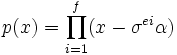
NOTE: In other words, p(x) = (x - σeα)(x - σ2eα)*...*(x - σfeα)
For review of σ notation, see here.
(5) If we multiply all of the products together, we get the following form:
p(x) = xf + φ1(η)xf-1 + ... + φf-(η)x + φf(η)
where φ(η) is a cyclotomic integer.
(6) We note that σep(x) = p(x) since:
(a) σep(x) = (x - σ2eα)(x - σ3eα)*...*(x - σefeα)
(b) σefe = σeσef = σeσλ-1 = σe [Since ef = λ - 1 by step #3 above and σλ-1 is identity from here]
(c) Combining (a) and (b) gives us:
σep(x) = (x - σ2eα)(x - σ3eα)*...*(x - σeα)
(7) From a previous result (see Lemma 4 here), we know that p(x) must consist of periods of length f so that taking our result from step #5:
p(x) = xf + φ1(η)xf-1 + ... + φf-(η)x + φf(η)
We know that φ1(η), φ2(η), ..., φf(η) must all be cyclotomic integers made up of periods of length f.
(8) Now we know that p(α) = 0 since:
(a) p(α) = (α - σeα)(α - σ2eα)*...*(α - σfeα)
(b) fe = λ - 1 (from step #3)
(c) σλ-1 is the identity (see here) so that σλ-1α = α
(d) Applying #8b and #8c to (a) gives us:
p(α) = (α - σeα)(α - σ2eα)*...*(α - σfeα) =
=(α - σeα)(α - σ2eα)*...*(α - α) =
= (α - σeα)(α - σ2eα)*...*(0) = 0
(9) So putting this all together gives us:
p(α) = αf + φ1(η)αf-1 + ... + φf-(η)α + φf(η) = 0
QED
Corollary 3.1: Every cyclotomic integer g(α) can be expressed in terms of cyclotomic integers made up of periods of length f such that:
g(α) = g1(η)αf-1 + g2(η)αf-2 + ... + gf(η)
where g1(η), g2(η), ..., gf(η) are cyclotomic integers made up of periods of length f.
Proof:
(1) Let g(α) be a cyclotomic integer such that:
g(α) = a0 + a1α + a2α2 + ... + aλ-1αλ-1
NOTE: See Lemma 1 here for details on why all cyclotomic integers can be expressed in this form.
(2) We can restate g(α) in terms of g(x) so that:
g(x) = a0 + a1x + a2x2 + ... + aλ-1
(3) Let p(x) be a polynomial such that:
p(x) = xf + φ1(η)xf-1 + ... + φf-1(η)x + φf(η)
where φ(η) is a cyclotomic integer.
(4) Using Division by Polynomials (see here) we know that there exists q(x),r(x) such that:
g(x) = q(x)(xf) + r(x) where degree of r(x) is less than f or r(x) = 0.
(5) Now from Lemma 1 above, we know that r(α) is expressible in terms of cyclotomic integers made up of periods of length f.
(6) Since p(α) = 0 (see Lemma 3 above), we know that αf is expressible in terms of cyclotomic integers made up of periods of length f since:
αf = -φ1(η)xf-1 - ... - φf-1(η)x - φf(η)
(7) For now, let's assume that q(x) is of degree less than f.
(8) Then we can apply Lemma 1 above and conclude that q(x) is expressible in terms of cyclotomic integers made up of periods of length f.
(9) Now since g(α) = q(α)(αf) + r(α), we can apply Lemma 2 above to conclude that g(α) is expressible in terms of cyclotomic integers made up of periods of length f.
(10) Now let's assume that q(α) is of degree f.
(11) Using q(x), we can again apply the Division Algorithm for Polynomials to get:
q(x) = q1(x)(xf) + r(x)
Since we are assuming q(x) has a degree of f, it follows that q1(x) will have a degree less than f.
(12) Using Lemma 2 above, we can conclude that q(α) is expressible in terms of cyclotomic integers since q1(α), αf, and r(α) are expressible in terms of cyclotomic integers made up of periods of length f.
(13) Using the Principle of Induction, we can now conclude that this works regardless of the degree of q(α). [Since q(α) with degree f-1 works and since q(α) with degree f-1 working implies that a q(α) with degree f works]
(14) So, using Lemma 2 above, since q(α), r(α), and αf are expressible in terms of cyclotomic integers made up of periods of length f, so is g(α) since:
g(α) = q(α)αf + r(α)
QED
Example:
Let λ = 5, f = 2, and γ = 2
So e = (λ - 1)/f = 4/2 = 2
Let g(α) = α4 + 2α3 + 3α2 + 4α + 5
We note that:
21 ≡ 2 (mod 5)
22 ≡ 4 (mod 5)
23 ≡ 3 (mod 5)
24 ≡ 1 (mod 5)
In this case,
p(x) = (x - σeα)(x - σ2eα)
Now σeα = αγ2 = α4
σ2eα = αγ4 = α
So,
p(x) = x2 - x(α4 + α) + α5 = x2 - x(α4 + α) + 1.
We see that p(α) = 0 since:
p(α) = α2 - α(α4 + α) + 1 = α2 - 1 + α2 + 1 = 0
So that:
α2 = α(α4 + α) - 1
Let g(x) = x4 + 2x3 + 3x2 + 4x+ 5
Now, let's express each of these terms in terms of cyclotomic integers made up of periods of length f=2:
with:
η0 = α4 + α
η1 = α3 + α2
(η0)2 = α3 + α2 + 2.
(η0)(η1) = η0 + η1
Using the Division Algorithm for polynomials, we see that:
g(x) = q(x)(x2) + r(x)
where:
q(x) = x2 + 2x + 3
r(x) = 4x + 5
x2 = x(α4 + α) - 1
and:
q(α) = [α(α4 + α) - 1] + [2α + 3] = α(η0 + 2) + (2)
r(α) = 4α + 5 = α(4) + (5)
α2 = [α(α4 + α) - 1] = α(η0) + (-1)
Then
g(α) = q(α)α2 + r(α) =
= α2(η02 + 2η0) + α(2η0) + α(-η0 - 2) -2 + α(4) + (5) =
= [α(η0) -1](3η1 + 2) + α(η0 +2) + (3) =
= α(4η0 + 3η1+ 4) + (-3η1 + 1)
So, let:
g1(η) = 4η0 + 3η1 + 4
g2(η) = -3η1 + 1
And finally, this gives us:
g(α) = g1(η)α + g2(η)
Lemma 1: Any arbitary cyclotomic integer g(α) of degree f-1 or less can be expressed in terms of cyclotomic integers made up of periods of length f such that:
g(α) = g1(η)αf-1 + g2(η)αf-2 + ... + gf(η)
where g1(η), g2(η), ..., gf(η) are cyclotomic integers made up of periods of length f. [See Definition 2 here for review of cyclotomic integers made up of periods of length f]
Proof:
(1) Let g(α) be a cyclotomic integer of degree f-1 so that:
g(α) = a0 + a1α + a2α2 + ... + af-1αf-1
(2) Let's define the following polynomials made up of periods of length f [letting e = (λ-1)/f]:
Let gf(η) = a0 + (0)η0 + (0)η1 + ... + (0)ηe-1
Let gf-1(η) = a1 + (0)η0 + (0)η1 + ... + (0)ηe-1
and so on until:
Let g1(η) = af-1 + (0)η0 + (0)η1 + ... + (0)ηe-1
(3) With the values in (step #2), we see that:
g(α) = g1(η)αf-1 + g2(η)αf-2 + ... + gf(η)
QED
Lemma 2: If g(α), h(α), and i(α) are cyclotomic integers expressible in terms of cyclotomic integers made up of periods of length f,
then g(α)h(α) + j(α) is expressible in terms of cyclotomic integers made up of periods of length f.
Proof:
(1) Since g(α), h(α), and j(α) are expressible in terms of cyclotomic integers made up of periods of length f, we have:
g(α) = g1(η)αf-1 + g2(η)αf-2 + ... + gf(η)
h(α) = h1(η)αf-1 + h2(η)αf-2 + ... + hf(η)
j(α) = j1(η)αf-1 + j2(η)αf-2 + ... + jf(η)
where where g1(η), g2(η), ..., gf(η), hi(η), ji(η) are cyclotomic integers made up of periods of length f.
(2) We know that the sum of two cyclotomic integers expressible in terms of cyclotomic integers made up of periods of length f is itself expressible in terms of cyclotomic integers made up of periods of length f.
If s(α) = g(α) + h(α) then we can define the following:
For each gi(η), hi(η), we have:
gi(η) = a0 + a1η0 + ... + afηf-1
hi(η) = b0 + b1η0 + ... + bfηf-1
And we can define si(η) such that:
si(η) = (a0 + b0) + (a1 + b1)η0 + ... + (af + bf)ηf-1
(3) The product of g(α)*h(α) is also expressible in terms of cyclotomic integers made up of periods of length f since:
g(α)h(α) = [g1(η)αf-1 + g2(η)αf-2 + ... + gf(η)][h1(η)αf-1 + h2(η)αf-2 + ... + hf(η)] =
= [g1(η)αf-1][h1(η)αf-1] + ... + [ gf(η) ][hf(η)]
Since the product of two cyclotomic integers made up periods of length f is itself made up of periods of length f (see Corollary 4.1 here), we can conclude that the product of g(α)h(α) is itself a sum of cyclotomic integers made up of periods of length f.
Now from this sum and from the result in step #2, we are done.
QED
Lemma 3: There exists a function p(x) such that:
p(α) = αf + φ1(η)αf-1 + ... + φf-(η)α + φf(η) = 0
where φ1(η), φ2(η), ..., φf(η) are cyclotomic integers made up of periods of length f.
Proof:
(1) Let λ be an odd prime.
(2) Let α be a primitive root of unity such that λ is the least positive integer whereby αλ = 1.
(3) Let e,f be positive integers such that e is a factor of λ - 1 and f = (λ - 1)/e.
(4) Let p(x) be a function such that:

NOTE: In other words, p(x) = (x - σeα)(x - σ2eα)*...*(x - σfeα)
For review of σ notation, see here.
(5) If we multiply all of the products together, we get the following form:
p(x) = xf + φ1(η)xf-1 + ... + φf-(η)x + φf(η)
where φ(η) is a cyclotomic integer.
(6) We note that σep(x) = p(x) since:
(a) σep(x) = (x - σ2eα)(x - σ3eα)*...*(x - σefeα)
(b) σefe = σeσef = σeσλ-1 = σe [Since ef = λ - 1 by step #3 above and σλ-1 is identity from here]
(c) Combining (a) and (b) gives us:
σep(x) = (x - σ2eα)(x - σ3eα)*...*(x - σeα)
(7) From a previous result (see Lemma 4 here), we know that p(x) must consist of periods of length f so that taking our result from step #5:
p(x) = xf + φ1(η)xf-1 + ... + φf-(η)x + φf(η)
We know that φ1(η), φ2(η), ..., φf(η) must all be cyclotomic integers made up of periods of length f.
(8) Now we know that p(α) = 0 since:
(a) p(α) = (α - σeα)(α - σ2eα)*...*(α - σfeα)
(b) fe = λ - 1 (from step #3)
(c) σλ-1 is the identity (see here) so that σλ-1α = α
(d) Applying #8b and #8c to (a) gives us:
p(α) = (α - σeα)(α - σ2eα)*...*(α - σfeα) =
=(α - σeα)(α - σ2eα)*...*(α - α) =
= (α - σeα)(α - σ2eα)*...*(0) = 0
(9) So putting this all together gives us:
p(α) = αf + φ1(η)αf-1 + ... + φf-(η)α + φf(η) = 0
QED
Corollary 3.1: Every cyclotomic integer g(α) can be expressed in terms of cyclotomic integers made up of periods of length f such that:
g(α) = g1(η)αf-1 + g2(η)αf-2 + ... + gf(η)
where g1(η), g2(η), ..., gf(η) are cyclotomic integers made up of periods of length f.
Proof:
(1) Let g(α) be a cyclotomic integer such that:
g(α) = a0 + a1α + a2α2 + ... + aλ-1αλ-1
NOTE: See Lemma 1 here for details on why all cyclotomic integers can be expressed in this form.
(2) We can restate g(α) in terms of g(x) so that:
g(x) = a0 + a1x + a2x2 + ... + aλ-1
(3) Let p(x) be a polynomial such that:
p(x) = xf + φ1(η)xf-1 + ... + φf-1(η)x + φf(η)
where φ(η) is a cyclotomic integer.
(4) Using Division by Polynomials (see here) we know that there exists q(x),r(x) such that:
g(x) = q(x)(xf) + r(x) where degree of r(x) is less than f or r(x) = 0.
(5) Now from Lemma 1 above, we know that r(α) is expressible in terms of cyclotomic integers made up of periods of length f.
(6) Since p(α) = 0 (see Lemma 3 above), we know that αf is expressible in terms of cyclotomic integers made up of periods of length f since:
αf = -φ1(η)xf-1 - ... - φf-1(η)x - φf(η)
(7) For now, let's assume that q(x) is of degree less than f.
(8) Then we can apply Lemma 1 above and conclude that q(x) is expressible in terms of cyclotomic integers made up of periods of length f.
(9) Now since g(α) = q(α)(αf) + r(α), we can apply Lemma 2 above to conclude that g(α) is expressible in terms of cyclotomic integers made up of periods of length f.
(10) Now let's assume that q(α) is of degree f.
(11) Using q(x), we can again apply the Division Algorithm for Polynomials to get:
q(x) = q1(x)(xf) + r(x)
Since we are assuming q(x) has a degree of f, it follows that q1(x) will have a degree less than f.
(12) Using Lemma 2 above, we can conclude that q(α) is expressible in terms of cyclotomic integers since q1(α), αf, and r(α) are expressible in terms of cyclotomic integers made up of periods of length f.
(13) Using the Principle of Induction, we can now conclude that this works regardless of the degree of q(α). [Since q(α) with degree f-1 works and since q(α) with degree f-1 working implies that a q(α) with degree f works]
(14) So, using Lemma 2 above, since q(α), r(α), and αf are expressible in terms of cyclotomic integers made up of periods of length f, so is g(α) since:
g(α) = q(α)αf + r(α)
QED
Example:
Let λ = 5, f = 2, and γ = 2
So e = (λ - 1)/f = 4/2 = 2
Let g(α) = α4 + 2α3 + 3α2 + 4α + 5
We note that:
21 ≡ 2 (mod 5)
22 ≡ 4 (mod 5)
23 ≡ 3 (mod 5)
24 ≡ 1 (mod 5)
In this case,
p(x) = (x - σeα)(x - σ2eα)
Now σeα = αγ2 = α4
σ2eα = αγ4 = α
So,
p(x) = x2 - x(α4 + α) + α5 = x2 - x(α4 + α) + 1.
We see that p(α) = 0 since:
p(α) = α2 - α(α4 + α) + 1 = α2 - 1 + α2 + 1 = 0
So that:
α2 = α(α4 + α) - 1
Let g(x) = x4 + 2x3 + 3x2 + 4x+ 5
Now, let's express each of these terms in terms of cyclotomic integers made up of periods of length f=2:
with:
η0 = α4 + α
η1 = α3 + α2
(η0)2 = α3 + α2 + 2.
(η0)(η1) = η0 + η1
Using the Division Algorithm for polynomials, we see that:
g(x) = q(x)(x2) + r(x)
where:
q(x) = x2 + 2x + 3
r(x) = 4x + 5
x2 = x(α4 + α) - 1
and:
q(α) = [α(α4 + α) - 1] + [2α + 3] = α(η0 + 2) + (2)
r(α) = 4α + 5 = α(4) + (5)
α2 = [α(α4 + α) - 1] = α(η0) + (-1)
Then
g(α) = q(α)α2 + r(α) =
= α2(η02 + 2η0) + α(2η0) + α(-η0 - 2) -2 + α(4) + (5) =
= [α(η0) -1](3η1 + 2) + α(η0 +2) + (3) =
= α(4η0 + 3η1+ 4) + (-3η1 + 1)
So, let:
g1(η) = 4η0 + 3η1 + 4
g2(η) = -3η1 + 1
And finally, this gives us:
g(α) = g1(η)α + g2(η)
Thursday, May 25, 2006
Cyclotomic Integers: More on cyclotomic periods
In today's blog, I continue to review results from Harold Edward's Fermat's Last Theorem: A Genetic Introduction to Algebraic Number Theory. I am continuing down the same chapter that I started in an earlier blog. If you would like to start at the beginning of cyclotomic integer properties, start here.
Lemma 1: g(α) = g(αp) if and only if g(α) is a cyclotomic integer made up of periods of length f.
Proof:
(1) Let λ be an odd prime.
(2) Let α be a primitive root of unity such that αλ = 1.
(3) Let p be an odd prime distinct from λ
(4) Let τ be mapping such that τα = αp
(5) Let f be the least positive integer for which pf ≡ 1 (mod λ)
(6) We know that f divides λ -1 since:
(a) pλ-1 ≡ 1 (mod λ) from Fermat's Little Theorem (since p,λ are distinct primes)
(b) From a previous result (see Lemma 2 here), we know if f is the least positive integer, then it must divide λ-1.
(7) Let e= (λ-1)/f
(8) Assume that g(α) is made up of periods of length f. [See here for review of cyclotomic periods]
(9) Then, σeg(α) = g(α) [See Lemma 4 here for details.]
(10) Then, there must exist an integer k such that:
τ = σk
Since the primitive root (see here for review if needed) can take all possible values mod λ [By definition σ = a mapping between α and αγ where γ is a primitive root, see here]
(11) Using step #10, we note that:
τf = σkf
Since τf ≡ 1 (mod λ), we know that σkf ≡ 1 (mod λ)
(12) Since the order of λ is λ -1 (see here), we know that kf must be divisible by λ - 1 (see Lemma 2 here) which means it is divisible by ef since ef=λ - 1.
So, ef divides kf means that e must divide k.
(13) So, from step #10 and step #12:
τ is a power of σe
(14) So, there exists k' such that ek' = k.
(15) From #14, we have:
τ = (σ1e)(σ2e)...(σk'e)
and therefore:
τg(α) =(σ1e)(σ2e)...(σk'e)g(α) = g(α)
(16) Assume that τg(α) = g(α)
(17) We know that there exists k such that:
τ = σk [Since σ is a mapping to γ which is a primitive root and the primitive root can take on all values modulo λ]
(18) Since g(α) repeats at τg(α), we know that g(α) consists of e periods of length f. [See Corollary 1.2 here]
(19) By definition, e divides (λ - 1) [See here for definition of periods]
(20) Thus, e is a common divisor of k and λ - 1.
(21) e is the greatest common divisor of k and λ - 1 since:
(a) Let d be an integer that divides both k, λ-1 so that:
k = qd
λ - 1 = df'
(b) Now,
τf' = σkf' = σqdf' = σ(λ - 1)q which is identity[from step #17, #21a, and since σλ-1 is the identity, see here]
(c) So that:
f' ≥ f [Since f is least value where pf ≡ 1 (mod λ)]
d ≤ e [Because d = (λ-1)/f' where f' ≥ f and e=(λ - 1)/f]
(22) Using Bezout's Identity, there exists a,b such that:
e = ak + b(λ - 1)
(23) Further,
σe = σakσb(λ-1) = [from step #22]
= σak = [Since σb(λ-1) is identity]
= τa [Since τ = σk from step #17]
(24) From this, we see that:
σeg(α) = τag(α) = g(α)
QED
Lemma 2: Let h(α) be a prime cyclotomic integer. For any cyclotomic integer g(α) made up of periods of length f, there exists an integer u such that g(α) ≡ u (mod h(α))
Proof:
(1) Fermat's Little Theorem gives us:
xp-1 ≡ 1 (mod p)
So that:
p divides xp-1 - 1
So that:
x(xp-1 - 1) = xp - x ≡ 0 (mod p)
(2) We also know that:
(x -1)*(x-2)*...(x-p) ≡ 0 (mod p)
(a) There exists a r such that x ≡ r (mod p)
(b) We know that p divides x - r
(c) We also know that r is between 0 and p-1.
(d) if r is 0, then p divides x-p; otherwise, p divides x-r.
(3) Putting (#1) and (#2) together, we have:
xp - x ≡ (x-1)(x-2)*...*(x-p) (mod p)
(4) Let x = g(α)
(5) Then:
g(α)p - g(α) ≡ [g(α) - 1][g(α) - 2]*...*[g(α) - p] (mod p)
(6) From a previous result (see Lemma 3 here), where g(α)p ≡ g(αp) (mod p), we have:
g(αp) - g(α) ≡ [g(α) - 1][g(α) - 2]*...*[g(α) - p] (mod p)
(7) Since h(α) divides p, then we have:
g(αp) - g(α) ≡ [g(α) - 1][g(α) - 2]*...*[g(α) - p] (mod h(α))
(8) Now, since g(α) is made up of periods of length f, we know that g(αp) = g(α) [See Lemma 1 above]
So that:
g(αp) - g(α) = 0 ≡ 0 (mod h(α))
(9) This gives:
[g(α) - 1][g(α) - 2][g(α) - 3]*...*[g(α)-p] ≡ 0 (mod h(α))
(10) Since h(α) is a prime cyclotomic integer, one of these values must be divisible by h(α) [By the definition of a cyclotomic prime, see here]
(11) So there exists an integer u such that h(α) divides g(α) - u
Which means that:
g(α) ≡ u (mod h(α))
QED
Corollary 2.1: Let h(α) be a prime cyclotomic integer. Let ηi be a period of length f. Then, there exists an integer ui such that ηi ≡ ui (mod h(α))
Proof:
(1) Each period ηi can be thought of as a cyclotomic integer made up of periods of length f:
g(α) = (0)η0 + ... + (1)ηi + ... + (0)ηe-1 = ηi
(2) From Lemma 2 above, we know that there exists an integer ui such that g(α) ≡ ui (mod h(α))
(3) So, we see that for each ηi, there exists ui such that:
ηi ≡ ui (mod h(α))
QED
Lemma 1: g(α) = g(αp) if and only if g(α) is a cyclotomic integer made up of periods of length f.
Proof:
(1) Let λ be an odd prime.
(2) Let α be a primitive root of unity such that αλ = 1.
(3) Let p be an odd prime distinct from λ
(4) Let τ be mapping such that τα = αp
(5) Let f be the least positive integer for which pf ≡ 1 (mod λ)
(6) We know that f divides λ -1 since:
(a) pλ-1 ≡ 1 (mod λ) from Fermat's Little Theorem (since p,λ are distinct primes)
(b) From a previous result (see Lemma 2 here), we know if f is the least positive integer, then it must divide λ-1.
(7) Let e= (λ-1)/f
(8) Assume that g(α) is made up of periods of length f. [See here for review of cyclotomic periods]
(9) Then, σeg(α) = g(α) [See Lemma 4 here for details.]
(10) Then, there must exist an integer k such that:
τ = σk
Since the primitive root (see here for review if needed) can take all possible values mod λ [By definition σ = a mapping between α and αγ where γ is a primitive root, see here]
(11) Using step #10, we note that:
τf = σkf
Since τf ≡ 1 (mod λ), we know that σkf ≡ 1 (mod λ)
(12) Since the order of λ is λ -1 (see here), we know that kf must be divisible by λ - 1 (see Lemma 2 here) which means it is divisible by ef since ef=λ - 1.
So, ef divides kf means that e must divide k.
(13) So, from step #10 and step #12:
τ is a power of σe
(14) So, there exists k' such that ek' = k.
(15) From #14, we have:
τ = (σ1e)(σ2e)...(σk'e)
and therefore:
τg(α) =(σ1e)(σ2e)...(σk'e)g(α) = g(α)
(16) Assume that τg(α) = g(α)
(17) We know that there exists k such that:
τ = σk [Since σ is a mapping to γ which is a primitive root and the primitive root can take on all values modulo λ]
(18) Since g(α) repeats at τg(α), we know that g(α) consists of e periods of length f. [See Corollary 1.2 here]
(19) By definition, e divides (λ - 1) [See here for definition of periods]
(20) Thus, e is a common divisor of k and λ - 1.
(21) e is the greatest common divisor of k and λ - 1 since:
(a) Let d be an integer that divides both k, λ-1 so that:
k = qd
λ - 1 = df'
(b) Now,
τf' = σkf' = σqdf' = σ(λ - 1)q which is identity[from step #17, #21a, and since σλ-1 is the identity, see here]
(c) So that:
f' ≥ f [Since f is least value where pf ≡ 1 (mod λ)]
d ≤ e [Because d = (λ-1)/f' where f' ≥ f and e=(λ - 1)/f]
(22) Using Bezout's Identity, there exists a,b such that:
e = ak + b(λ - 1)
(23) Further,
σe = σakσb(λ-1) = [from step #22]
= σak = [Since σb(λ-1) is identity]
= τa [Since τ = σk from step #17]
(24) From this, we see that:
σeg(α) = τag(α) = g(α)
QED
Lemma 2: Let h(α) be a prime cyclotomic integer. For any cyclotomic integer g(α) made up of periods of length f, there exists an integer u such that g(α) ≡ u (mod h(α))
Proof:
(1) Fermat's Little Theorem gives us:
xp-1 ≡ 1 (mod p)
So that:
p divides xp-1 - 1
So that:
x(xp-1 - 1) = xp - x ≡ 0 (mod p)
(2) We also know that:
(x -1)*(x-2)*...(x-p) ≡ 0 (mod p)
(a) There exists a r such that x ≡ r (mod p)
(b) We know that p divides x - r
(c) We also know that r is between 0 and p-1.
(d) if r is 0, then p divides x-p; otherwise, p divides x-r.
(3) Putting (#1) and (#2) together, we have:
xp - x ≡ (x-1)(x-2)*...*(x-p) (mod p)
(4) Let x = g(α)
(5) Then:
g(α)p - g(α) ≡ [g(α) - 1][g(α) - 2]*...*[g(α) - p] (mod p)
(6) From a previous result (see Lemma 3 here), where g(α)p ≡ g(αp) (mod p), we have:
g(αp) - g(α) ≡ [g(α) - 1][g(α) - 2]*...*[g(α) - p] (mod p)
(7) Since h(α) divides p, then we have:
g(αp) - g(α) ≡ [g(α) - 1][g(α) - 2]*...*[g(α) - p] (mod h(α))
(8) Now, since g(α) is made up of periods of length f, we know that g(αp) = g(α) [See Lemma 1 above]
So that:
g(αp) - g(α) = 0 ≡ 0 (mod h(α))
(9) This gives:
[g(α) - 1][g(α) - 2][g(α) - 3]*...*[g(α)-p] ≡ 0 (mod h(α))
(10) Since h(α) is a prime cyclotomic integer, one of these values must be divisible by h(α) [By the definition of a cyclotomic prime, see here]
(11) So there exists an integer u such that h(α) divides g(α) - u
Which means that:
g(α) ≡ u (mod h(α))
QED
Corollary 2.1: Let h(α) be a prime cyclotomic integer. Let ηi be a period of length f. Then, there exists an integer ui such that ηi ≡ ui (mod h(α))
Proof:
(1) Each period ηi can be thought of as a cyclotomic integer made up of periods of length f:
g(α) = (0)η0 + ... + (1)ηi + ... + (0)ηe-1 = ηi
(2) From Lemma 2 above, we know that there exists an integer ui such that g(α) ≡ ui (mod h(α))
(3) So, we see that for each ηi, there exists ui such that:
ηi ≡ ui (mod h(α))
QED
Cyclotomic Integers: g(α)p ≡ g(αp) (mod p)
In today's blog, I continue to review results from Harold Edward's Fermat's Last Theorem: A Genetic Introduction to Algebraic Number Theory. I am continuing down the same chapter that I started in an earlier blog. If you would like to start at the beginning of cyclotomic integer properties, start here.
Lemma 1: if p is a prime, then (x + y)p ≡ xp + yp
Proof:
(1) Using the Binomial Theorem, we know that:

(2) Now, this means that each of the coefficients is equal to:
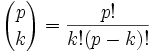
(3) But since p is a prime, p divides all coefficients.
For all values where k is between 1 and p-1, p, as a prime, will not be divisible by either k! or by (p-k)!.
(4) This means that p will divides (x + y)p - xp - yp.
QED
Lemma 2: xp ≡ x (mod p)
Proof:
(1) xp - x = x(xp-1 - 1)
(2) if gcd(x,p)=1, then by Fermat's Little Theorem, xp-1 ≡ 1 (mod p) so p divides xp-1-1.
(3) if p divides x, then of course p divides x(xp-1-1)
QED
Lemma 3: g(α) ≡ g(αp) mod p
Proof:
(1) Let g(α) = a0 + a1α + ... + αλ-1αλ-1.
(2) Then g(α)p = (a0 + [a1α + ... + αλ-1αλ-1])p
(3) Now using Lemma 1 above, we can break #2 out in the following ways:
(a0 + [a1α + ... + αλ-1αλ-1])p ≡ (a0)p + (a1α + [... + αλ-1αλ-1])p (mod p).
(4) We could keep breaking out each element until we get:
(a0 + [a1α + ... + αλ-1αλ-1])p ≡ (a0)p + (a1α)p + ... + (aλ-1αλ-1)p (mod p)
(5) Now for each coefficient ai, using Lemma 2 above, we have:
aip ≡ ai (mod p)
So this gives us:
(a0)p + (a1α)p + ... + (aλ-1αλ-1)p ≡ a0 + a1αp + ... + aλ-1(αλ-1)p (mod p)
(6) And we are done since this shows that:
g(α)p ≡ g(αp) (mod p)
QED
Lemma 1: if p is a prime, then (x + y)p ≡ xp + yp
Proof:
(1) Using the Binomial Theorem, we know that:

(2) Now, this means that each of the coefficients is equal to:

(3) But since p is a prime, p divides all coefficients.
For all values where k is between 1 and p-1, p, as a prime, will not be divisible by either k! or by (p-k)!.
(4) This means that p will divides (x + y)p - xp - yp.
QED
Lemma 2: xp ≡ x (mod p)
Proof:
(1) xp - x = x(xp-1 - 1)
(2) if gcd(x,p)=1, then by Fermat's Little Theorem, xp-1 ≡ 1 (mod p) so p divides xp-1-1.
(3) if p divides x, then of course p divides x(xp-1-1)
QED
Lemma 3: g(α) ≡ g(αp) mod p
Proof:
(1) Let g(α) = a0 + a1α + ... + αλ-1αλ-1.
(2) Then g(α)p = (a0 + [a1α + ... + αλ-1αλ-1])p
(3) Now using Lemma 1 above, we can break #2 out in the following ways:
(a0 + [a1α + ... + αλ-1αλ-1])p ≡ (a0)p + (a1α + [... + αλ-1αλ-1])p (mod p).
(4) We could keep breaking out each element until we get:
(a0 + [a1α + ... + αλ-1αλ-1])p ≡ (a0)p + (a1α)p + ... + (aλ-1αλ-1)p (mod p)
(5) Now for each coefficient ai, using Lemma 2 above, we have:
aip ≡ ai (mod p)
So this gives us:
(a0)p + (a1α)p + ... + (aλ-1αλ-1)p ≡ a0 + a1αp + ... + aλ-1(αλ-1)p (mod p)
(6) And we are done since this shows that:
g(α)p ≡ g(αp) (mod p)
QED
Cyclotomic Integers: Periods
In today's blog, I will review the concept of periods for cyclotomic integers from Harold Edward's Fermat's Last Theorem: A Genetic Introduction to Algebraic Number Theory. I am continuing down the same chapter that I started in an earlier blog. If you would like to start at the beginning of cyclotomic integer properties, start here.
I will continue to use Edward's σg(α) notation that I reviewed in a previous blog.
Lemma 1:
Let e be a factor of λ - 1 where λ is an odd prime and α is a primitive root of unity where αλ = 1.
Then, for a given cyclotomic integer g(α) there exists a cyclotomic integer G(α) such that:
Ng(α) = G(α)*σG(α)*...*σe-1G(α)
Proof:
(1) Let G(α) = g(α)*σeg(α)*σ2eg(α)*...*σ-eg(α) where σ-e denotes σλ-1-e
(2) With this definition we can see that:
G(α) = g(α)*g(αγe)*g(αγ2e)*...*g(αγ(λ-1-e))
σG(α) = g(αγ)*g(αγ(e+1))*g(αγ2e+1)*...*g(αγλ-e)
...
σe-1G(α) = g(αγ(e-1))*g(αγ(2e-1))*...*g(αγ(λ-2))
(3) Putting this all together, we see that:
Ng(α) = g(α)*g(αγ)*g(αγ*γ)*...*g(αγ(λ-2))
(4) Since γ is a primitive root mod λ, we know that (3) is the same as:
Ng(α) = g(α)*g(α2)*g(α3)*..*g(αλ-1)
QED
Example 1: λ = 13, γ = 2, and e = 4
In this case, Ng(α) = G(α)G(α)G(α4)G(α8)
Each term G(α) = g(α)*g(α24)*g(α22*4) = g(α)*g(α3)*g(α9)
Since:
2 ≡ 2 (mod 13)
22 ≡ 4 (mod 13)
23 ≡ 8 (mod 13)
24 ≡ 16 ≡ 3 (mod 13)
25 ≡ 32 ≡ 6 (mod 13)
26 ≡ 64 ≡ 12 (mod 13)
27 ≡ 128 ≡ 11 (mod 13)
28 ≡ 256 ≡ 9 (mod 13)
29 ≡ 512 ≡ 5 (mod 13)
210 ≡ 1024 ≡ 10 (mod 13)
211 ≡ 2048 ≡ 7 (mod 13)
212 ≡ 4096 ≡ 1 (mod 13)
Corollary 1.1: σeG(α) = G(α)
Proof:
(1) G(α) = g(α)*g(αγe)*g(αγ2e)*...*g(αγ(λ-1-e))
(2) And we find that:
σeG(α) = g(αγe)*g(αγ2e)*g(αγ3e)*...*g(αγλ-1)
(3) And since γλ-1 ≡ 1 (mod λ) (By Fermat's Little Theorem), we see that the result in step #2 is the same as the result in step #1.
QED
Corollary 1.2: σeG(α) = G(α) implies that there exists a set of e cyclotomic integers: η0, η1, ... ηe-1 such that:
(a) η0 = α + σeα + σ2eα + ... + σλ-1-eα
(b) ηi+1 = σηi
(c) G(α) = a0 + a1η0 + a2η1 + ... + aeηe-1 where ai are integers.
Proof:
(1) σeG(α) = G(α)
(2) Since G(α) is a cyclotomic integer, we know that (see Lemma 1 here):
G(α) = a0 + a1α + ... + aλ-1αλ-1
(3) Now, (#1) implies that the coefficient for any αj, αj = σeαj
(4) In order for #3 to be true, then G(α) must have the following form:
G(α) = a0 + a1(α + σeα + σ2eα + ... + σλ-1-e) + a2(σα + σσeα + ...) + ... + ae(σe-1α + σe-1σeα + ...)
The reason being that each time all the values G(α) shifts by e, the new value must also have had the same coefficient and further, all new resulting values must be the same as values that existed before the shift. For each coefficient, the set of possible αj values must be closed.
(5) Now, we can define η0 in the following way:
η0 = α + σeα + σ2eα + ... + σλ-1-e
(6) We can likewise define ηi+1 as:
ηi+1 = σηi
(7) Putting (5) and (6) into the equation in step #4 gives us:
G(α) = a0 + a1η0 + ... + aeηe-1
QED
Definition 1: Cyclotomic Period
Let λ be a prime integer. Let α be a primitive root of unity such that αλ=1. Let γ be a primitive root modulo λ. Let e be a factor of λ - 1.
Let G(α) = g(α)*g(αγe)*g(αγ2e)*...*g(αγ(λ-1-e))
Then there exists a set of e cyclotomic integers: η0, η1, ... ηe-1 such that:
(a) η0 = α + σeα + σ2eα + ... + σλ-1-eα
(b) ηi+1 = σηi
(c) G(α) = a0 + a1η0 + a2η1 + ... + aeηe-1 where ai are integers.
The cyclotomic integers η0, η1, ... ηe-1 that meet conditions (a), (b), and (c) are called cyclotomic periods.
Note:
As a convention, ηe = η0 and η-1 = ηe-1. So one can think of ηi as an ever repeating pattern of e values such that ηi+1 = σηi
In this way, ηi is defined for all integers i.
Example 1: period for λ = 13, μ = 2, γ = 4
In this case, the cyclotomic periods are:
η0 = α + σ4α + σ8α = α + α3 + α9
η1 = σα + σα3 + σα9 = α2 + α6 + α5
η2 = σ2α + σ2α3 + σ2α9 = α4 + α12 + α10
η3 = σ3α + σ3α3 + σ3α9 = α8 + α11 + α7
Lemma 2: σeηi = ηi
Proof:
(1) For Case 0, this is given by the note in definition 1 above.
σeη0 = ηe = η0
(2) Let's assume that this is true up to i so that:
σeηi = ηi where 0 ≤ i.
(3) Then, this is also true for ηi+1 since:
σe(ηi+1) = σe(σηi) [From Definition 1 above]
Now σeσ = σe+1 = σσe
So that we get:
σeηi+1 = σ(σeηi)
By assumption at step #2, σeηi = ηi
So that we end up with:
σeηi+1 = σηi = ηi+1
(4) So, by the principle of induction, we are done.
QED
Lemma 3: Each period η consists of (λ-1)/e terms.
Proof:
(1) Let f = (λ - 1)/e.
(2) σefα = σλ-1α = α
(3) σ(λ - 1 - e)α = σe(f-1)α = (σe)f-1α
(4) So we can see that each term in α + σeα + σ2eα + ... + σλ-1-eα is σiα where i is 0*e, 1*e, 2*e, ... , (f-1)*e.
QED
Definition 2: Made up of periods of length f
A cyclotomic integer is made up of periods of length f if it can be put in the form:
a0 + a1η1 + a2η2 + ... + aeηe
where ai are integers and ηi are periods of length f.
Lemma 4: A cyclotomic integer g(α) is made up of periods of length if and only if σeg(α) = g(α)
Proof:
(1) Assume that g(α) is a cyclotomic integer made up of periods of length f.
(2) Then, there exists ai and ηi such that:
g(α) = a0 + a1η0 + a2η1 + ... + aeηe-1
(3) Applying σe to g(α) gives us:
σeg(α) = a0 + a1σeη0 + ... + aeσeηe-1
(4) Applying Lemma 2 above gives us:
σeg(α) = a0 + a1η0 + ... + aeηe-1
(5) Assume that σeg(α) = g(α)
(6) Then by Corollary 1.2 above, g(α) consists of e periods.
(7) And by Lemma 3, each period will be of length f.
QED
Corollary 4.1: The product of two cyclotomic integers made up of periods of length f is itself made up of periods of length f.
Proof:
(1) Let f(α), g(α) be cyclotomic integers made up of periods of length f so that:
σef(α) = f(α)
σeg(α) = g(α)
(2) But then:
σe[f(α)g(α)] = [σef(α)][σeg(α)] = f(α)g(α)
(3) So that by Lemma 4 above, we have proved that f(α)g(α) must itself be made up of periods of length f.
QED
Example: λ = 13, f = 3, e = 4
We note that:
(η0)2 = η1 + 2η2
η0η1 = η0 + η1 + η3
η0η2 = 3 + η1 + η3
Likewise, applying σ to these equations gives us:
(η1)2 = η2 + 2η0
η1η2 = η1 + η2 + η0
And so forth.
I will continue to use Edward's σg(α) notation that I reviewed in a previous blog.
Lemma 1:
Let e be a factor of λ - 1 where λ is an odd prime and α is a primitive root of unity where αλ = 1.
Then, for a given cyclotomic integer g(α) there exists a cyclotomic integer G(α) such that:
Ng(α) = G(α)*σG(α)*...*σe-1G(α)
Proof:
(1) Let G(α) = g(α)*σeg(α)*σ2eg(α)*...*σ-eg(α) where σ-e denotes σλ-1-e
(2) With this definition we can see that:
G(α) = g(α)*g(αγe)*g(αγ2e)*...*g(αγ(λ-1-e))
σG(α) = g(αγ)*g(αγ(e+1))*g(αγ2e+1)*...*g(αγλ-e)
...
σe-1G(α) = g(αγ(e-1))*g(αγ(2e-1))*...*g(αγ(λ-2))
(3) Putting this all together, we see that:
Ng(α) = g(α)*g(αγ)*g(αγ*γ)*...*g(αγ(λ-2))
(4) Since γ is a primitive root mod λ, we know that (3) is the same as:
Ng(α) = g(α)*g(α2)*g(α3)*..*g(αλ-1)
QED
Example 1: λ = 13, γ = 2, and e = 4
In this case, Ng(α) = G(α)G(α)G(α4)G(α8)
Each term G(α) = g(α)*g(α24)*g(α22*4) = g(α)*g(α3)*g(α9)
Since:
2 ≡ 2 (mod 13)
22 ≡ 4 (mod 13)
23 ≡ 8 (mod 13)
24 ≡ 16 ≡ 3 (mod 13)
25 ≡ 32 ≡ 6 (mod 13)
26 ≡ 64 ≡ 12 (mod 13)
27 ≡ 128 ≡ 11 (mod 13)
28 ≡ 256 ≡ 9 (mod 13)
29 ≡ 512 ≡ 5 (mod 13)
210 ≡ 1024 ≡ 10 (mod 13)
211 ≡ 2048 ≡ 7 (mod 13)
212 ≡ 4096 ≡ 1 (mod 13)
Corollary 1.1: σeG(α) = G(α)
Proof:
(1) G(α) = g(α)*g(αγe)*g(αγ2e)*...*g(αγ(λ-1-e))
(2) And we find that:
σeG(α) = g(αγe)*g(αγ2e)*g(αγ3e)*...*g(αγλ-1)
(3) And since γλ-1 ≡ 1 (mod λ) (By Fermat's Little Theorem), we see that the result in step #2 is the same as the result in step #1.
QED
Corollary 1.2: σeG(α) = G(α) implies that there exists a set of e cyclotomic integers: η0, η1, ... ηe-1 such that:
(a) η0 = α + σeα + σ2eα + ... + σλ-1-eα
(b) ηi+1 = σηi
(c) G(α) = a0 + a1η0 + a2η1 + ... + aeηe-1 where ai are integers.
Proof:
(1) σeG(α) = G(α)
(2) Since G(α) is a cyclotomic integer, we know that (see Lemma 1 here):
G(α) = a0 + a1α + ... + aλ-1αλ-1
(3) Now, (#1) implies that the coefficient for any αj, αj = σeαj
(4) In order for #3 to be true, then G(α) must have the following form:
G(α) = a0 + a1(α + σeα + σ2eα + ... + σλ-1-e) + a2(σα + σσeα + ...) + ... + ae(σe-1α + σe-1σeα + ...)
The reason being that each time all the values G(α) shifts by e, the new value must also have had the same coefficient and further, all new resulting values must be the same as values that existed before the shift. For each coefficient, the set of possible αj values must be closed.
(5) Now, we can define η0 in the following way:
η0 = α + σeα + σ2eα + ... + σλ-1-e
(6) We can likewise define ηi+1 as:
ηi+1 = σηi
(7) Putting (5) and (6) into the equation in step #4 gives us:
G(α) = a0 + a1η0 + ... + aeηe-1
QED
Definition 1: Cyclotomic Period
Let λ be a prime integer. Let α be a primitive root of unity such that αλ=1. Let γ be a primitive root modulo λ. Let e be a factor of λ - 1.
Let G(α) = g(α)*g(αγe)*g(αγ2e)*...*g(αγ(λ-1-e))
Then there exists a set of e cyclotomic integers: η0, η1, ... ηe-1 such that:
(a) η0 = α + σeα + σ2eα + ... + σλ-1-eα
(b) ηi+1 = σηi
(c) G(α) = a0 + a1η0 + a2η1 + ... + aeηe-1 where ai are integers.
The cyclotomic integers η0, η1, ... ηe-1 that meet conditions (a), (b), and (c) are called cyclotomic periods.
Note:
As a convention, ηe = η0 and η-1 = ηe-1. So one can think of ηi as an ever repeating pattern of e values such that ηi+1 = σηi
In this way, ηi is defined for all integers i.
Example 1: period for λ = 13, μ = 2, γ = 4
In this case, the cyclotomic periods are:
η0 = α + σ4α + σ8α = α + α3 + α9
η1 = σα + σα3 + σα9 = α2 + α6 + α5
η2 = σ2α + σ2α3 + σ2α9 = α4 + α12 + α10
η3 = σ3α + σ3α3 + σ3α9 = α8 + α11 + α7
Lemma 2: σeηi = ηi
Proof:
(1) For Case 0, this is given by the note in definition 1 above.
σeη0 = ηe = η0
(2) Let's assume that this is true up to i so that:
σeηi = ηi where 0 ≤ i.
(3) Then, this is also true for ηi+1 since:
σe(ηi+1) = σe(σηi) [From Definition 1 above]
Now σeσ = σe+1 = σσe
So that we get:
σeηi+1 = σ(σeηi)
By assumption at step #2, σeηi = ηi
So that we end up with:
σeηi+1 = σηi = ηi+1
(4) So, by the principle of induction, we are done.
QED
Lemma 3: Each period η consists of (λ-1)/e terms.
Proof:
(1) Let f = (λ - 1)/e.
(2) σefα = σλ-1α = α
(3) σ(λ - 1 - e)α = σe(f-1)α = (σe)f-1α
(4) So we can see that each term in α + σeα + σ2eα + ... + σλ-1-eα is σiα where i is 0*e, 1*e, 2*e, ... , (f-1)*e.
QED
Definition 2: Made up of periods of length f
A cyclotomic integer is made up of periods of length f if it can be put in the form:
a0 + a1η1 + a2η2 + ... + aeηe
where ai are integers and ηi are periods of length f.
Lemma 4: A cyclotomic integer g(α) is made up of periods of length if and only if σeg(α) = g(α)
Proof:
(1) Assume that g(α) is a cyclotomic integer made up of periods of length f.
(2) Then, there exists ai and ηi such that:
g(α) = a0 + a1η0 + a2η1 + ... + aeηe-1
(3) Applying σe to g(α) gives us:
σeg(α) = a0 + a1σeη0 + ... + aeσeηe-1
(4) Applying Lemma 2 above gives us:
σeg(α) = a0 + a1η0 + ... + aeηe-1
(5) Assume that σeg(α) = g(α)
(6) Then by Corollary 1.2 above, g(α) consists of e periods.
(7) And by Lemma 3, each period will be of length f.
QED
Corollary 4.1: The product of two cyclotomic integers made up of periods of length f is itself made up of periods of length f.
Proof:
(1) Let f(α), g(α) be cyclotomic integers made up of periods of length f so that:
σef(α) = f(α)
σeg(α) = g(α)
(2) But then:
σe[f(α)g(α)] = [σef(α)][σeg(α)] = f(α)g(α)
(3) So that by Lemma 4 above, we have proved that f(α)g(α) must itself be made up of periods of length f.
QED
Example: λ = 13, f = 3, e = 4
We note that:
(η0)2 = η1 + 2η2
η0η1 = η0 + η1 + η3
η0η2 = 3 + η1 + η3
Likewise, applying σ to these equations gives us:
(η1)2 = η2 + 2η0
η1η2 = η1 + η2 + η0
And so forth.
Subscribe to:
Posts (Atom)


