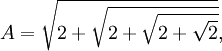
The third step in solving
Van Roomen's problem is realizing its relation to trigonometry. Using
Fn(x) defined in my last blog (see
here), I will show that:
2cos(nα) = Fn(2cosα) where
n ≥ 1.and
2sin(nα) = (-1)(n-1)/2Fn(2sinα) where
n is odd and
n ≥ 1.
Here are the details:
Lemma 1: n ≥ 1 → 2 cos(n)α = (2cos α)(2 cos (n-1)α) - 2 cos(n-1)αProof:
(1) From the addition and subtraction cosine formulas [see Theorem 1,
here], we know that:
cos (a + b) = cos a cos b + sin a sin bcos (a - b) = cos a cos b - sin a sin b(2) Adding these two identities together gives us:
cos (a + b) + cos (a - b) = cos a cos b + cos a cos b = 2cos a cos bOr in other words:
cos (a + b) = 2 cos a cos b - cos (a - b)(3) Since
a,b can be any value, let
b = α, let
a = (n-1)αSo that:
a + b = (n-1)b + b = (n-1+1)b = nαa - b = (n-1)b - b = (n-2)α(4) This then gives us that:
cos (nα) = (cos α)(2 cos(n-1)α) - cos(n-2)αOr equivalently:
2 cos (nα) = (2 cos α)(2 cos(n-1)α) - 2 cos(n-2)αQED
This trigonometric identity is relevant to Van Roomen's problem because it fits the same structure as
FnIn my previous blog, I showed that
Fn(x) = x*Fn-1(x) - Fn-2(x).Now, if
x = 2 cos α, then we have:
Fn(2 cos α) = (2 cos α)*Fn-1(2 cos α) - Fn-2(2 cos α)This brings us to the corollary:
Corollary 1.1: 2 cos(nα) = Fn(2 cos α)Proof:
(1) At
n = 1:F1 = x = 2 cos α = 2 cos(n α)(2) At
n = 2:F2 = x2 - 2 = (2 cos α)2 - 2 = 2(2 cos2(α) - 1)
Since
sin2(x) + cos2(x) = 1 (see Corollary 2,
here), we have :
2(2 cos2(α) - 1) = 2(2 cos2(α) - [sin2(α) + cos2(α)] ) = 2[cos2(α) - sin2(α)]
Using the formula for
cos(2x) (see Lemma 3,
here), we get:
2[cos2(α) - sin2(α)] = 2 (cos 2 α)(3) So, let's assume that
Fn(2 cos α) = 2 cos n α up to
n-1 where
n ≥ 3.
(4) Now, using our previous formula (see Theorem 1,
here), we know that:
Fn(x) = x*Fn-1(x) - Fn-2(x)(5) Using our assumption in step #3, we have:
Fn(2 cos α) = (2 cos α)*(2 cos(n-1)α) - (2 cos(n-2)α)(6) Now, using Lemma 1 above, we know that:
2 cos nα = (2 cos α)*(2 cos (n-1)α) - (2 cos(n-2)α) so that by induction (see Theorem,
here for review if needed), we have proven that:
Fn(2 cos α) = 2 cos n αQED
But we are not yet done, we can also show:
Corollary 1.2: For all odd n ≥ 1:2 sin nα = (-1)(n-1)/2Fn(2 sin α)Proof:
(1) From a previous result (see Lemma 1,
here), we know that:
cos(z) = sin(z + π/2) where
z is any number in radians (see
here for review of radians).
(2) Let
z = x - π/2(3) Then:
cos(x - π/2) = sin(x - π/2 + π2) = sin(x)(4) Now from Corollary 1.1 above, we have:
2 cos(nα) = Fn(2 cos α)(5) Since
α can be any value let
α = β - π/2so that:
2 cos(n[β - π/2]) = 2 cos(nβ - nπ/2) = 2 cos([nβ - (n-1)π/2] - π/2) = 2 sin(nβ - (n-1)π/2)and
Fn(2 cos (β - π/2)) = Fn(2sin(β))(6) Using the formula for
sin(a+b) [see Theorem 1,
here], we get:
sin(nβ - (n-1)π/2) = sin(nβ)cos([n-1]π/2) - cos(nβ)sin([n-1]π/2)(7) Since
n is odd, we know that
n-1 is even and there exists
m such that
(n-1)=2m which gives us:
cos([n-1]π/2) = cos(mπ) = (-1)m since:
(a)
n ≥ 1 so
m ≥ 0.
(b)
cos(0) = 1, cos(π)= -1 [See Property 6,
here]
(c) Finally
cos(x + 2π) = x [See Property 5,
here]
(d) If
m is even, then
mπ is divisible by
2π and
cos(mπ) = 1 = (-1)m(e) If
m is odd, then
mπ is not divisible by
2π and
cos(mπ) = -1 = (-1)mLikewise:
sin([n-1]π/2) = sin(mπ) = 0 since:
(a)
n ≥ 1 so
m ≥ 0.
(b)
sin(0) = 0, sin(π) = 0 [see Property 1,
here]
(c)
sin(x + 2π) = sin x [See Property 5,
here]
(d) Putting this together, we can see that
mπ ≡ 0 or
≡ π (mod 2π) and either way
sin(mπ)=0.
(8) So that we have:
2 sin(nβ - (n-1)π/2) = 2*[sin(nβ)cos([n-1]π/2) - cos(nβ)sin([n-1]π/2)] = 2*(-1)(n-1)/2*sin(nβ) - cos(nβ)*0 = 2*(-1)(n-1)/2sin(nβ)(9) Using step #8 and combining it with step #4 and step #5 gives:
2*(-1)(n-1)/2sin(nβ) = Fn(2sin(β))(10) Multiplying both sides by
(-1)(n-1)/2 gives us:
2sin(nβ) = (-1)(n-1)/2Fn(2sin(β))QED
References
 Albert Girard was born in France in 1595. His family later moved to the Netherlands as religious refugees. Girard attended the Univeristy of Leiden at age 22 where he studied music and his interest of choice was the lute. Indeed, he made his money at this as a musician.