Sunday, January 21, 2007

Solving Van Roomen's Problem: Step Five

In today's blog, I show how we can use the trigonometric identities in my previous blog to simplify Van Roomen's x and A examples. To see the statement of Van Roomen's problem, start here.

The content in today's blog is taken from Jean-Pierre Tignol's Galois' Theory of Algebraic Equations.

Lemma 1:
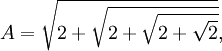


= 2 sin(15π/25)

Proof:

(1) cos(90°) = 0 [See Property 7, here]

(2) cos(2π/4) = cos(π/2) = cos(90°) = 0 [See here for review of radians]

(3) 2cos(π/4) = ±√2 + 2cos(π/2) [See Lemma 1, here]

(4) So, 2cos(π/4) = ±√2

(5) 2cos(π/8) = ±√2 + 2cos(π/4) = ±√2 + √2

(6) 2cos(π/16) = ±√2 + 2cos(π/8) = ±√2 + √(2 + √2)

(7) 2cos(π/32) = ±√2 + 2cos(π/16) = ±√2 + √[2 + √(2 + √2)]

(8) 2cos(π/32) = 2sin(π/2 - π/32) [See Lemma 1, here]

(9) 2sin(π/2 - π/32) = 2sin(16π/32 - π/32) = 2sin(15π/32) = 2sin(15π/25)

QED

Lemma 2:


= 2 sin(π/[25*3])

Proof:

(1) 2cos(π/6) = √3 [See Corollary 1.1, here]

(2) 2cos(π/12) = ±√2 + 2cos(π/6) [See Lemma 1, here]

(3) 2cos(π/12) = ±√2 + √3

(4) 2cos(π/24) = ±√2 + 2cos(π/12) = ±√2 + √(2 + √3)

(5) 2cos(π/48) = ±√2 + 2cos(π/24) = ±√2 + √[2 + √(2 + √3)]

(5) 2sin(π/96) = ±√2 - 2cos(π/48) [See Lemma 2, here]

(6) 2sin(π/96) = 2sin(π/[25*3]) = ±√2 - {2 + √[2 + √(2 + √3)]}

QED

Lemma 3:


= 2 sin(15π/26)

Proof:

(1) From step#6 in Lemma 1 above, we have:

2cos(π/16) = ±√2 + √(2 + √2)

(2) Using Lemma 2 here, we have:

2sin(π/32) = ±√2 - 2cos(π/16) = ±√2 - √[2 + √(2 + √2)]

(3) 2cos(π/2 - π/32) = 2sin(π/32) [See Corollary 1.1, here]

(4) 2cos(π/2 - π/32) = 2cos(16π/32 - π/32) = 2cos(15π/32)

(5) 2sin(15π/64) = ±√2 - 2cos(π/16) = ±√2 - √{2 - √[2 + √(2 + √2)]}

(6) 2sin(15π/64) = 2sin(15π/[26])

QED

Lemma 4:


= 2sin(π/[26*3])

Proof:

(1) Using step #5 from Lemma 2 above, we have:

2cos(π/24*3) = ±√2 + 2cos(π/24) = ±√2 + √[2 + √(2 + √3)]

(2) So we have:

2cos(π/25*3) = ±√2 + 2cos(π/24*3) = ±2 + {2 + √[2 + √(2 + √3)]}

(3) And also:

2sin(π/26*3) = ±√2 - 2cos(π/25*3) =

= ±
2 - √(2 + {2 + √[2 + √(2 + √3)]})

QED

Lemma 5:


= 2sin(3π/23)

Proof:

(1) From Lemma 1 above, step #5, we have:

2cos(π/8) = ±√2 + 2cos(π/4) = ±√2 + √2

(3) Using Lemma 1 here we have:

2cos(π/8) = 2sin(π/2 - π/8) = 2sin(4π/8 - π/8) = 2sin(3π/8) = 2sin(3π/23)

QED

Lemma 6:


= 2sin(π/[23*3*5])

Proof:

(1) π/5 - π/6 = 6π/30 - 5π/30 = π/30

(2) 2cos(π/30) = 2cos(π/5 - π/6) = 2cos(π/5)cos(π/6) + 2sin(π/5)sin(π/6) [See Theorem 2, here for cosine addition/subtraction rule]

(3) Using previous results, we can compute cos(π/10) and sin(π/10):

cos(π/10) = sin(π/2 - π/10) = sin(5π/10 - π/10) = sin(4π10) = sin(2π/5) [See here Lemma 1,here]

sin(2π/5) = (1/2)(5 + √5)/2 [See Lemma 6, here]

sin(π/10) = cos(π/2 - π/10) = cos(2π/10) [See Corollary 1.1, here]

cos(2π/5) = (√5 - 1)/4 [See Lemma 5, here]

(4) Now, we can use cos(π/10), sin(π/10) to compute cos(π/5) and sin(π/5):

Using the cosine double angle formula (see Corollary 3.1, here):
cos(2x) = 2cos2(x) - 1

So,
cos(2*π/10) = cos(π/5) = 2cos2(π/10) - 1 = (2)(1/8)[5 + √5] - 1 = 5/4 + (√5)/4 - 4/4 = (√5 + 1)/4

Now, we can use sin2(π/5) + cos2(π/5) = 1 [see Corollary 2, here], to get:

sin(π/5)2 = 1 - cos2(π/5) = 16/16 - (1/16)(5 + 2√5 + 1) = (1/16)[10 - 2√5 ]

This gives us:
sin(π/5) = (1/4)√10 - 2√5

(5) Using a previous result (see Corollary 1.2, here), we know that:

cos(π/6) = cos(30°) = √3/2

sin(π/6) = sin(30 °) = (1/2)

(6) So, this gives us that:

cos(π/30) = 2[(√5 + 1)/4][3/2] + 2[(1/4)√10 - 2√5][(1/2)] =

= (1/4)[15 + 3] + (1/4)[10 - 2√5] =(3/16) + (15/16) + (5/8) - √(5/64).

(7) 2cos(π/[22*5*3]) = ±√2 + 2cos(π/30) [See Lemma 1, here]

So that:
2cos(π/[22*5*3]) = ±√{2 + (3/16) + (15/16) + [(5/8) - √(5/64)]}

(8) 2sin(π/[23*5*3]) = ±√2 - 2cos(π/[22*5*3]) [See Lemma 2, here]

So:
2sin(π/[23*5*3]) = ±√2 - √{2 + (3/16) + (15/16) + [(5/8) - √(5/64)]}

QED

Lemma 7:


= 2 sin(π/[3*5])

Proof:

(1) 2sin(π/15) = (1/2)√7 - √5 - √(30 - 6√5) [See Corollary 7.1, here]

(2) Since (1/2) = (1/√4), we have:

2sin(π/15) = √(7/4) - √(5/16) - √[(30 - √[36*5])/16] =

= √(7/4) - √(5/16) - √[15/8 - √(36*5/16*16)] =

= √(7/4) - √(5/16) - √[15/8 - √(9*5/4*16)] =

= √(7/4) - √(5/16) - √[15/8 - √(45/64)]

QED

References

Solving Van Roomen's Problem: Step Four

In today's blog, I will present some simple trigonometric identities that can be used to simplify Van Roomen's examples of x and A values. For those who want an introduction to Van Roomen's Problem, start here. In my next blog, I will apply these lemmas to Van Roomen's problem.

The content in today's blog is taken from Jean-Pierre Tignol's Galois' Theory of Algebraic Equations.

Let me start by introducting the some basic ideas from trigonometry.

Lemma 1: 2 cos(α/2) = ± √2 + 2 cos α

Proof:

(1) cos(2x) = 2 cos2(x) - 1 [See Corollary 3.1, here]

(2) Let x = α/2, then we get:

cos(α) = 2cos2(α/2) - 1

(3) Rearranging terms gives us:

2cos2(α/2) = cos(α) + 1

(4) Multiplying both sides by 2 gives us:

4cos2(α/2) = 2cos(α) + 2

(5) Finally, taking the square root of both sides gives us:

2cos(α/2) = ±√2 + 2cos(α)

QED

Lemma 2: 2 sin(α/2) = ± √2 - 2 cos α

Proof:

(1) cos(2x) = 1 - 2 sin2(x) [See Corollary 3.1, here]

(2) Let x = α/2, then we get:

cos(α) = 1 - 2sin2(α/2)

(3) Rearranging terms gives us:

2sin2(α/2) = 1 - cos(α)

(4) Multiplying both sides by 2 gives us:

4sin2(α/2) = 2 - 2cos(α)

(5) Finally, taking the square root of both sides gives us:

2sin(α/2) = ±√2 - 2cos(α)

QED

Lemma 3: 2 cos(π/3) = 1

Proof:

(1) 2cos(π/3) = 2cos(60°) [See here for review of radians]

(2) 2cos(60°) = 2(1/2) = 1 [See Corollary 1.2, here]

QED

Lemma 4: 2 sin(π/3) = √3

Proof:

(1) 2sin(π/3) = 2sin(60°) [See here for review of radians]

(2) 2sin(60°) = 2*(3/2) = 3 [See Corollary 1.2, here]

QED

Lemma 5: 2cos(2π/5) = (√5 - 1)/2

Proof:

(1) cos (2π/5) = (√5 - 1)/4 [See Corollary 1.1, here]

(2) So:

2cos(2π/5) = (√5 - 1)/2

QED

Lemma 6: 2sin(2π/5) = √(5 + √5)/2

Proof:

(1) sin (2π/5) = √5 + √5/8 [See Corollary 1.1, here]

(2) So:

2*sin (2π/5) = 2(1/2)√5 + √5/2 = √(5 + √5)/2

QED

Lemma 7: 2cos(π/15) = (1/4)(√30 + 6√5 + √5 - 1)

Proof:

(1) 2π/5 - π/3 = 6π/15 - 5π/15 = π/15

(2) 2cos(π/15) = 2cos(2π/5 - π/3) = 2cos(2π/5)cos(π/3) + 2sin(2π/5)sin(π/3) [See Theorem 2, here]

2cos(2π/5) = (√5 - 1)/2 [See Lemma 5 above]

cos(π/3) = 1/2 [See Lemma 3 above]

2sin(2π/5) = (5 + √5)/2 [See Lemma 6 above]

sin(π/3) = 3/2 [See Lemma 4 above]

(4) 2cos(π/15) = [ (√5 - 1)/2 ][1/2] + [(5 + √5)/2][3/2] =

= [ (√5 - 1)/4] +(1/2) [(15 + 3√5)/2] = [ (√5 - 1)/4] + (1/4)[(30 + 6√5)]

= (1/4)[5 - 1 + (30 + 6√5)]

QED

Corollary 7.1: 2sin(π/15) = (1/2)√7 - √5 - √(30 - 6√5)

Proof:

(1) 2cos(π/15) = (1/4)(√30 + 6√5 + √5 - 1) [See Lemma 7 above]

(2) 4cos2(π/15) = (1/16)(30 + 6√5 + 5 + 1 + 2(√30 + 6√5)(5) - 230 + 6√5 - 2√5 = (1/16)(36 + 4√5 + 2(√30 + 6√5)(5) - 230 + 6√5)

(3) Since sin2(x) + cos2(x) = 1 [See Corollary 2, here], we have:

4sin2(π/15) = 4 - cos2(π/15) =

= (1/16)[64 - 36 - 4√5 - 2(√30 + 6√5)(5) + 230 + 6√5 ] =

= (1/16)[28 - 4√5 - 2(√30 + 6√5)(5) + 230 + 6√5] =

= (1/16)[28
- 4√5 - (30 + 6√5)(25 - 2)] =

=
(1/16)[28 - 4√5 - (√30 + 6√5)(√2√5 - 2)2] =

= (1/16)[28 - 4√5 - (30 + 6√5)(√20 - 85 + 4)] =

=
(1/16)[28 - 4√5 - (30 + 6√5)(√24 - 85)] =

=
(1/16)[28 - 4√5 - (√720 - 240√5 + 1445 - 240)] =

= (1/16)[28 - 4√5 - (√480 - 96√5] =

= (1/16)[28 - 4√5 - 4(30 - 65]


(4) 2sin(π/15) = √(1/16)[28 - 4√5 - 4(√30 -65] =

= (1/4)√[28 - 4√5 - 4(√30 -65] =

= (1/2)√[7 - √5 - √30 -65] =

QED

References

Friday, January 19, 2007

Solving Van Roomen's Problem: So far

So, up to know, I've shown that Van Roomen's monster equation: (see here):

(45)x - (3,795)x3 + (95,634)x5 - (1,138,500)x7 + (7,811,375)x9 - (34,512,075)x11 + (105,306,075)x13 - (232,676,280)x15 + (384,942,375)x17 - (488,494,125)x19 + (483,841,800)x21 - (378,658,800)x23 + (236,030,652)x25 - (117,679,100)x27 + (46,955,700)x29 - (14,945,040)x31 + (3,764,565)x33 - (740,259)x35 + (111,150)x37 - (12,300)x39 + (945)x41 - (45)x43 + x45 = A

simplifies to this one when n = 45 (see here for proof):


If we generalize the above equation to Fn (see below), there is an interesting recurrence relation that emerges (see here for details).

If we define:

Fn(x) =


Then:

Fn(x) = x*Fn-1(x) - Fn-2(x).

Finally, we can introduce trigonometry to the equation defined above (see here for proof) to get:

for any integer n ≥ 1:

2cos(nα) = Fn(2cosα)

For any odd integer n ≥ 1:

2 sin(nα) = (-1)(n-1)/2*Fn(2sinα)


Now, let's see if we can simplify the examples that Van Roomen gives for x and A (see here for details). It turns out that all can be simplified using trigonometric identities.

Here are three examples that Van Roomen provides. I should note that in Van Roomen's original problem, he made a mistake on example 2. For purposes of this blog, I have corrected his mistake. (See Jean-Pierre Tignol's book for more details).

Example 1:

If


Then:


Example 2:

If:


Then:


Example 3:

If:


Then:


In my next blog, I will show how each of these values can be simplified using trigonometry.

References

Saturday, January 13, 2007

Solving Van Roomen's Problem: Step Three

The third step in solving Van Roomen's problem is realizing its relation to trigonometry. Using Fn(x) defined in my last blog (see here), I will show that:

2cos(nα) = Fn(2cosα) where n ≥ 1.

and

2sin(nα) = (-1)(n-1)/2Fn(2sinα) where n is odd and n ≥ 1.

Here are the details:

Lemma 1: n ≥ 1 → 2 cos(n)α = (2cos α)(2 cos (n-1)α) - 2 cos(n-1)α

Proof:

(1) From the addition and subtraction cosine formulas [see Theorem 1, here], we know that:

cos (a + b) = cos a cos b + sin a sin b

cos (a - b) = cos a cos b - sin a sin b

(2) Adding these two identities together gives us:

cos (a + b) + cos (a - b) = cos a cos b + cos a cos b = 2cos a cos b

Or in other words:

cos (a + b) = 2 cos a cos b - cos (a - b)

(3) Since a,b can be any value, let b = α, let a = (n-1)α

So that:

a + b = (n-1)b + b = (n-1+1)b = nα

a - b = (n-1)b - b = (n-2)α

(4) This then gives us that:

cos (nα) = (cos α)(2 cos(n-1)α) - cos(n-2)α

Or equivalently:

2 cos (nα) = (2 cos α)(2 cos(n-1)α) - 2 cos(n-2)α

QED

This trigonometric identity is relevant to Van Roomen's problem because it fits the same structure as Fn

In my previous blog, I showed that Fn(x) = x*Fn-1(x) - Fn-2(x).

Now, if x = 2 cos α, then we have:

Fn(2 cos α) = (2 cos α)*Fn-1(2 cos α) - Fn-2(2 cos α)

This brings us to the corollary:

Corollary 1.1: 2 cos(nα) = Fn(2 cos α)

Proof:

(1) At n = 1:

F1 = x = 2 cos α = 2 cos(n α)

(2) At n = 2:

F2 = x2 - 2 = (2 cos α)2 - 2 = 2(2 cos2(α) - 1)

Since sin2(x) + cos2(x) = 1 (see Corollary 2, here), we have :

2(2 cos2(α) - 1) = 2(2 cos2(α) - [sin2(α) + cos2(α)] ) = 2[cos2(α) - sin2(α)]

Using the formula for cos(2x) (see Lemma 3, here), we get:

2[cos2(α) - sin2(α)] = 2 (cos 2 α)

(3) So, let's assume that Fn(2 cos α) = 2 cos n α up to n-1 where n ≥ 3.

(4) Now, using our previous formula (see Theorem 1, here), we know that:

Fn(x) = x*Fn-1(x) - Fn-2(x)

(5) Using our assumption in step #3, we have:

Fn(2 cos α) = (2 cos α)*(2 cos(n-1)α) - (2 cos(n-2)α)

(6) Now, using Lemma 1 above, we know that:

2 cos nα = (2 cos α)*(2 cos (n-1)α) - (2 cos(n-2)α) so that by induction (see Theorem, here for review if needed), we have proven that:

Fn(2 cos α) = 2 cos n α

QED

But we are not yet done, we can also show:

Corollary 1.2: For all odd n ≥ 1:

2 sin nα = (-1)(n-1)/2Fn(2 sin α)

Proof:

(1) From a previous result (see Lemma 1, here), we know that:

cos(z) = sin(z + π/2) where z is any number in radians (see here for review of radians).

(2) Let z = x - π/2

(3) Then:

cos(x - π/2) = sin(x - π/2 + π2) = sin(x)

(4) Now from Corollary 1.1 above, we have:

2 cos(nα) = Fn(2 cos α)

(5) Since α can be any value let α = β - π/2

so that:

2 cos(n[β - π/2]) = 2 cos(nβ - nπ/2) = 2 cos([nβ - (n-1)π/2] - π/2) = 2 sin(nβ - (n-1)π/2)

and

Fn(2 cos (β - π/2)) = Fn(2sin(β))

(6) Using the formula for sin(a+b) [see Theorem 1, here], we get:

sin(nβ - (n-1)π/2) = sin(nβ)cos([n-1]π/2) - cos(nβ)sin([n-1]π/2)

(7) Since n is odd, we know that n-1 is even and there exists m such that (n-1)=2m which gives us:

cos([n-1]π/2) = cos(mπ) = (-1)m since:

(a) n ≥ 1 so m ≥ 0.

(b) cos(0) = 1, cos(π)= -1 [See Property 6, here]

(c) Finally cos(x + 2π) = x [See Property 5, here]

(d) If m is even, then is divisible by and cos(mπ) = 1 = (-1)m

(e) If m is odd, then is not divisible by and cos(mπ) = -1 = (-1)m

Likewise:

sin([n-1]π/2) = sin(mπ) = 0 since:

(a) n ≥ 1 so m ≥ 0.

(b) sin(0) = 0, sin(π) = 0 [see Property 1, here]

(c) sin(x + 2π) = sin x [See Property 5, here]

(d) Putting this together, we can see that mπ ≡ 0 or ≡ π (mod 2π) and either way sin(mπ)=0.

(8) So that we have:

2 sin(nβ - (n-1)π/2) = 2*[sin(nβ)cos([n-1]π/2) - cos(nβ)sin([n-1]π/2)] = 2*(-1)(n-1)/2*sin(nβ) - cos(nβ)*0 = 2*(-1)(n-1)/2sin(nβ)

(9) Using step #8 and combining it with step #4 and step #5 gives:

2*(-1)(n-1)/2sin(nβ) = Fn(2sin(β))

(10) Multiplying both sides by (-1)(n-1)/2 gives us:

2sin(nβ) = (-1)(n-1)/2Fn(2sin(β))

QED

References

Thursday, January 11, 2007

Solving Van Roomen's Problem: Step Two

In my previous blog, I showed how Van Roomen's problem could be reduced to a summation formula:

(45)x - (3,795)x3 + (95,634)x5 - (1,138,500)x7 + (7,811,375)x9 - (34,512,075)x11 + (105,306,075)x13 - (232,676,280)x15 + (384,942,375)x17 - (488,494,125)x19 + (483,841,800)x21 - (378,658,800)x23 + (236,030,652)x25 - (117,679,100)x27 + (46,955,700)x29 - (14,945,040)x31 + (3,764,565)x33 - (740,259)x35 + (111,150)x37 - (12,300)x39 + (945)x41 - (45)x43 + x45 =


where n = 45.

In today's blog, I will show how a recurrence relation can be introduced to simplify the problem further.

The key insight comes to generalizing the above summation formula. For example, let's define:

Fn(x) =


It turns out that it is possible to show that for any n ≥ 1:

2cos(nα) = Fn(2cosα)

For any odd n ≥ 1:

2 sin(nα) = (-1)(n-1)/2*Fn(2sinα)

François Viète knew both of these identities and he would use them to find his solutions to Van Roomen's problem. In today's blog, I will show the proof for the recurrent relation and in my next blog, I will show how this recurrence relation leads to the trigonometric identities above.

Theorem 1: Recurrence Formula

If:

Fn(x) =


Then:

Fn(x) = x*Fn-1(x) + Fn-2(x)

Proof:

(1) F1(x) = (-1)0*(1/1)*[(1!)/(0!1!)]x1-0 = x

(2) F2(x) = (-1)0*(2/2)*[(2!)/(0!2!)]x2-0 + (-1)1*(2/1)*[(1!)/(1!0!)]x2-2 = x2 - 2

(3) F3(x) = (-1)0*(3/3)*[(3!)/(0!3!)]x3-0 + (-1)1*(3/2)*[(2!)/(1!1!)]x3-2 = x3 - 3x

(4) We can see that x*F2(x) - F1(x) = x*(x2 - 2) - x = x3 - 3x.

(5) So, we can assume that the recurrence formula is true up to some integer n-1 where n ≥ 4, that is:

Fn-1(x) = x*Fn-2(x) - Fn-3(x)

(6) Now, x*Fn-1(x) =


=


(7) Likewise, Fn-2(x) =


=


=


(8) So, we see that: x*Fn-1(x) - Fn-2(x) =


where if n is odd,

C = 0

and if n is even,

C =

-(-1)
(n/2 - 1)[(n-2)/(n-1-n/2)][(n-1-n/2)!/(n/2-1)!(n-1-n/2-(n/2-1))!]xn-2(n/2) =

= (-1)(n/2)[(n-2)/(n/2-1)][(n/2-1)!/(n/2 -1)!(0!)]x0 =

= (-1)(n/2)[(n-2)]/[(n/2-1)](1)(1) = (-1)(n/2)(n-2)*(2)/(n-2) =

= (-1)(n/2)*2

(9) So, x*Fn-1(x) - Fn-2(x) - C - xn =


(10) Focusing solely on the middle part, we see that:


(11) If n is odd:

Fn(x) =


(12) If n is even:

Fn(x) =


(13) So, either way we have:

Fn(x) = x*Fn-1(x) - Fn-2(x).

QED

Solving Van Roomen's Problem: Step One

In the last blog, I presented Van Roomen's Problem:

(45)x - (3,795)x3 + (95,634)x5 - (1,138,500)x7 + (7,811,375)x9 - (34,512,075)x11 + (105,306,075)x13 - (232,676,280)x15 + (384,942,375)x17 - (488,494,125)x19 + (483,841,800)x21 - (378,658,800)x23 + (236,030,652)x25 - (117,679,100)x27 + (46,955,700)x29 - (14,945,040)x31 + (3,764,565)x33 - (740,259)x35 + (111,150)x37 - (12,300)x39 + (945)x41 - (45)x43 + x45 = A

where:


Each of the coefficients is large and none of them are prime. Nineteen of them, for example, are divisible by 5. 95,634 is divisible by 7. 236,030,652 is divisible by 12. 740,259 is divisible by 3.

In addition, if we examine the coefficients in series from x1 thru x45, we can see that they are smallest at the edges and progressively larger toward the middle. This is a pattern also exhibited by binomials such as (x + y)n.

François Viète was able to reformulate's Adriaan van Roomen's equation into a summation equation. Using modern notation, he reduced the problem to:


where:

n = 45

= the largest integer ≤ n/2


[See here for review of factorial (!) if needed]


The floor(n/2) function is used because we only want to generate 22 different terms. Van Roomen's equation consists solely of odd powers.

If you want to see that it works, you can work it out for each term. Here are some examples of how the summation formula works:

At i=0:

(-1)0*(45/45)*[(45)!/(0!45!)]x45 = x45

At i=1:

(-1)1*(45/44)[(44)!/(1!43!)]x43 = -45x43

Let's skip to i=11:

(-1)11*(45/34)*[(34)!/(11!23!)]x23 = -(45*33!)/(11!23!)x23 = -(378,658,800)x23

and so on up to i=22:

(-1)22*(45/23)*[(23)!/(22!1!)]x1 = 45x

In my next blog, I will show how a recurrence relation can further simplify the problem.

References

Friday, December 29, 2006

Van Roomen's Problem

Adriaan Van Roomen was a professor of mathematics and medicine in Louvain who had developed a strong reputation as one of the top mathematicians of his age. In 1593, he published a survey of the most important living mathematicians. In this work, he proposed a math problem that he dared any of these top mathematicians to solve:

(45)x - (3,795)x3 + (95,634)x5 - (1,138,500)x7 + (7,811,375)x9 - (34,512,075)x11 + (105,306,075)x13 - (232,676,280)x15 + (384,942,375)x17 - (488,494,125)x19 + (483,841,800)x21 - (378,658,800)x23 + (236,030,652)x25 - (117,679,100)x27 + (46,955,700)x29 - (14,945,040)x31 + (3,764,565)x33 - (740,259)x35 + (111,150)x37 - (12,300)x39 + (945)x41 - (45)x43 + x45 = A

where:


To show that Van Roomen had a solid understanding of this monstrous equation, he observed the following:

(a) If:


Then:


(b) If:


Then:


(c) If:


Then:


This problem was mentioned in a meeting between the Dutch ambassador and the King Henry IV of France. The Dutch ambassador had noted that not a single French mathematician had been listed in van Roomen's survey of the great mathematicians.

King Henry IV presented the problem to François Viète who was able to solve it. Viète's solution is historically significant because he not only demonstrated how trigonometry can be used to solve algebraic equations, he also showed that this problem possessed 45 different solutions. This result was important in helping to establish the Fundamental Theorem of Algebra.

How did Viète solve it? I will show his solution in my next blog.

References

Sunday, December 10, 2006

François Viète

François Viète was born in 1540 in France; he was a successful politician who also made very important contributions to algebra. He is credited for example with introducing letters to represent known and unknown values in mathematical equations. His writings were also important in establishing the symbol (+) as representing addition and (-) as representing subtraction.

His family was well connected; his mother, for example, was the first cousin of the president of Parliament in Paris. Viète was able to take advantage of these connections through out his life. He attended the University of Poitiers and in 1560, he graduated with a law degree.

Although a lawyer by profession, he took a strong interest in math and science and published his first mathematical paper in 1571. He was especially interested in the works of Pappus and Diophantus.

Viète was a Huguenot and he lived in Paris during the St. Bartholomew's Day Massacre where many thousands of protestant Hugeuenots were killed.

In 1573, he became a councillor at Rennes where he remained until 1580. At that time, he was appointed by King Henry III to be a royal privy councillor in Paris. In 1584, King Henry III's younger brother became ill and died; this meant that Henry of Navarre, a protestant, became heir to the throne. In the struggle that erupted, Viète, a protestant, was kicked out of office.

Viète left Paris and headed to the small town of Beauvoir-sur-Mer. He spent five years there where he was able to devote time to studying mathematics. It was during this time that he did most of his most imporant work relating to cubic equations and mathematical notation.

Viète believed that the Greeks had not revealed all their mathematical insights. He believed that they had secret methods which he hoped to rediscover. In this way, he introduced what would later become variables and coefficients. In Viète's view, he had restored the hidden mathematical methods of the Greeks.

In 1589, he was called back to parliament in Tours. This happened just before Henry III was assassinated on August 1, 1589. He stayed on as the protestant Henry of Navarre became King Henry IV.

In 1590, a coded letter to King Philip II of Spain was intercepted by the French. Viète, at this time, had a very strong reputation in mathematics and he was given the task of deciphering the note. This he accomplished in March of 1590. The MacTutor web site quotes a historical text:
... when Philip, assuming that the cipher could not be broken, discovered that the French were aware of his military plans, he complained to the Pope that black magic was being employed against his country.
When in 1592, King Henry IV converted to Catholicism. Viète did the same.

In 1593, there was a challenge made to all mathematicians by Adriaan van Roumen, a professor of math at Louvain. Roumen asked for a solution to an equation which had 45 terms. Viète was able to solve this problem. In fact, Roumen asked for one solution. Viète was able to demonstrate that there were 23 positive solutions.

Viète was very wealthy. He published all of his writings himself and sent them out to scholars throughout Europe. In all of his writings, he only focuses on positive values. Like many of the mathematicians before him, he did not include consideration of negative numbers in his writings.

He was a member of the Royal Privy Council until his death in February, 1603.

References